
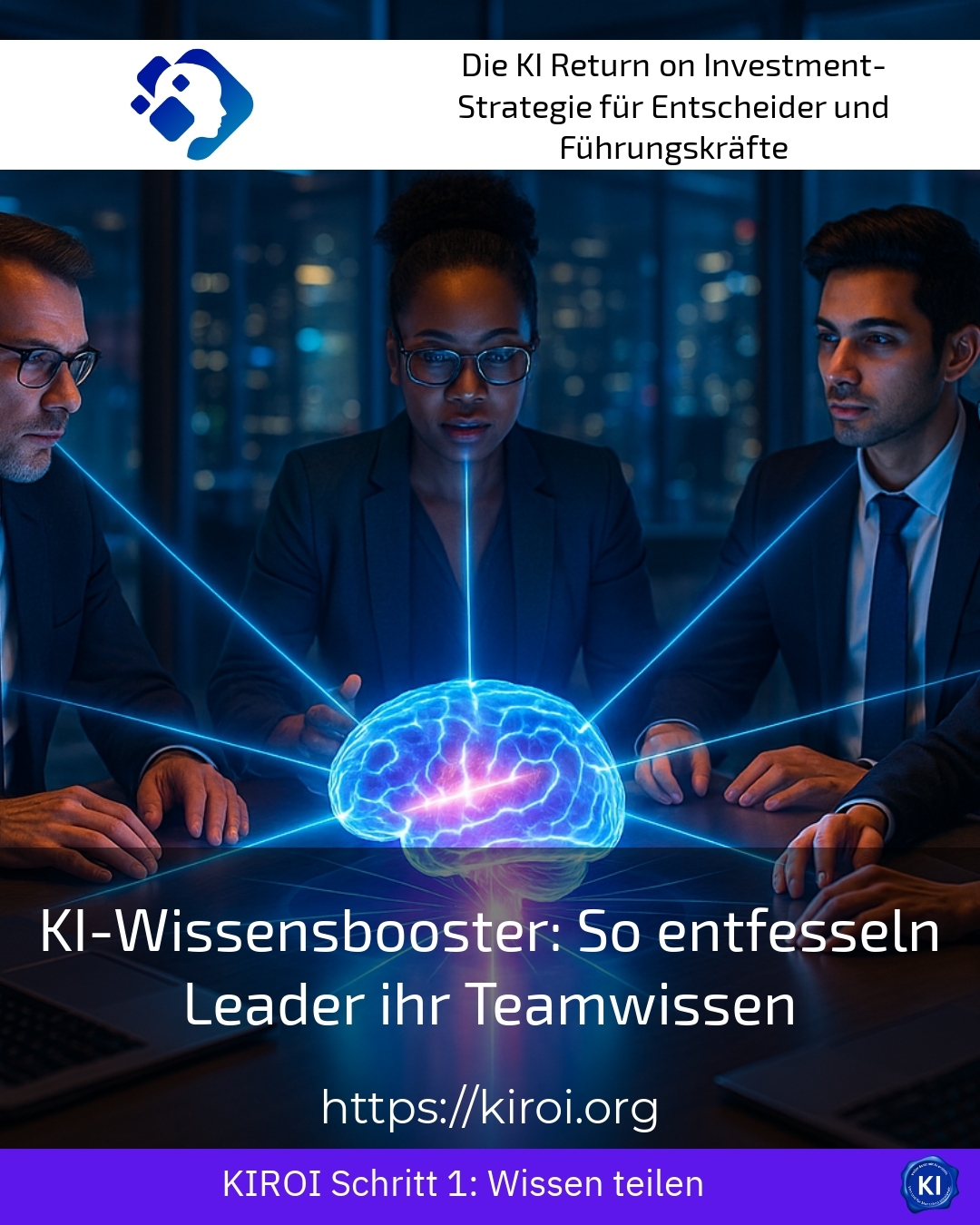
Imagine all of your organisation's knowledge being accessible at any time, structured and instantly usable for every decision your leaders need to make. The AI Knowledge Booster is increasingly transforming this vision into a tangible reality, and this is precisely where the exciting journey begins that I would like to embark on with you today. Leaders frequently report a paradoxical phenomenon: the more information available, the harder it becomes to provide the relevant knowledge at the right time in the right place. This area of tension between information overload and a scarcity of knowledge concerns numerous decision-makers who come to me for coaching because they are looking for ways to connect their teams more intelligently and unlock hidden potential.
Uncovering the hidden treasures of knowledge within organisations
Every organisation possesses an enormous wealth of tacit knowledge. This knowledge slumbers in the minds of experienced employees. It manifests itself in proven processes and established routines. Unfortunately, it often remains invisible and is therefore left unutilised.
For example, a medium-sized manufacturing company realised that the expertise of long-standing foremen was being lost when they left. Production management looked for solutions to preserve experiential knowledge and make it accessible to junior staff. A financial services provider, in turn, struggled with the fact that different departments were repeatedly carrying out similar analyses without knowing about each other. This redundancy not only wasted time, but also considerable resources.
A comparable issue is particularly evident in the healthcare sector. Hospitals possess decades of treatment experience, which is documented in patient files, logs and case discussions. The challenge lies in bringing this fragmented knowledge together into a coherent whole and making it usable for clinical decisions.
The AI knowledge booster as a catalyst for collective intelligence
Modern technological approaches make it possible to analyse unstructured data sets and uncover connections. These connections often remain hidden to the human eye. The point here is not to replace human expertise. Rather, the focus is on complementing and reinforcing existing skills.
A logistics company implemented a system that optimised delivery routes based on historical data. The drivers contributed their experiential knowledge of traffic patterns and local idiosyncrasies. The combination of data-driven analysis and human expertise led to significant improvements. In the pharmaceutical industry, similar approaches support research teams in identifying relevant studies more quickly and recognising cross-connections between seemingly unrelated research fields.
Best practice with a AIROI customer
An internationally active consultancy firm with several thousand employees approached our transruptions coaching with a complex issue. Over the years, the consultants had gathered extensive project experience, but this knowledge was stored in a fragmented way across individual documents, emails and personal note-taking systems. Junior consultants constantly had to reinvent the wheel because they had no access to the insights from previous projects. Together, we developed a strategy that initially involved mapping and prioritising the various knowledge sources. In a second step, we supervised the implementation of a semantic search system capable of processing natural language queries. The consultants were now able to ask questions such as: „What challenges arose during digitalisation projects in mechanical engineering?“ The system then searched project reports, presentations and documented lessons learned in order to deliver relevant answers. Following the introduction, team leaders reported a noticeable acceleration in project initiation because existing knowledge was available more quickly. The induction period for new employees was also significantly shortened, and the quality of the consulting services increased measurably.
Redefining leadership: From knowledge hoarder to knowledge enabler
The role of leaders is undergoing a fundamental transformation. Traditionally, bosses were seen as those who, by virtue of their experience, knew most of the answers. Today, this notion falls well short of the mark. The complexity of modern business environments far exceeds the capacity of any single individual.
Successful leaders increasingly see themselves as architects of knowledge ecosystems. They create structures and cultures that enable the free flow of information. In the automotive industry, this shift is particularly striking: development teams are working more and more interdisciplinary and across locations. The coordination of this distributed expertise requires new leadership approaches and technological support.
A telecommunications provider fundamentally reformed its executive development. Instead of primarily linking leadership competence to specialist knowledge, the ability to support teams in knowledge networking came to the fore. The energy industry underwent a similar shift when the transformation to renewable energy required completely new competence profiles and traditional expert knowledge quickly became obsolete.
Overcoming psychological barriers when using the AI knowledge booster
Technological solutions alone are not enough. The greatest barriers to the release of knowledge are often human in nature. Employees hoard knowledge because they want to protect their status as indispensable experts. Leaders shy away from transparency because they fear losing control.
In the insurance industry, we frequently encountered the concern that knowledge sharing could lead to people being replaced. Taking these fears seriously and addressing them constructively forms a central part of our transruptions coaching support. In the banking sector, on the other hand, a silo mentality long dominated, with departments viewing their knowledge as a strategic advantage in internal competition. The chemical industry struggled with similar challenges when research departments withheld their findings for fear of internal ideas being stolen.
Overcoming these barriers requires patient cultural work. Incentive systems must reward knowledge sharing instead of punishing it. Leaders must be role models and actively share their own knowledge. This creates spaces of trust where open exchange becomes possible.
Practical implementation strategies for knowledge networking
The path to intelligent knowledge organisation begins with an honest audit. Where is the critical knowledge located within the organisation? Who are the informal knowledge holders? Which information is most frequently sought after, but most difficult to find?
An engineering company started with a systematic survey of its service technicians. They possessed invaluable practical knowledge of fault patterns and their remedy, but this knowledge existed only in their heads. Documentation was fragmentary at best. In food production, a similar analysis identified the knowledge of experienced quality inspectors as a critical bottleneck, the loss of which could jeopardise product safety.
Retail underwent an interesting shift when it began to systematically capture the knowledge of its sales staff. They knew customer preferences, seasonal peculiarities and local conditions that were not recorded in any database. The combination of this tacit knowledge with sales data unlocked entirely new optimisation potentials.
Best practice with a AIROI customer
A medium-sized software developer with around three hundred employees sought our transruptions coaching support because recurring project problems could not be sustainably resolved despite extensive retrospectives. The insights from past projects disappeared into Confluence pages that nobody read anymore, and the same mistakes repeated themselves in new projects with alarming regularity. We accompanied the company in developing a living knowledge system based on several pillars: firstly, we implemented regular knowledge transfer sessions in which experienced developers passed on their insights in a structured format; secondly, we introduced a mentoring programme that combined explicit and implicit knowledge and purposefully connected junior staff with experienced colleagues; thirdly, and finally, we established a technical system that automatically suggested relevant lessons learned from past projects when creating new ones. After around eighteen months, the management reported a clear improvement in project quality and a measurable reduction in rework efforts, and employee satisfaction also rose noticeably as frustrating repetitive mistakes occurred less frequently.
AI knowledge booster in the context of continuous learning
Knowledge management must not be a one-off project. It must be understood as an ongoing process. Organisations that achieve sustainable success establish mechanisms for continuous learning and constant knowledge adaptation.
In the aviation industry, this principle is demonstrated by the established incident reporting systems, which enable the continuous improvement of the safety culture [1]. Medicine is increasingly adopting similar approaches within the framework of morbidity and mortality conferences, in which critical cases are systematically reviewed. The construction industry is beginning to use Building Information Modeling not only for the planning phase, but also to feed back operational experience and thus optimise future projects.
A sportswear manufacturer implemented a system that analysed customer feedback, return data and social media comments, and fed the insights gained directly into the product development process. The textile industry followed this example in order to identify and resolve quality issues more quickly before major damage could occur.
The ethical dimension of intelligent knowledge systems
As the capabilities of knowledge systems increase, ethical challenges are also growing. Who owns the knowledge that employees feed into corporate systems? How is it ensured that automated recommendations do not discriminate? What transparency obligations exist towards those affected?
These questions are particularly pressing in human resources. Applicant screening and performance appraisal systems must operate fairly and transparently [2]. In healthcare, it is a matter of nothing less than the well-being of patients when decision support systems issue diagnostic or therapeutic recommendations. The financial services industry faces similar challenges in lending, where algorithmic assessments can have far-reaching consequences for applicants.
Responsible leaders ask themselves these questions proactively. They establish governance structures that set ethical guardrails. They promote transparency and create mechanisms to review automated decisions.
My AIROI Analysis
The transformation of organisations into learning, knowledge-connected systems is one of the central leadership tasks of our time, and from my consulting practice I can observe that those companies operate most successfully which combine technological possibilities with an appreciative leadership culture. The AI Knowledge Booster only unfolds its full potential when leaders create the necessary cultural prerequisites and accompany their teams on this journey.
The most common topics clients bring to me revolve around precisely this interface between technology and humans, because many feel that the pure implementation of systems is not enough to effect real change. Transruption coaching helps leaders to address both the strategic and the human aspects of this transformation, and guides teams through the inevitable resistance and uncertainties that come with change processes.
My analysis clearly shows that sustainable success occurs where technological innovation and organisational development go hand in hand, and where leaders are willing to fundamentally rethink their own role. The path from knowledge hoarder to knowledge enabler requires courage, patience and the willingness to let go of past recipes for success, but the results – more engaged teams, faster innovation, more resilient organisations – far outweigh this investment. Following our collaborative work, clients frequently report a changed self-perception as a leader that extends far beyond the original project objective and positively influences their entire leadership practice.
Further links from the text above:
[1] SKYbrary – Safety Reporting Systems in Aviation
[2] AlgorithmWatch – Monitoring Automated Decision-Making Systems
For more information and if you have any questions, please contact Contact us or read more blog posts on the topic Artificial intelligence here.










 Deutsch
  English (UK)