
What if you never had to stand alone before a consequential decision again, because intelligent systems had already played through millions of scenarios before you even step foot into the boardroom?
This question preoccupies leaders worldwide and is changing the foundation of strategic corporate management. The AIROI strategy offers a radically new approach that goes far beyond the conventional use of intelligent systems. Imagine that every one of your decisions is subjected to a rigorous stress test before it unfolds any consequences in the real world. In an era where data centres can simulate millions of alternative courses of action within seconds, solitary brooding in the executive suite seems almost anachronistic. The transformation of the decision-making process is imminent, and those who sleep through it risk losing touch with a new generation of competitors who have long since understood that collective machine intelligence can complement individual genius.
The traditional decision paradigm and its limits
For decades, organisations have followed a proven pattern that has become established in countless industries. Leaders gather information, consult advisors and then make their decisions based on experience and intuition. This model worked as long as complexity remained manageable. Today, however, the volume of available data is exploding exponentially. A single human can no longer take all relevant variables into account. Cognitive capacity is hitting natural limits. At the same time, the pressure to make decisions faster is increasing. Markets are changing more rapidly than ever before. Competitors operate globally and react to changes in real time.
Let us consider, for example, the challenges of supply chain optimisation, where thousands of variables interact on a daily basis. A production manager has to keep track of delivery times, inventory levels, staff availability and machine utilisation all at the same time. Added to this are external factors such as raw material prices, currency fluctuations and geopolitical risks. No matter how experienced a manager may be, no one can optimise all these factors simultaneously. Human intuition, valuable though it may be, fails when processing such complex interrelationships. Nevertheless, leaders bear full responsibility for their decisions, even when these are based on incomplete information.
How average companies tackle the problem
Most organisations have recognised that intelligent systems can offer valuable support. They are investing in analytics tools and dashboards. They are implementing forecasting models and early-warning systems. Yet the fundamental decision-making process remains unchanged. The technology provides information, and the manager decides as before. Experts refer to this model as assisted decision-making [1]. It represents a first step, but by no means exhausts the potential of modern systems.
In practice, this frequently looks like department heads receiving an automatically generated report in the morning. This contains key figures, trends and perhaps even recommended courses of action. The manager skims the summary, nods in agreement and then makes their decision based on what they have always done. The technology becomes an expensive alibi that justifies decisions instead of improving them. In quality control, for example, sensors detect deviations more reliably than human inspectors. Nevertheless, final approval is often down to a superior who only checks the data superficially. In the field of resource planning, algorithms calculate optimal allocations. Yet project managers regularly override these recommendations out of habit or political considerations.
This discrepancy between available technology and actual usage costs companies millions annually. Studies show that only about twenty percent of generated analyses actually flow into decisions [2]. The rest gathers dust in digital archives or is simply ignored. Management remains the bottleneck through which all decisions must be forced. This creates a paradox: the more data available, the more overwhelmed the individual decision-maker becomes, and the less systematically decisions are made.
The AIROI strategy: A fundamental shift in perspective
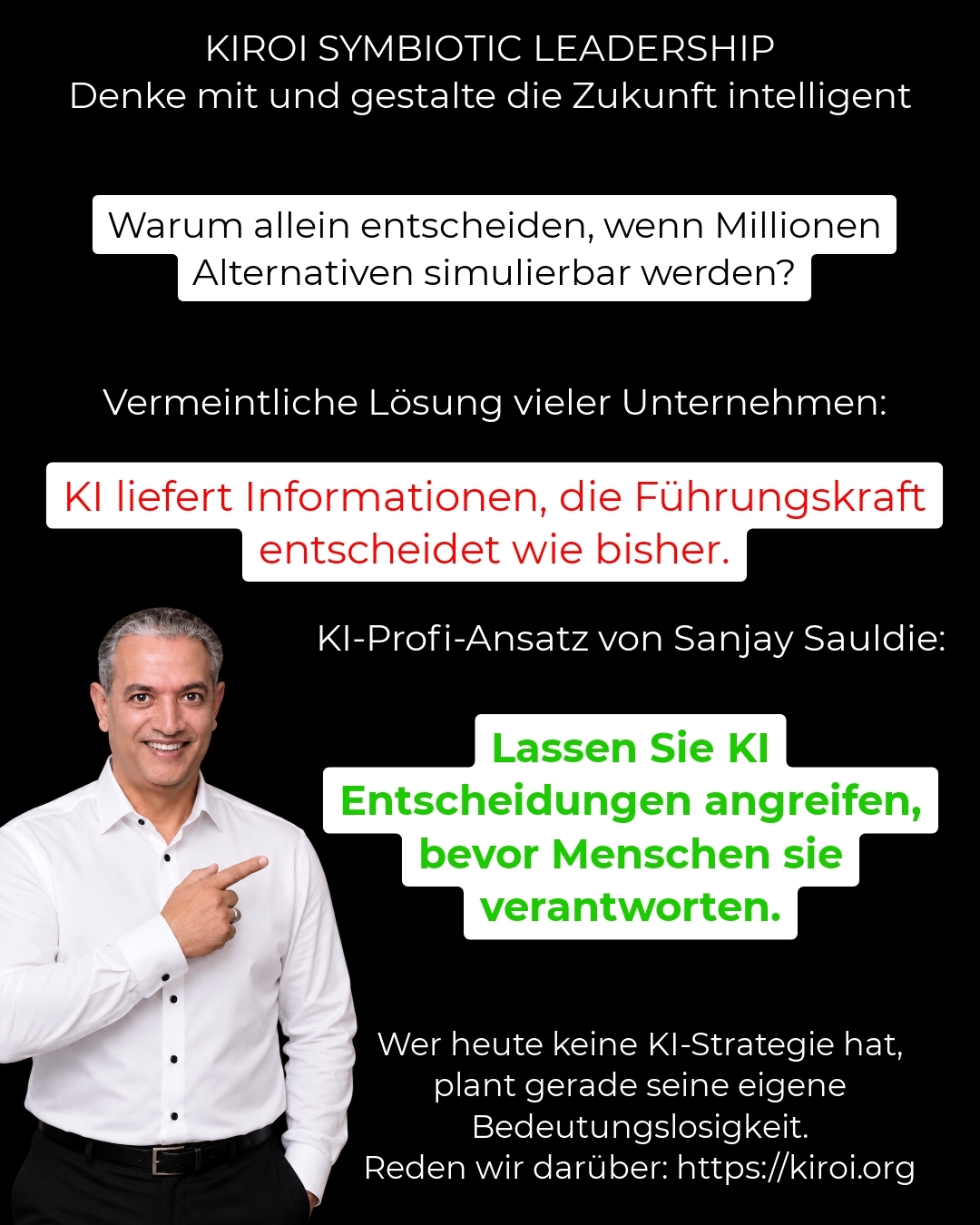
The AIROI approach makes a radical break with this outdated paradigm. It reverses the logic and transforms intelligent systems from passive information providers into active critics. The central idea is: have intelligent systems challenge decisions before humans take responsibility for them. This philosophy changes the entire dynamic of the decision-making process, leading to more robust, better thought-out outcomes that withstand even adverse circumstances.
Imagine you are planning an expansion into new markets. Before consulting the board of directors, you have your strategy analysed by a critical system. This system does not look for validation. It looks for vulnerabilities. It simulates economic downturns, aggressive competitor responses and regulatory hurdles. It identifies hidden dependencies and blind spots in your reasoning. Only when your strategy survives this stress test do you present it to the board. In the realm of product development, this means prototypes are tested virtually under extreme conditions before physical models are created. In investment decisions, cash-flow scenarios are tested against dozens of macroeconomic developments. In workforce planning, the system anticipates demographic shifts, skills gaps and attrition patterns over years to come.
Best practice with a AIROI customer
A medium-sized enterprise faced the challenge of fundamentally modernising its manufacturing processes while simultaneously integrating the existing workforce into the new way of working. The management team had already developed a detailed roadmap and was convinced that it had taken all relevant factors into account. As part of the AIROI support however, this strategy was subjected to a systematic stress test in which intelligent analysis systems deliberately searched for vulnerabilities and overlooked risks. The result surprised even the most experienced executives: the system identified a critical dependency on a single supplier whose capacities would not be sufficient if the plan were fully implemented. In addition, the analysis revealed that the planned training period for employees was calculated to be at least six weeks too short, which would have led to significant losses in productivity during the transition phase. Thanks to these insights, the company was able to adapt its plan, establish alternative supplier relationships and set a more realistic timeframe for the upskilling measures. The transformation ultimately implemented went much more smoothly than originally forecast, and the workforce reported a higher level of trust in management decisions because they felt that potential issues had been thoroughly thought through in advance.
The role of humans in the AIROI model
Critics might object that this approach strips the leader of power and replaces them with algorithms. However, the opposite is true. The AIROI strategy strengthens human decision-making capability by enabling leaders to make better informed and more robust decisions. The human remains the final decision-maker and person responsible. However, they make their decisions on a more solid foundation because potential weaknesses have already been identified and addressed.
In the field of strategic planning, for example, this enables executive boards to no longer be confronted with unverified presentations. Every strategy that reaches the board has already survived multiple rounds of review. In budget allocation, distribution decisions are tested against historical patterns and industry benchmarks. In times of crisis, leadership teams can play through various response scenarios before having to act. Human judgement remains indispensable for the final balancing of values, priorities and long-term visions. Yet this judgement is now supported by systematic analyses rather than being hindered by fragmented information.
Practical implementation of the critical analysis function
The introduction of a system that actively searches for vulnerabilities requires both technical and cultural adjustments. Technically, organisations need systems that not only aggregate data, but can also creatively generate alternative scenarios. These systems must be capable of formulating plausible counter-arguments and questioning hidden assumptions. Culturally, the approach requires an attitude of intellectual humility that many leaders first need to develop.
In operational implementation, this is demonstrated, for example, in the introduction of new product lines, where market entry plans are tested against various competitive scenarios before resources are committed. In reorganisation projects, critical systems analyse which informal networks might be destroyed by new structures. In procurement, algorithms check whether supplier consolidations actually deliver the predicted savings or harbour hidden risks. Transruption coaching accompanies organisations in establishing these new processes and cultivating the necessary openness to critical feedback.
Best practice with a AIROI customer
A large corporation with several thousand employees was planning a comprehensive digitalisation initiative designed to transform all core processes from order processing to delivery. The initial budget amounted to a high double-digit million figure, and the executive board expected a return on investment within three years. As part of the AIROI approach the entire planning was subjected to a systematic review, in which intelligent analysis systems specifically searched for optimistic assumptions and underestimated complexities. The results were sobering and valuable at the same time: the system identified that the planned integration time for legacy systems had been underestimated by about forty percent, based on empirical data from comparable projects. In addition, the analysis indicated that the expected ROI was based on unrealistic productivity gains during the transition phase. After intense discussions and the adjustment of the plan, the project started with more realistic expectations and an adapted timeframe. The management team later reported that precisely this early sobering realisation had prevented the project from having to be cancelled as a failure after two years because the original promises could not be kept. Instead, the project was evaluated as a solid success that even slightly exceeded the adjusted targets.
The competitive advantage through systematic decision critique
Organisations that AIROI approach consistently implemented, develop a distinct competitive advantage over time. Your decisions are more robust because they have already been tested against resistance. Your strategies are more adaptive because alternative scenarios were factored in from the very beginning. Your leaders are more self-assured because they know their decisions stand on a solid analytical foundation.
In volatile markets this advantage becomes particularly clear when competitors are caught off guard by unexpected developments, whilst prepared organisations can already activate contingency plans. In talent acquisition, leaders frequently report that systematic preparation for critical questions has significantly increased their persuasiveness in interviews. When dealing with investors and stakeholders, the demonstrable robustness of strategies leads to greater trust and better valuations. The era of making lonely decisions behind closed doors is drawing to a close, and those who actively shape this change will be the leaders of tomorrow.
My AIROI Analysis
Following intensive engagement with this subject, a clear picture emerges: the fundamental transformation of the decision-making process can no longer be stopped, and organisations face the choice of actively shaping this development or being overwhelmed by it. The traditional approach, where intelligent systems merely supply information and leaders then decide as before, wastes enormous potential and will in the medium term lead to a serious competitive disadvantage. The AIROI philosophy of having decisions systematically challenged before humans take responsibility for them represents a paradigm shift that may initially seem uncomfortable, but in the long term leads to better results and higher satisfaction at all levels.
Particularly remarkable to me is the observation that this approach does not weaken the human leader, but rather strengthens them. Whoever knows that their decisions have withstood a rigorous stress test makes them with greater conviction and is also better able to defend them against sceptics. The fear of a loss of control, which many leaders feel when it comes to intelligent systems, proves upon closer inspection to be unfounded. Transruption coaching can support leaders in developing this new mindset and anchoring it within their organisations. The journey may be challenging, but the goal – more robust decisions, more adaptive strategies and self-assured leadership – is well worth the effort.
Further links from the text above:
[1] Harvard Business Review – Decision Making and Problem Solving
[2] McKinsey Digital Insights – Analytics Implementation Studies
Are you a leader and would you like to learn how you can genuinely introduce AI into your company in a valuable and sustainable way, away from the hype? Take part Contact us or read more blog posts on the topic Artificial intelligence here.






 Deutsch
 English (UK)