
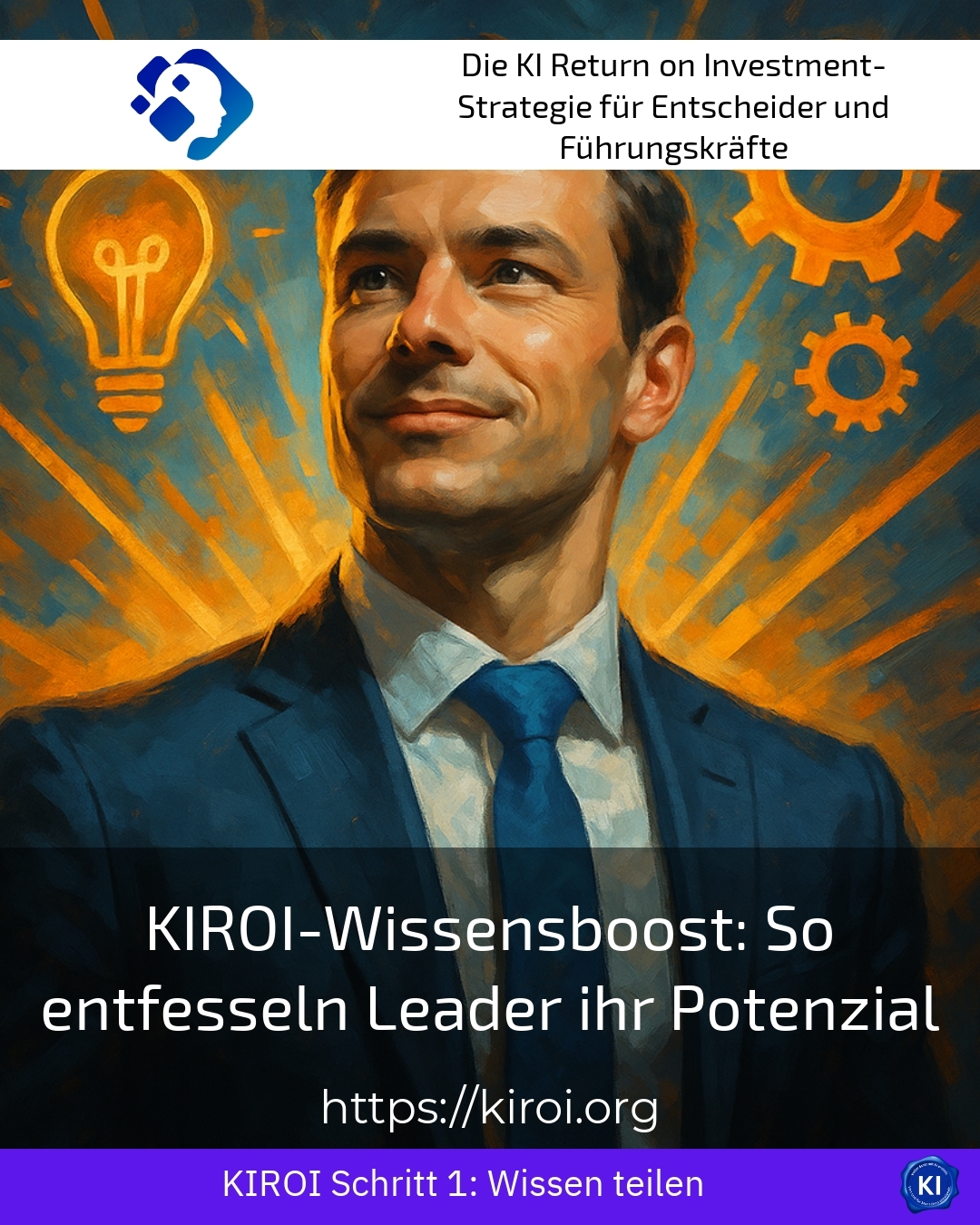
Have you ever wondered why some leaders seemingly navigate complex transformation processes effortlessly, while others remain stuck in the starting blocks despite enormous effort? The KIROI Knowledge Boost provides precisely those methodological tools that can make the crucial difference. In an era where technological upheavals are revolutionising entire business models, leaders need more than just expertise. They require a structured approach that empowers them not only to manage change but to actively shape it. This article shows you how successful leaders systematically expand their competencies while remaining authentic.
Why traditional leadership approaches are reaching their limits
The requirements for modern leaders have fundamentally changed in recent years. Many leaders report that tried-and-tested methods are suddenly no longer working. Classical hierarchical structures are increasingly giving way to agile organisational forms. Teams collaborate remotely and across different time zones. Employees today expect more autonomy and purpose in their work. At the same time, the pressure to make decisions faster is increasing. This dynamic often overwhelms even experienced managers.
This challenge is particularly evident in the field of logistics. For example, a freight forwarding company introduced a new fleet management system. Drivers were expected to optimise their routes and document delivery times via an app. Technically, everything worked flawlessly. Nevertheless, the project initially failed due to resistance within the team. Another example comes from a large warehouse. Autonomous transport robots were implemented there. However, employees felt overlooked and excluded. In the third case, a courier service attempted to fully automate its call centre. Customers subsequently complained massively about a lack of personal support.
The KIROI Knowledge Boost as a Compass for Transformation Processes
The methodological framework of KIROI Knowledge Boost It supports leaders in taking a holistic view of change processes. It combines technological understanding with people-centred leadership, with the insight that transformation always affects people being at its core. Technology alone does not create sustainable change. Only the combination of a clear vision and empathetic communication enables real transformation. Leaders learn to keep both dimensions in view simultaneously.
A container terminal at the Port of Hamburg faced the challenge of retraining its crane operators on new digital control systems. The managers used a structured coaching approach. They involved experienced employees in the planning process early on. The result was significantly higher acceptance. A similar path was chosen at a fulfilment centre for an online retailer. New order picking systems were to be introduced there. The team leaders received intensive training in change communication beforehand. A third example shows an international parcel service. This company introduced predictive maintenance systems for its vehicle fleet. The workshop managers were actively used as ambassadors of change.
Best practice with a KIROI customer A medium-sized logistics company specialising in temperature-controlled transport approached us because the implementation of a new cold chain tracking system had failed multiple times, and management did not understand why the technically flawless solution was being rejected by the drivers. As part of the transruptions coaching support, we first analysed the communication channels between management and operational teams. It emerged that the drivers perceived the system as a surveillance tool, even though its primary purpose was quality assurance. Together with the management, we developed a new communication strategy that clearly highlighted the benefits for all involved. The drivers were given the opportunity to contribute their own suggestions for improvement. After six months, the usage rate was over ninety percent. Customers reported significantly fewer complaints regarding interrupted cold chains. This project impressively demonstrates the importance of the human element in technological transformations.
The five pillars of successful leadership development
Successful transformation is based on several supporting elements. These pillars form the foundation for sustainable change. Firstly, leaders need a deep understanding of technological possibilities [1]. Secondly, they must develop and cultivate emotional intelligence. Thirdly, strategic thinking in complex systems is essential. Fourthly, they require authentic communication skills. Fifthly, continuous learning and adaptation are necessary.
In the air cargo industry, the importance of these pillars is particularly evident. A cargo handler at Frankfurt Airport faced massive challenges. The automation of freight handling required new skills at all levels. Shift leaders suddenly had to demonstrate both technical and interpersonal expertise. A second example is provided by a sea freight company. This company introduced blockchain-based documentation for supply chains. Managers had to be able to explain this complex technology understandably. In the third case, a rail logistics provider implemented new capacity planning software. Dispatchers needed intensive support when switching from their familiar systems.
Self-reflection as a key competence in the KIROI knowledge boost
The KIROI Knowledge Boost places particular emphasis on developing self-reflection skills. Leaders who regularly question their own behaviour are demonstrably more effective [2]. They recognise blind spots and can specifically address them. Self-reflection also enables authentic leadership. Employees sense when their superiors are honestly confronting their own weaknesses. This builds trust and promotes an open culture of making mistakes.
A distribution centre for pharmaceutical products experienced this impressively. Through structured reflection, the site manager recognised his tendency towards micromanagement. He learned to delegate more responsibility to his team leaders. Productivity subsequently increased noticeably. Similarly, the head of a spare parts warehouse in the automotive industry had a similar experience. Through coaching, she discovered that she exhibited conflict-avoidant behaviour. After intensive work on this trait, the team climate improved significantly. A third case concerns the head of a contract logistics division. He recognised his tendency to postpone decisions. With targeted exercises, he developed more decisiveness.
Practical Tools for Everyday Management
Theory alone is not enough to bring about change. Leaders need concrete tools for their everyday work. These include structured conversation formats for difficult situations. Methods for prioritisation in complex decision-making situations are equally important. Techniques for energy management and stress coping also play a central role. These practical aids make the difference between knowing and doing.
A less-than-truckload (LTL) freight consolidation centre tested different meeting formats. Managers introduced daily stand-up meetings. These lasted a maximum of fifteen minutes. Communication became more focused and efficient as a result. In a second example, a furniture store warehouse manager used visualisation techniques. They made processes and key performance indicators (KPIs) visible to all employees. Team engagement noticeably increased. Thirdly, a last-mile delivery company experimented with new feedback methods. Couriers received weekly brief conversations with their team leaders. Staff turnover subsequently fell by a third.
Best practice with a KIROI customer An internationally operating provider of supply chain solutions sought support with a comprehensive cultural change that accompanied the introduction of a new company platform. Middle management were both sceptical and overwhelmed. As part of our "transruptions" coaching support, we developed a modular programme for leadership development. Each module combined theoretical input with practical exercises. Participants worked on real challenges from their daily work. The introduction of peer coaching groups proved particularly effective. Managers supported each other in implementing new behaviours. After one year, over eighty percent of participants reported noticeable improvements in their leadership. Employee satisfaction in the relevant areas increased significantly. Management subsequently decided to extend the programme to further locations.
Communication as the core of leadership
Without effective communication, even the best strategies will fail. Leaders must be able to communicate complex issues in an understandable way [3]. They should listen and take their employees' perspectives seriously. At the same time, they need the ability to speak uncomfortable truths. Finding this balance requires practice and continuous development.
A logistics provider for the food industry experienced this firsthand. There was significant resistance when new hygiene regulations were introduced. Initially, the communication was too technical and lacked motivation. After the messages were revised, the mood changed fundamentally. A haulier specialising in hazardous goods transport faced similar challenges. New safety guidelines had to be communicated to all drivers. The managers learned to package this information into understandable stories. In the third case, an e-commerce fulfillment provider introduced seasonal flexibility. Communicating this change to the workforce required a special touch.
Developing resilience in turbulent times
The ability to deal with setbacks is becoming increasingly important. Resilient leaders recover more quickly from crises. They keep a clear head in stressful situations. Furthermore, they radiate confidence, even when the situation appears difficult. This inner strength can be developed through targeted exercises. KIROI Knowledge Boost offers proven methods and approaches for this.
A cross-docking terminal experienced a massive system failure. Managers had to switch to manual processes within hours. Those with higher resilience mastered this situation significantly better. A parcel sorting facility experienced an employee strike. Site management had to conduct negotiations under enormous pressure. Their inner strength was crucial for a successful outcome. A third example shows a port logistics provider during a cyberattack. IT systems were unavailable for days. Resilient managers kept operations running.
My KIROI Analysis
Engaging deeply with the topic of leadership development in the logistics sector has impressively shown me how closely technological change and human factors are interwoven. Many clients come to us with the conviction that their transformation problems are purely technical in nature. However, in our collaborative work, it often emerges that the greatest levers lie in the areas of communication and leadership. The examples from warehouses, forwarding companies, and distribution centres illustrate this impressively. Technology is important and necessary. However, it only unfolds its potential through people who understand and support it.
The KIROI Knowledge Boost provides a structured framework for this development. It does not replace one's own work on oneself. Rather, it provides impetus and guidance during implementation. The most successful leaders I observe are characterised by their willingness to learn. They understand that leadership is not a static skill. Instead, effective leadership requires continuous adaptation and development. In an industry that is changing as rapidly as logistics, this attitude is indispensable. Those who are willing to invest in their own development will be able to master the challenges of the future.
Further links from the text above:
[1] Harvard Business Review – Technology Leadership
[2] McKinsey – Insights on People and Organisational Performance
[3] Forbes – Leadership and Communication
For more information and if you have any questions, please contact Contact us or read more blog posts on the topic Artificial intelligence here.








 Deutsch
  English (UK)