
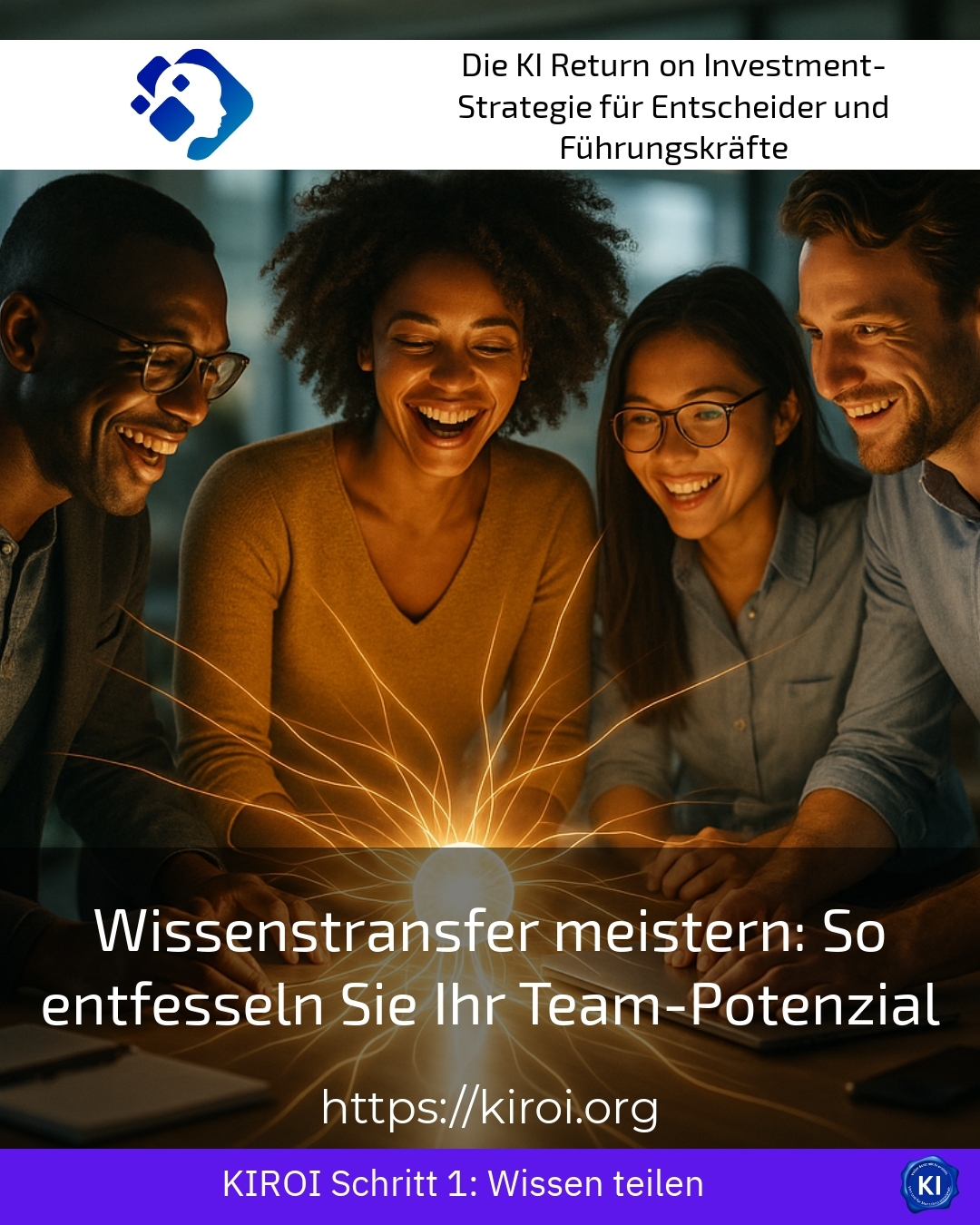
Imagine your most experienced employee leaves the company tomorrow. What happens to all the knowledge they've built up over the years? This is precisely where the art of... Knowledge transfer as, because this will significantly determine the long-term success of your team. Many organisations underestimate the importance of structured knowledge sharing and thereby lose valuable know-how. In this post, you will learn how to unleash your team's hidden potential through targeted measures. The following strategies and examples will support you in establishing a sustainable learning culture.
Warum strukturierte Wissensweitergabe den Unterschied macht
In a time of constant change, the systematic transfer of experience and skills forms the foundation for sustainable business success. Managers often report situations where important specialist knowledge was irretrievably lost when employees left. This phenomenon affects not only large corporations but also medium-sized businesses and smaller teams equally. The challenge lies in making implicit knowledge visible and transforming it into explicit, transferable formats [1].
For instance, a manufacturing company in the mechanical engineering sector faced the challenge of documenting the practical knowledge of its long-serving skilled workers. The solution involved structured mentoring programmes and the introduction of knowledge maps. A logistics company, on the other hand, used digital collaboration platforms to consolidate the decentralised knowledge of its field service staff. The healthcare sector also demonstrates the need for efficient transfer methods when experienced nurses need to pass on their practical knowledge to new entrants to the profession.
Mastering knowledge transfer through cultural change
Establishing a genuine knowledge culture requires far more than mere technical solutions or formal processes. It is rather about creating an environment in which employees willingly share their knowledge and actively seek out the knowledge of others. Many organisations fail at this point because they underestimate the psychological barriers. Fear of losing control or the concern of becoming replaceable through knowledge sharing significantly hinder free exchange.
In the financial services sector, for example, an insurance company implemented an incentive system for active knowledge sharers. Employees received recognition and small bonuses for particularly helpful documentation and training. A software development company introduced weekly knowledge sessions where developers presented their insights from completed projects. In retail, in turn, tandem models proved successful, where experienced store managers accompanied and coached new colleagues over several months [2].
Best practice with a AIROI customer
A medium-sized technology company with around three hundred employees approached transruptions coaching with a specific challenge. Several key employees from the research and development department were about to retire. The company feared the loss of over twenty years of accumulated expertise in specialised manufacturing processes. As part of the support process, we first developed a detailed knowledge map that identified and prioritised all critical knowledge areas. We then implemented a multi-stage transfer programme that combined structured interviews, documentation processes and shadowing phases. The departing experts were given dedicated time for knowledge transfer, which was recognised as a fully-fledged work assignment. We also organised workshops in which we addressed psychological barriers and established a culture of appreciation for knowledge sharing. After six months of intensive support, the company had a comprehensive knowledge database and trained successors for all critical positions. Managers reported a noticeable cultural change as employees were now actively documenting and sharing knowledge.
Methods and tools for effective transfer
The selection of suitable methods depends heavily on the type of knowledge to be transferred and the organisational framework. Documentations, manuals and digital knowledge databases are particularly well-suited for explicit knowledge. Implicit knowledge, on the other hand, can often only be transferred through personal interaction and joint work. Combining different approaches significantly increases the probability of success.
For example, a pharmaceutical company used expert interviews and video documentation to capture the knowledge of its lab heads. The recorded explanations of complex analytical procedures now serve as valuable training material for new employees. In the construction industry, an architectural firm established regular project reviews where teams systematically reflected on and documented their experiences. In turn, a consulting firm relied on communities of practice, where experts from different locations regularly exchanged ideas on specialist topics [3].
Mastering digital support for knowledge transfer
Modern technologies open up numerous possibilities for making knowledge transfer more efficient and sustainable. Cloud-based platforms enable location-independent access to documented knowledge and promote collaboration across departmental and site boundaries. Artificial intelligence can assist in identifying and assigning relevant knowledge. However, these tools do not replace human interaction and personal relationships [4].
An automotive supplier implemented an intelligent search function in its intranet, connecting employees with suitable experts. A media company used chatbot technology to automatically provide frequently requested knowledge, thereby relieving experts. In the banking sector, an institution introduced virtual learning rooms where experienced advisors shared their knowledge of complex financial products in interactive sessions.
The role of leadership in the transfer process
Leaders bear a special responsibility when it comes to fostering and maintaining a positive knowledge culture. They must not only provide the necessary resources but also act as role models and actively share knowledge themselves. Furthermore, it is their task to identify and purposefully dismantle barriers. Valuing knowledge providers through explicit recognition and appropriate career opportunities reinforces desired behaviours.
An energy supply company integrated knowledge transfer goals into the performance reviews of its managers. A trading company created the new role of Knowledge Champion, who acted as a multiplier and point of contact. In the public sector, a local authority established regular leadership dialogues where department heads exchanged experiences and learned from each other.
Best practice with a AIROI customer
An international service provider in the field of technical testing and certification was looking for support in establishing systematic knowledge transfer. The initial situation was characterised by highly siloed departments with hardly any knowledge exchange between them. At the same time, the company had highly specialised experts whose knowledge would have been valuable for the entire organisation. As part of the transruption coaching process, we first analysed the existing formal and informal knowledge flows within the organisation. In doing so, we identified both bottlenecks and existing transfer mechanisms that we could build on. Together with an interdisciplinary project team, we developed a concept for cross-divisional knowledge tandems and thematic expert communities. Implementation took place gradually, starting with a pilot area, in order to gather experience and continuously adapt the procedure. Accompanying communication measures promoted acceptance and understanding of the importance of knowledge sharing throughout the company. After around nine months, the managers involved reported noticeably improved collaboration and faster problem solving thanks to easier access to relevant experts.
Overcoming obstacles and mastering knowledge transfer
The implementation of effective transfer strategies frequently encounters various resistances and obstacles in practice. Lack of time is one of the most commonly cited problems, as operational tasks displace knowledge transfer. A lack of technical infrastructure or insufficient methodological expertise can also significantly complicate the process. Consciously addressing these barriers is the first step towards overcoming them [5].
One telecommunications company solved the time problem by introducing dedicated knowledge times during which no meetings were allowed. A food producer invested in training on documentation skills after finding that many employees did not know how to properly record their knowledge. In the tourism sector, a tour operator helped its employees systematically capture relevant experiential knowledge using pre-structured templates and guiding questions.
Securing sustainability in the transfer process
One-off measures are not sufficient to achieve lasting improvement in knowledge transfer. Indeed, continuous maintenance and further development of established structures and processes are required. Regular review of effectiveness and adaptation to changed circumstances ensure long-term success. The integration of knowledge transfer into existing routines and procedures increases the likelihood of sustainable embedding.
A chemical company carried out quarterly reviews of its knowledge base and updated outdated content. An IT service provider integrated knowledge sessions firmly into its agile development cycles as part of sprint retrospectives. In the healthcare sector, a clinic association established an annual knowledge audit to identify critical knowledge gaps early on.
My AIROI Analysis
The systematic sharing of knowledge and experience is a crucial success factor for organisations of all sizes and industries. The examples presented illustrate that there is no universal solution, but rather that individual approaches are required. Technological tools can support the process but do not replace the human component of exchange. Leaders play a key role in establishing a supportive culture and providing the necessary resources.
From my experience supporting numerous organisations with this topic, it consistently becomes clear that the cultural aspect is frequently underestimated. The best technical systems and well-thought-out processes remain ineffective if employees are unwilling to share their knowledge. The creation of trust and psychological safety therefore forms the foundation for any successful transfer process. Transruptions coaching can provide valuable impetus here and support organisations on their journey to becoming a learning organisation.
Investing in structured knowledge transfer pays off in the long run, even if the results are not always immediately visible. Organisations that neglect this area risk the slow erosion of valuable skills and experience. The best time to act is now, before critical knowledge is lost forever. The approaches and examples presented here offer suggestions for initial steps on this important path.
Further links from the text above:
[1] Knowledge transfer in companies – basics and methods
[2] Haufe – How to ensure knowledge transfer in your company
[3] McKinsey – Knowledge Management Insights
[4] Gartner – Knowledge Management Research and Insights
[5] Harvard Business Review – Knowledge Management
For more information and if you have any questions, please contact Contact us or read more blog posts on the topic Artificial intelligence here.






 Deutsch
  English (UK)