
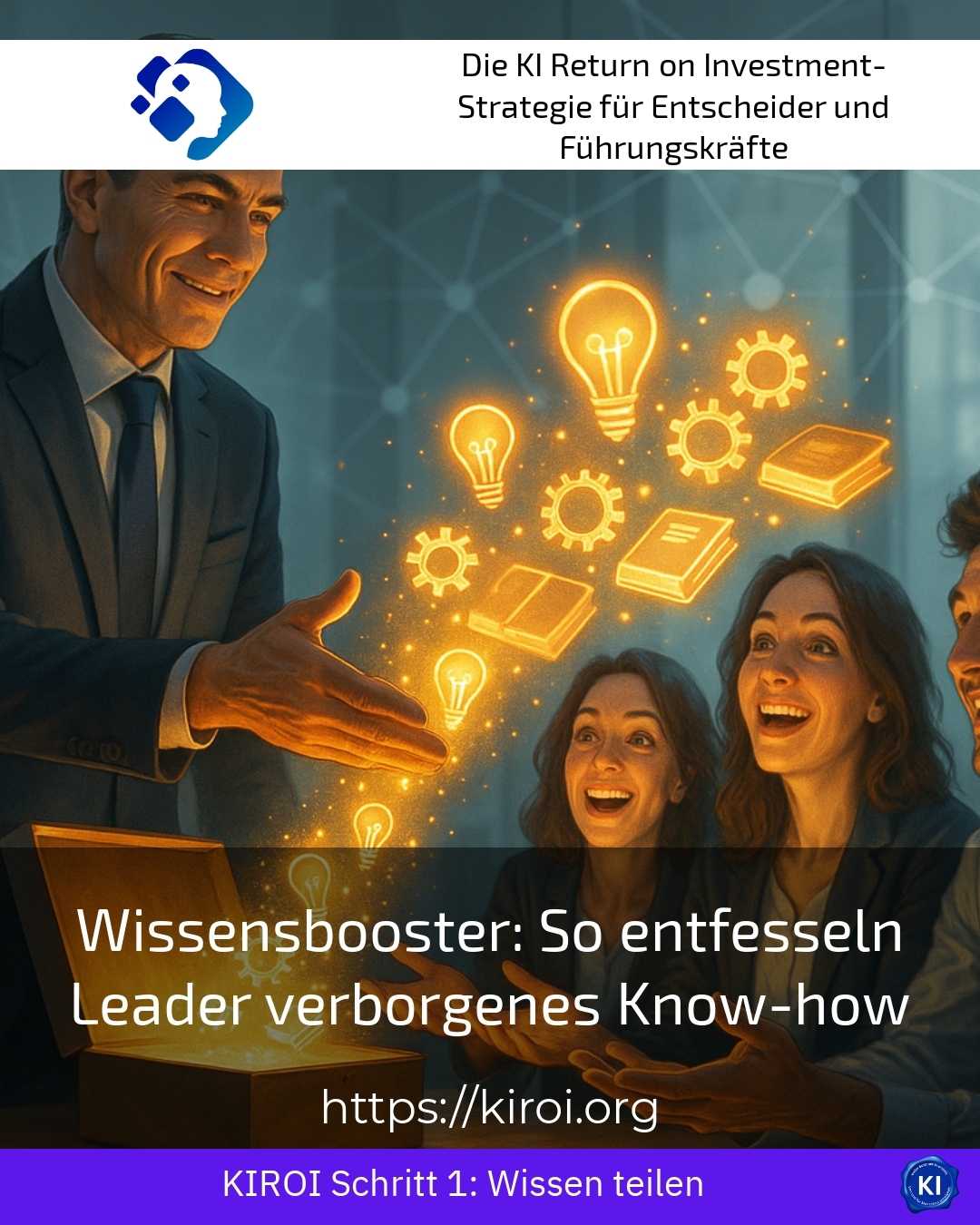
Have you ever wondered why some leaders seemingly effortlessly access solutions that others remain hidden from while their teams simultaneously develop extraordinary innovation and master challenges with remarkable ease? The answer often lies hidden in a crucial factor that we refer to as Knowledge booster This ability to identify, activate, and utilize dormant insights and untapped potential systematically is what can be referred to as strategic intelligence. In an economic world characterized by increasing complexity and rapid change, this competence proves to be an indispensable competitive advantage that enables organizations to not only survive but actually thrive.
Recognize and highlight the hidden treasures in organizations
Every organization possesses an enormous wealth of experience, insights, and practical knowledge that often remains untapped in the minds of employees because the necessary structures and processes are lacking to systematically harness this valuable asset. Leaders who are true champions of change are the ones who can harness this valuable asset effectively. Knowledge booster By acting, they masterfully bring these hidden resources to light. They create spaces for open exchange. They foster a culture of curiosity. They establish methods that make implicit knowledge explicit.
For example, a mid-sized technology company recognized that experienced service technicians possessed decades of accumulated problem-solving knowledge that was not documented anywhere. By introducing structured knowledge transfer sessions, this expertise could be preserved. Similarly, a logistics service provider established systematic storytelling rounds. Long-time employees shared their experiences with critical situations. New team members benefited enormously from these insights. Another example comes from a pharmaceutical company that introduced so-called „Failure Fridays“—regular meetings where teams openly discussed failed experiments and often discovered approaches that proved valuable for other projects.
Best practice with a AIROI customer
An internationally operating machine manufacturer approached us with a special challenge that many organizations are familiar with: the company faced a massive generational change, as about thirty percent of the most experienced professionals would retire within three years, and no one had previously systematically recorded the specialized knowledge these employees had built up over decades. As part of the transruptive coaching process, we developed a multi-stage program for knowledge extraction that included both formal interviews and informal mentoring partnerships, supported by digital documentation tools. The „critical events“ method proved particularly effective, in which experienced employees were asked to describe the ten most difficult situations of their careers and to detail how they had mastered them. These stories were recorded, transcribed, and converted into a searchable knowledge database that subsequent generations can now access. Often, clients report that such measures not only serve to preserve knowledge but also noticeably increase appreciation for long-standing employees.
Knowledge boosters in practice: methods for sustainable knowledge culture
The transformation to a knowledge-based organization requires more than good intentions. It requires concrete methods and persistent implementation. Successful leaders utilize a variety of tools to activate hidden knowledge. These tools range from simple conversation formats to complex digital platforms.
A financial services provider implemented so-called „knowledge breakfasts“ where employees from different departments shared their expertise in an informal atmosphere. The results positively surprised even skeptical executives. A car parts supplier, however, relied on „reverse mentoring“ – where younger employees coached their more experienced colleagues on digital topics. However, the flow of knowledge went both ways. A retail group, on the other hand, introduced „learning journeys“ in which teams visited other companies and documented their observations in a structured manner to identify best practices and transfer them to their own organization.
The role of psychological safety for the knowledge booster effect
No matter how sophisticated a knowledge-sharing system is, it won’t work if employees are afraid. Fear of appearing stupid. Fear of sharing their knowledge and thus becoming replaceable. Psychological safety forms the foundation of any successful knowledge culture. Leaders who act as Knowledge booster Those who want to work in this field must first create an environment in which openness is rewarded.
A software development company introduced a rule that leadership should be the first to admit their own knowledge gaps in meetings. This seemingly small measure fundamentally changed the team dynamics. A consulting firm established the principle of „No Dumb Questions“ and visualised it through posters in all meeting rooms. A healthcare provider went even further and introduced a „Ignorance Premium“ – employees who bravely admitted not knowing something and asked for help received public recognition.
Design the knowledge transfer between generations and departments
One of the biggest challenges facing modern organizations is bridging silos. Departments develop their own languages and perspectives. Generations bring different worlds of experience with them. Successful knowledge management systematically overcomes these barriers. It builds bridges where there were previously trenches.
An energy provider installed „ambassador programs“ in which employees spent several weeks in other departments and then acted as intermediaries between the different areas. An insurance company established interdisciplinary „innovation labs“ where teams from different generations and disciplines worked together on future-oriented topics. A media company created so-called „knowledge communities“ – partnerships between experienced journalists and digitally-savvy young talent who mutually enriched each other.
Best practice with a AIROI customer
A traditional family business from the food industry sought our guidance because communication between the production facility and the newly established digital unit had almost completely come to a standstill, even though both areas were urgently dependent on each other to successfully manage the impending digitalization of the production processes. As part of the transruptive coaching, we developed a „bridge-builder program“ in which two people from both areas worked together as a tandem for six months, bridging both professional and cultural differences. These tandems met weekly for structured exchange sessions, conducted joint project diaries, and presented their findings monthly to the leadership team, which not only transferred concrete knowledge but also fostered mutual understanding and respect. After completing the program, the participants reported unanimously that they had now found a common language and that problems that previously seemed unsolvable could suddenly be approached constructively. This example impressively demonstrates how targeted support can overcome organizational barriers.
Digital tools as amplifiers of the knowledge booster approach
Modern technologies offer enormous potential for supporting knowledge management. However, they never replace the human factor. Smart leaders see digital tools as amplifiers. They use them purposefully to complement personal interaction.
A telecommunications provider introduced an AI-powered knowledge platform that automatically linked requests to existing expert knowledge and suggested suitable contact points [1]. A chemical company used virtual reality technology to make complex laboratory processes documentable and teachable. A construction company relied on a collaboration platform that enabled the sharing of project experiences across locations and the use of proven solutions for similar challenges [2]. These examples illustrate how technology can support knowledge transfer.
Leadership as a catalyst for organizational learning
The role of the leader is fundamentally changing. From a knowledge monopolist to a knowledge creator. From a controller to a curator. This transformation requires a new sense of self. It demands the willingness to gain power through sharing.
A business company specifically trained its management team in questioning techniques that reveal hidden knowledge. The effect quickly showed in the quality of team discussions. An industrial company introduced „listening tours,“ in which top managers regularly visited employees at all levels and actively sought their knowledge and suggestions for improvement [3]. A technology company established the concept of „servant leadership“ – in this context, supervisors were primarily seen as supporters of their teams.
The Knowledge booster-The approach only succeeds if leaders authentically lead by example, what they preach. They must learn themselves. They must admit mistakes. They must generously share knowledge. Only then does a culture emerge in which others emulate them.
My AIROI Analysis
After intensive discussion on the topic of knowledge activation in organizations, a clear picture emerges: The sustainable success of companies depends largely on how effectively they can mobilize and utilize the expertise available within their structures. Technical solutions alone will never be enough to accomplish this demanding task. The AIROI methodology provides a holistic framework that takes into account both the human and technological aspects of knowledge management, helping to develop tailored strategies for individual organizational challenges.
What seems particularly remarkable to me is the realization that many organizations possess a wealth of experience without realizing or utilizing it, while at the same time investing significant resources in acquiring external expertise. Transruptive coaching can provide valuable insights in this regard. It helps leaders reflect on their own behavior and accompanies them in developing a knowledge-enhancing culture.
The examples presented illustrate that successful knowledge culture is not a luxury for large corporations. Even medium-sized companies can achieve significant progress with modest effort. The key lies in its consistent implementation. It lies in patience, allowing changes to take time. It lies in genuine leadership at the management level. Those who adhere to these principles will experience how hidden potential becomes visible and the organization as a whole emerges strengthened from the transformation process.
Further links from the text above:
[1] McKinsey – Unlocking the Potential of Knowledge Management
[2] Harvard Business Review – Knowledge Sharing and Organizational Learning
[3] Forbes – The Power of Leadership Listening Skills
For more information and if you have any questions, please contact Contact us or read more blog posts on the topic Artificial intelligence here.






 Deutsch
 English (UK)