
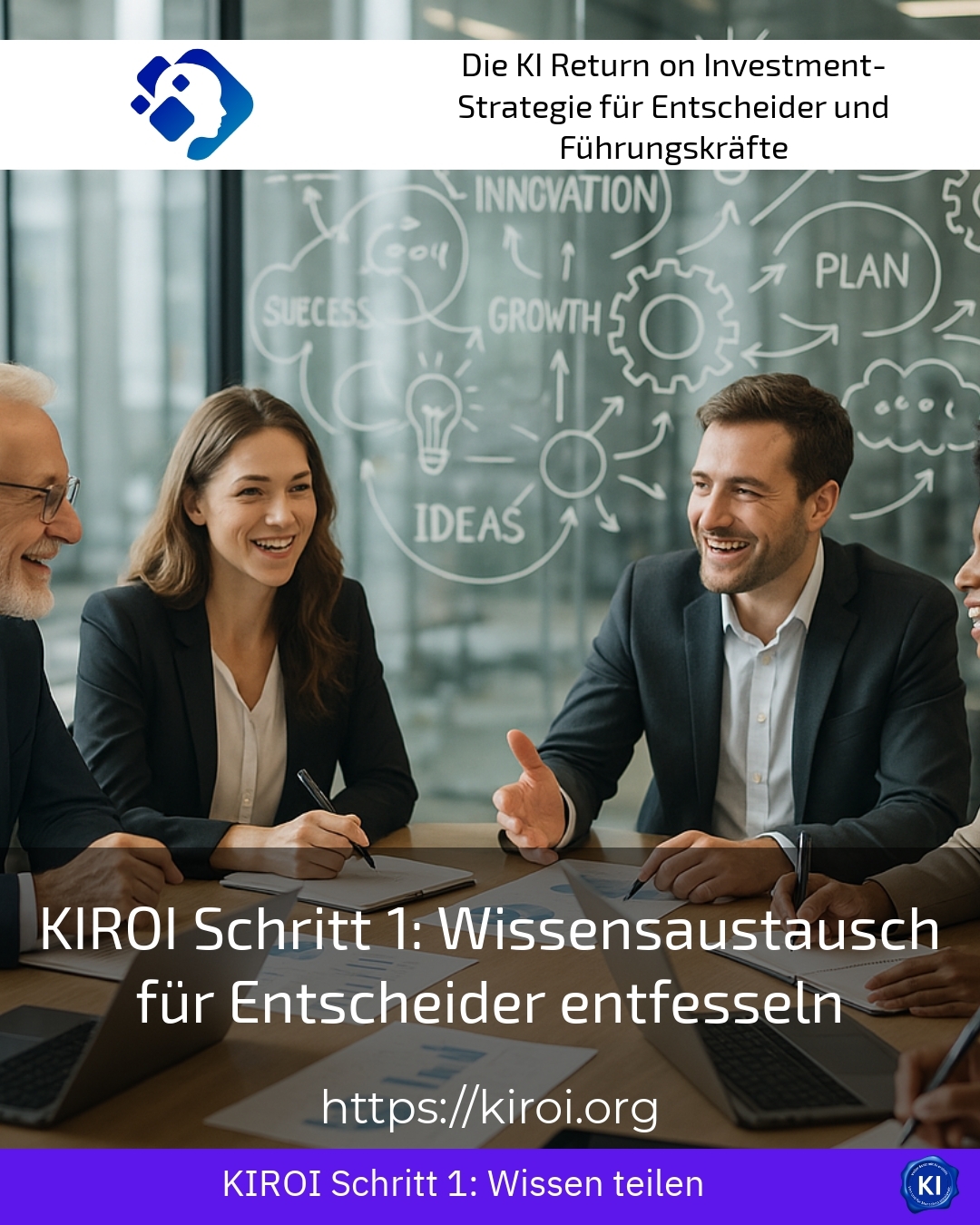
KIROI Step 1: Knowledge Exchange as the Foundation for Effective Decisions
Knowledge sharing is more than just a buzzword – it forms the heart of modern, agile organisations. When decision-makers consciously promote this process, transparency, trust, and genuine innovation emerge. Especially in a world where knowledge becomes outdated faster than ever before, the open exchange of information, experiences, and skills becomes a decisive competitive advantage.
Many clients report encountering obstacles with knowledge-sharing projects. They sense that valuable expertise is remaining siloed, collaboration is faltering, and important decisions are being made without sufficient information. This is where transruption coaching comes in: we support teams and leaders in intentionally cultivating knowledge sharing – and thus laying the foundation for sustainable project success.
Why knowledge sharing is crucial for decision-makers
In my practice, I repeatedly experience how organisations benefit from knowledge sharing. When employees share their knowledge, a collective knowledge pool is created that empowers the entire company to remain flexible, creative, and capable of learning[1][4]. Decisions are then no longer based on intuition, but on a broad basis of data and experience.
For example, a technical director from the mechanical engineering sector reports that regular exchange formats have significantly reduced the error rate in production. In another case, the introduction of an internal Wiki in engineering led to new employees being able to familiarise themselves more quickly. And in a third example, an open error culture programme ensured that failures were no longer covered up but instead used as learning opportunities.
These examples demonstrate that knowledge sharing is not an end in itself, but a key driver of efficiency, quality, and innovation – and thus for overall business success[3][5].
Examples of successful knowledge transfer
A client from the energy sector has worked with us to set up a structured mentoring programme. Senior employees pass on their experience and knowledge to junior staff, and in return, younger colleagues introduce new technologies. This creates a dynamic exchange of knowledge that enriches both sides.
In the automotive industry, a digital collaboration tool has been established that promotes exchange between development, production, and sales. This shortens coordination loops and ensures projects run more smoothly.
Another example comes from the healthcare sector: here, a customer uses regular interdisciplinary case conferences to bring together the knowledge of medical, nursing, and administrative teams. This results in holistic solutions that directly benefit patients.
BEST PRACTICE with one customer (name hidden due to NDA contract) We supported a medium-sized company in the chemical industry in strengthening knowledge exchange between research, production, and sales. To achieve this, cross-functional teams were formed, discussing challenges and developing solutions in weekly exchange meetings. In parallel, a digital knowledge portal was created, documenting key processes, lessons learned, and best practices. Within a year, the innovation rate increased significantly, and employees reported greater cohesion and higher identification with the company. Knowledge exchange thus became a living culture – and the company a pioneer in its industry.
How to implement knowledge sharing in your environment
The path to successful knowledge sharing begins with an open attitude. Decision-makers should send clear signals that knowledge sharing is desired and valued. Concrete measures that can be easily integrated into everyday life can help with this:
- Create regular exchange formats such as Lunch & Learns, Knowledge Cafés, or After Action Reviews.
- Utilise digital platforms, wikis or internal social networks to make information easily accessible[6].
- Foster an open culture of error, in which failures are seen as learning opportunities.
- Actively involve different hierarchical levels and departments to break down silos.
- Reward and acknowledge commitment to knowledge sharing visibly – for example, through awards or career opportunities.
Many of our clients report that even small steps have a big impact. For example, a team from the logistics sector started with a monthly presentation round where each department presented a current project. This not only promoted understanding of other areas of work but also sparked new ideas for process optimisation.
Even agile methods like retrospectives or design thinking workshops support knowledge sharing, as they specifically encourage dialogue and reflection.
Challenges in knowledge sharing and how to deal with them
Knowledge sharing doesn't always go smoothly. Common hurdles include a lack of time, insufficient incentives, or the fear of losing influence by sharing knowledge [2]. To counteract this, it is advisable to establish clear frameworks and make the benefits transparent to all involved.
An example from the financial industry shows how important trust is: A client established an anonymous feedback system, allowing employees to share knowledge and suggestions for improvement without fear of repercussions. This significantly increased participation in knowledge sharing.
Another success factor is support from senior management. If supervisors actively share knowledge and lead by example in participation, the team usually follows suit. Finally, it is worthwhile to continuously measure and optimise knowledge sharing – for example, through feedback rounds or key performance indicators.
Technology as an enabler for knowledge sharing
Modern tools and platforms greatly facilitate knowledge sharing. They allow information to be stored centrally, searched, and disseminated in a targeted manner [6]. Solutions that support the sharing of explicit knowledge (like documents or instructions) and implicit knowledge (like experiences or tips) are particularly practical.
A practical example from the IT sector: A software company uses a chat tool where employees can quickly ask questions and receive answers. This is supplemented by a wiki where best practices and project completion reports are collected. This way, valuable knowledge remains within the company – even if employees leave.
However, technology alone is not enough. Only the combination of digital solutions, appropriate processes and an open culture makes knowledge sharing sustainably successful[2][9].
My analysis
Knowledge sharing is not a project with a fixed end date, but a continuous process that makes companies more agile, innovative, and resilient [1][3]. Decision-makers who actively shape this path create real added value for their team, their department, and their entire company. They lay the foundation for knowledge not to be lost, but to be systematically used and further developed.
All parties benefit from this: employees feel valued and can fulfil their potential. Teams work more efficiently and creatively. And the company secures its long-term success in a dynamic environment. Those who promote knowledge sharing are investing in the future – and creating a company culture that puts learning, collaboration, and innovation at its heart.
Further links from the text above:
The importance of knowledge sharing in a company
Definition Knowledge Exchange | Business Processes Glossary
Knowledge Exchange in Knowledge Management: Tools & Methods
Knowledge Management in Business | Zendesk DE
Knowledge sharing in the workplace: Top tips and a guide
Knowledge Sharing: The Ultimate Guide
Wissensaustausch ist aus mehreren Gründen von entscheidender Bedeutung für Unternehmen. Erstens fördert er Innovation und Kreativität, indem er verschiedene Perspektiven und Ideen zusammenbringt. Dies kann zur Entwicklung neuer Produkte, Dienstleistungen und Prozesse führen. Zweitens verbessert er die Problemlösungsfähigkeiten, da Mitarbeiter auf ein breiteres Spektrum an Wissen und Erfahrungen zurückgreifen können, um Herausforderungen zu bewältigen. Drittens steigert er die Effizienz und Produktivität, da Mitarbeiter nicht mehr bei Null anfangen müssen und von den Erkenntnissen anderer lernen können. Viertens trägt er zur Mitarbeiterentwicklung und -bindung bei, da er Lernmöglichkeiten bietet und die Mitarbeiter stärker in das Unternehmen einbindet. Schließlich hilft er, organisatorisches Wissen zu bewahren und zu verbreiten, wodurch der Verlust von kritischem Wissen durch Mitarbeiterfluktuation oder Ruhestand minimiert wird.
For more information and if you have any questions, please contact Contact us or read more blog posts on the topic Artificial intelligence here.











 Deutsch
  English (UK)