
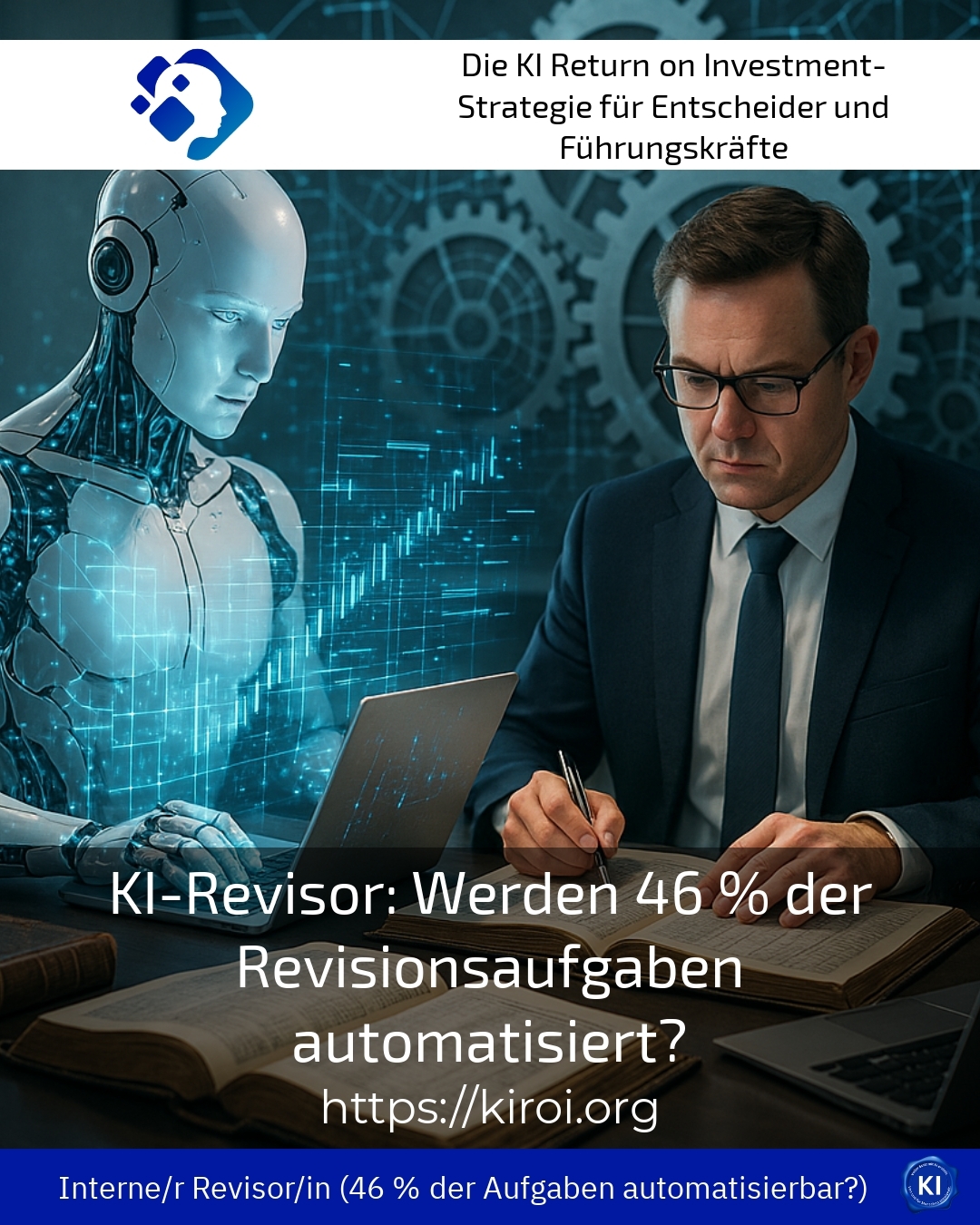
Can machines actually take on the critical task of testing business processes, which was previously reserved exclusively for experienced professionals; and what does this development mean for those who work in this sensitive field? The discussion about the AI Auditor It is gaining increasing momentum, as current analyses indicate that almost half of all activities in this professional field could be supported or even replaced by algorithmic systems. This number may seem frightening at first glance, but it also holds enormous potential for those professionals who are willing to actively engage with the new technologies and further develop their skills accordingly.
The findings presented here are based, among other things, on data from the Job Future Observatory of the Institute for Employment Research [1]. If you are yourself active in this field and are wondering how you can benefit from these changes, the seminars offer AIROI in-depth guidance for your professional transformation. The current dates can be found here. https://risawave.org/de/live-events-mit-sanjay-sauldie/ [2]. These events provide insights on how to meaningfully integrate algorithmic tools into your daily work.
How the AI auditor is changing the audit landscape
The integration of intelligent systems into the world of enterprise surveillance is taking place at a remarkable pace that many industry experts would have considered unthinkable just a few years ago. Traditionally, reviewing business documents required a high level of experience, intuition, and the ability to read between the lines and detect inconsistencies that are not immediately apparent. Today, learning algorithms are taking on a growing share of these tasks. They scan millions of datasets in fractions of a second. They identify patterns and anomalies with astonishing precision. This creates a new form of quality assurance.
An impressive example is provided by the automated analysis of travel expense reports, where intelligent systems can quickly verify the plausibility of thousands of documents. Another application area is in the continuous monitoring of payment flows. Algorithms detect suspicious transactions in near real-time here. Thirdly, automated contract review revolutionizes the work of many professionals. It analyzes legal documents and identifies potential risk areas with remarkable accuracy.
Best practice with a AIROI customer A medium-sized manufacturing company faced the challenge of fundamentally modernizing its internal control mechanisms without completely abandoning the proven structures that had grown over the years and proven themselves in practice. As part of AIROI the mentoring process, the team developed a hybrid strategy in which algorithmic tools were specifically used for repetitive testing tasks, while the experts focused on complex evaluation questions and strategic advice for the management. The implementation took place gradually over a period of several months, with employees being continuously involved in the development process and their practical experience directly influencing the optimization of the systems. The result exceeded initial expectations significantly, as the throughput times for standard tests decreased by more than sixty percent, while the error rate in detecting irregularities dropped significantly. At the same time, the professionals reported a noticeably higher level of job satisfaction. They were finally able to focus on more demanding tasks that matched their qualifications and generated real added value for the company.
Which activities the AI auditor already performs today
The range of automated tasks now extends across large parts of the traditional spectrum of activities, with data-intensive and rule-based processes particularly at the forefront of technological development. Machine proofing forms a key focus here. Algorithms compare incoming invoices with orders and delivery notes and automatically mark deviations for manual follow-up. Similarly, automated sampling has taken off. Intelligent systems select relevant data sets for in-depth checks based on statistical methods.
A particularly illustrative example can be found in the field of wage accounting control. Here, learning systems continuously monitor compliance with tariff regulations and legal requirements. A second application area is evident in the auditing of procurement processes. Algorithms analyze supplier relationships and detect potential conflicts of interest. As a third example, automated control of access rights is used. Systems monitor authorization structures and identify violations of the four-eyes principle.
AIROI The strategy guides professionals in strategically utilizing these technological opportunities. It provides insights for their own positioning in a changing professional field. In the workshops and lectures, participants learn how to combine their individual strengths with algorithmic support to create sustainable value for their organization while simultaneously advancing their own professional development.
The remaining 54 percent: Where human expertise remains indispensable
Despite the impressive advances of algorithmic systems, there still remain numerous areas of activity where human experts will remain indispensable. This applies particularly to the complex evaluation questions that require deep industry knowledge and contextual judgment. Assessing business risks often requires an understanding of economic relationships. This understanding goes far beyond the analysis of quantitative data.
One example is the evaluation of strategic management decisions. Here, professionals must assess the long-term implications of complex decisions. Another area is communication with supervisory bodies. Presenting sensitive findings requires diplomatic skill and empathy. Third, advising on the design of internal control systems remains a human domain. It requires a deep understanding of organizational dynamics and individual corporate cultures.
The AI auditor becomes a tool, not a replacement
The crucial question is not whether algorithmic systems will make their way into the examination process. This development is already a reality. Rather, the question is how professionals can use these tools optimally to increase their own effectiveness while opening up new career prospects that arise from the combination of technological expertise and professional expertise.
The proactive engagement with these technologies opens up manifold opportunities. A first example is seen in the role of the algorithm supervisor. Professionals monitor and validate the results of automated tests. A second example is found in their function as bridge builders. They translate between technical possibilities and business requirements. Thirdly, new specializations are emerging in the field of data analysis. Professionals interpret complex analyses and issue actionable recommendations.
Best practice with a AIROI customer An international corporate group with locations in several European countries sought ways to harmonize its group-wide audit processes while adequately considering the local specificities of the individual subsidiaries. This proved to be a significant challenge. AIROI The coaching focused on developing a competency model that systematically captured the technological skills of employees and derived targeted development measures, with particular emphasis on individual development. The professionals learned to critically question algorithmic evaluations and recognize the limits of automated analysis, leading to significantly improved quality of the audit results. The finding that the combination of machine pre-analysis and human interpretation led to results that neither the one method nor the other could have achieved was particularly valuable. The employees often reported a strengthened sense of self-confidence. They now understood their role as an indispensable addition to the technical systems.
The importance of continuous training in the context of the AI Auditor
Rapid technological development requires a fundamental willingness to learn throughout life from all involved, which goes far beyond occasional training measures and reflects a fundamental attitude towards one's own professional development. AIROI The seminars provide structured guidance that imparts both technical fundamentals and opens up strategic perspectives, helping participants to define their individual path of development.
An example of relevant learning content is understanding basic algorithms and their functioning. Another example concerns the critical evaluation of data quality and its impact on analysis results. Thirdly, the ability to effectively collaborate with technical teams is becoming increasingly important.
The practical workshops as part of the AIROI-Veranstaltungen enable participants to work on concrete use cases from their professional everyday lives and develop actionable strategies that they can immediately implement in their workplace upon returning home.
My AIROI Analysis
The intense discussion on the topic clearly shows that the often-discussed automation rate of 46 percent should not be viewed as a threat at all, but rather as an opportunity for a fundamental realignment of the professional image that can bring significant benefits both to individual professionals and the organizations in which they operate. AI Auditor In this context, it does not evolve into a substitute for human expertise, but rather into a powerful tool that enhances the effectiveness of qualified professionals and enables them to focus on those tasks that actually require human judgment.
The experiences from numerous mentoring AIROI programs consistently show that those professionals who adopt a proactive attitude towards technological changes and see them as an opportunity for personal development are most successful. This does not mean becoming a programmer; it means developing a deep understanding of the possibilities and limitations of algorithmic systems. Those who build this competence will find that new and often more attractive career prospects open up, while those who cling to outdated practices actually risk losing relevance.
AIROI The strategy helps professionals actively shape this transformation process. It offers not only theoretical knowledge but also practical insights for professional life. In the lectures and workshops, participants learn how to specifically utilize their unique human abilities. The synthesis of technological support and human expertise creates added value that goes beyond the sum of its parts.
Further links from the text above:
[1] IAB Job-Futuromat – Automation potential of occupations
[2] AIROI seminars and live events with Sanjay Sauldie
For more information and if you have any questions, please contact Contact us or read more blog posts on the topic Artificial intelligence here.








 Deutsch
 English (UK)