
Have you ever wondered why your company is stuck in digital transformation despite all the precautions taken, while agile competitors seem to breeze past you effortlessly? This question currently concerns numerous executives who are grappling with the tension between Maximum AI security and must confront the necessary capacity for innovation. The dilemma is real and tangible: The more security measures you implement, the more severely the ability to innovate seems to suffer. But this apparent contradiction can be resolved if you know and apply the right strategies. In this article, you will learn how advanced companies master this balancing act and why this is AIROI-Master plan concept offers a promising way out of this dilemma.
The paradox of over-cautious organization
In numerous organizations, we observe a recurring pattern that proves to be counterproductive. The fear of possible errors leads to a veritable standstill. Leaders hesitate when making important decisions. They wait for absolute certainty, which will never come. This behavior manifests itself especially clearly when it comes to the deployment of intelligent systems. For example, a medium-sized machine manufacturer waited two years for the perfect solution. During this time, a competitor had already optimized its production processes. A logistics company analyzed all conceivable risk scenarios for months. Meanwhile, a start-up successfully automated its route planning.
The consequences of this excessive caution are severe and far-reaching. Employees lose their motivation for improvement suggestions. Talented professionals switch to more innovative employers. The company gradually loses its competitiveness in the market. One automotive supplier missed the opportunity to enter the electric vehicle market due to excessive risk aversion. A traditional retailer hesitated to adopt digital customer platforms. An insurance service provider initially categorically refused automated claims assessment.
How average companies perform Maximum AI security proceed
The typical approach of many organizations follows a predictable pattern that systematically inhibits innovation. First, extensive risk analyses are conducted, which often take months. Subsequently, various departments create detailed requirements catalogs. These documents grow into extensive regulations. Legal audits further delay any progress. Compliance departments identify new potential dangers. In the end, a categorical no is often given to any change.
One manufacturing company from the middle class illustrates this approach effectively. Before introducing an intelligent maintenance system, all theoretical risks had to be eliminated. The project team had to create over one hundred pages of documentation. Each department added its own concerns and requirements. After eighteen months, the project was on hold. Meanwhile, a competitor had already achieved measurable efficiency gains. A financial services provider followed a similar approach in customer consulting. Here, too, excessive caution led to significant competitive disadvantages.
The hidden costs of risk avoidance
What many decision-makers overlook are the hidden costs of this strategy. Opportunity costs often add up to millions of dollars. Missed market opportunities are difficult to recoup later on. The demotivation of the workforce leads to higher turnover. Valuable knowledge is irretrievably lost from the company. One energy provider quantified its delay costs at several million euros annually. A healthcare provider lost important employees to more innovative employers. A retail company later had to finance expensive catch-up strategies.
The AIROI solution: Controlled experimental rooms as the key to Maximum AI security
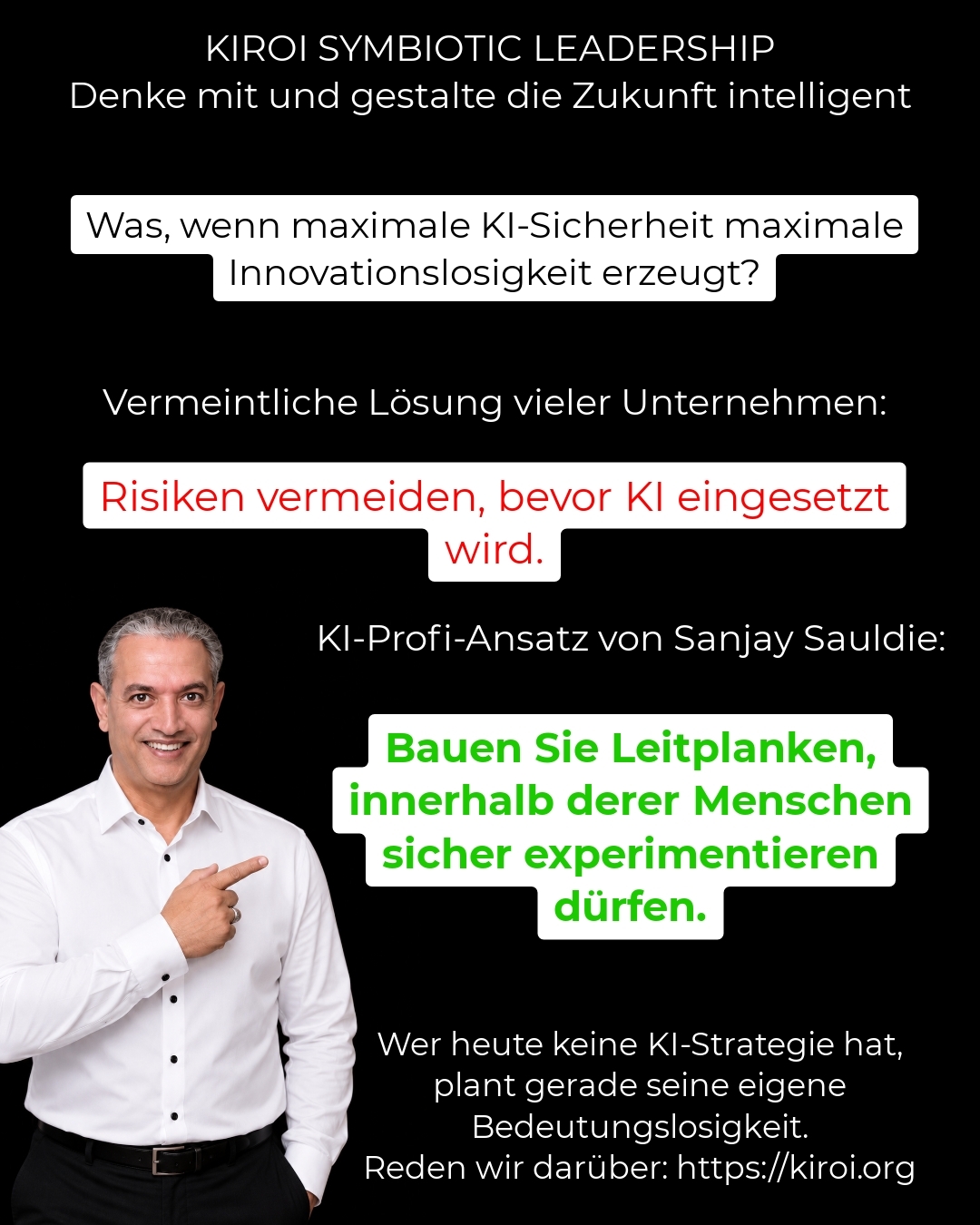
The AIROI-Masterplan takes a fundamentally different approach that combines safety and innovation. Instead of trying to eliminate all risks in advance, safe experimental spaces are created. These guiding principles define clear boundaries for permitted experiments. Within these limits, employees are free to experiment and learn. Mistakes are considered valuable learning opportunities and systematically evaluated. This approach enables rapid iteration while controlling risk.
Transruptions coaching helps organizations implement these experimental spaces. Leaders learn to define clear frameworks. Teams are given the freedom to innovate within these limits. One pharmaceutical company created a protected area for data analysis. A construction company tested planning tools in a limited pilot project. An educational institution tested new learning formats first with a small group.
Best practice with a AIROI customer
A medium-sized company from the manufacturing industry faced a typical dilemma that many organizations will be familiar with. The management wished to see more innovation in process optimization. At the same time, there was great concern about data privacy violations and quality issues. The IT department blocked any proposal with security concerns. The production department complained about a lack of support for digitalization. Through transruptive coaching, a clearly defined experimental space was created. This included a single production area with limited data volume. The guidelines were developed jointly with all stakeholders and documented. IT security, quality management, and production defined acceptable limits for experiments. Within these limits, the team received complete freedom of action without lengthy approval procedures. After three months of controlled experimentation, a remarkable change was observed. The efficiency in the pilot area increased by twelve percent compared to the same period last year. Not a single serious safety incident occurred during the entire testing phase. The model is now being gradually expanded to other business areas. The employees report increased motivation and self-responsibility in their daily work.
The principles of effective guidelines
Successful guidelines are characterized by certain characteristics that ensure their effectiveness. They are clearly formulated and understandable to all involved. They clearly define both permitted and prohibited actions. They leave sufficient room for creative solutions. They are regularly reviewed and adapted as needed. A chemical company formulated guidelines for handling process data. A media house defined limits for automated content production. A tourism provider established rules for personalized customer interaction.
Transruptions coaching supports the participatory development of these guidelines. Employees are involved from the very beginning of the process. Concerns and fears are heard and taken seriously. At the same time, opportunities and potential are systematically explored. The result is guidelines that are supported by everyone. A retailer developed rules for data-driven assortment planning. A craft business defined limits for digital customer support. A nursing home developed guidelines for technical support systems.
Practical implementation of the AIROI strategy
The concrete implementation follows a structured approach that has proven effective in practice [1]. First, existing bottlenecks and their causes are analyzed. Subsequently, we jointly identify suitable areas for initial experiments. Clear success criteria and termination conditions are defined. The team receives the necessary resources and competencies. Regular reflection loops ensure continuous learning. A sports equipment manufacturer started with demand forecasting in a market segment. A building technology company started with energy optimization of a site. A food producer initially tested the quality control of a product line.
The AIROI-Masterplan emphasizes the importance of gradually expanding successful experiments [2]. Successes are documented and communicated within the company. Failures are analyzed and turned into improved guidelines. This iterative approach builds trust and reduces resistance. A textile company scaled successful pilot projects systematically. A printing company transferred proven patterns to new business areas. An event service provider adapted solutions for different event formats.
The role of the leader in Maximum AI security
Leaders play a crucial role in the success of this transformation [3]. They must have the courage to allow controlled experiments. They protect their teams from excessive interventions by other departments. They celebrate learning successes, even when they stem from mistakes. They create a culture of psychological safety within the team. A manager allowed his team to experiment on their own initiative. A sales manager shielded pilot projects from internal critics. An IT manager supported innovative ideas despite initial concerns.
Transruptional coaching supports leaders in this challenging change. Clients often report initial uncertainty about letting go. The coaching provides impulses for new leadership approaches and behaviors. Regular reflection sessions support the personal development process. One CEO overcame his need for control through targeted guidance. A department manager learned to frame errors as learning opportunities. A project manager developed new skills in dealing with uncertainty.
My AIROI Analysis
After my thorough analysis, a clear picture emerges of the current situation. The pursuit of absolute security paradoxically leads to greater risk. Companies that want to avoid any mistakes lose their adaptability. They become vulnerable to disruptive changes in their market environment. The AIROI-approach with its defined experimental spaces offers a pragmatic solution. It combines the legitimate need for control with the necessary freedom to innovate.
The experiences from numerous mentoring projects clearly confirm this assessment. Organizations that implement guidelines instead of absolute prohibitions develop more quickly. Their employees show higher commitment and more initiative. The rate of innovation increases measurably without risks spiraling out of control. At the same time, the error rate declines in the long run because systematic learning takes place. The key lies in the balance between freedom and responsibility. Transruptive coaching supports leaders in finding and maintaining this balance. The investment in safe experimental spaces pays off multiple times.
The future belongs to organizations that experiment with control rather than reflexively banning things. They will learn faster, react more adaptively, and ultimately conduct more successful business. AIROI This concept provides a proven methodological framework with clear structure.
Further links from the text above:
[1] AIROI-Master plan overview
[2] Transruption and digital transformation
[3] Leadership development at AIROI
Are you a leader and would you like to learn how you can genuinely introduce AI into your company in a valuable and sustainable way, away from the hype? Take part Contact us or read more blog posts on the topic Artificial intelligence here.








 Deutsch
 English (UK)