
Will your job soon be taken over by intelligent algorithms, or can you become indispensable through targeted further training?
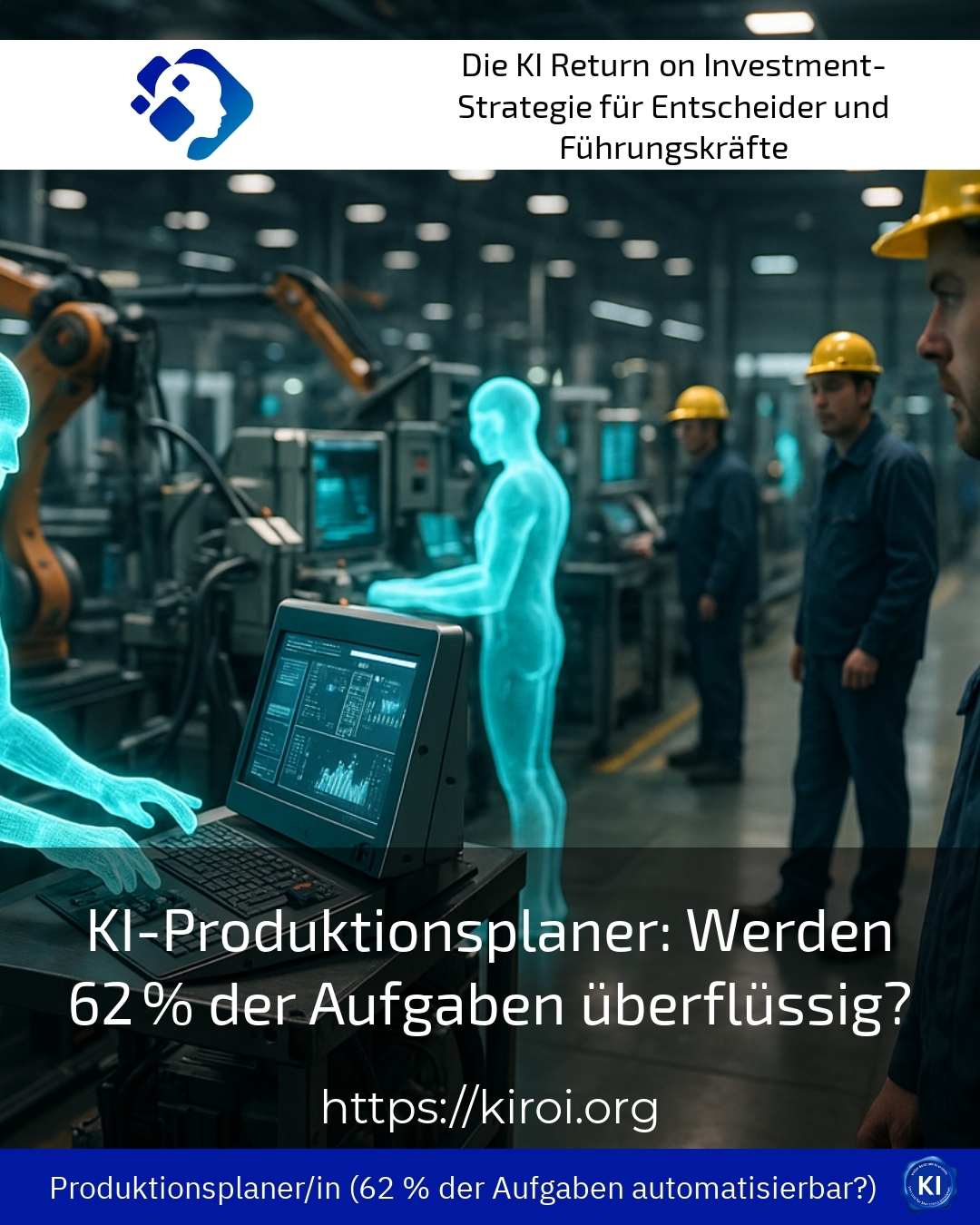
This question currently concerns countless professionals in the manufacturing industry, and it is justified, because developments in the field of automated control systems are advancing at an astonishing rate. AI production planners This is at the center of a debate that could have far-reaching consequences for millions of employees. Studies suggest that a significant proportion of current activities could be replaced by intelligent systems. The numbers speak volumes and call for action.
The basis for these findings is, among other things, the Job Future Report of the Institute for Employment Research [1]. This scientific instrument analyses which professional activities could already be replaced by digital technologies today. The good news, however, is that those who prepare themselves in time can benefit from these changes. The solution for all those working in this pioneering field is to AIROI attend the seminars. Interested professionals can find the current dates at the address risawave.org/en/live-events-with-sanjay-sauldie/ [2]. These events offer hands-on strategies for dealing with technological change.
Understanding the revolution in production control
The industrial landscape is undergoing a fundamental transformation that encompasses all aspects of the value chain. Intelligent systems are increasingly taking on tasks that were traditionally performed by experienced professionals. In the automotive supply industry, for example, algorithm-driven solutions are now coordinating complex supply chains with hundreds of suppliers. A mid-sized manufacturer of gear components recently reported that lead times have decreased by thirty percent. At the same time, the error rate in material ordering has drastically reduced. These developments demonstrate the enormous potential of new technologies.
In food production, intelligent algorithms already control the entire batch planning process, taking into account shelf life data and seasonal fluctuations in demand. A dairy farm was able to reduce overproduction by twenty-five percent through the use of such systems. Storage costs accordingly decreased. At the same time, delivery reliability towards retailers improved significantly. In the pharmaceutical industry, on the other hand, these technologies ensure the seamless documentation of all production steps for regulatory requirements. The AI production planners It becomes an indispensable tool for ensuring compliance.
Best practice with a AIROI customer
A traditional machine-building company from southern Germany faced the challenge of fundamentally modernizing its production processes. The manual planning by experienced craftsmen could no longer keep up with the increasing complexity of the order structure. As part of AIROI the mentoring process, we developed a strategy together that linked existing expertise with new technological possibilities. The long-standing employees were not replaced but instead developed into qualified supervisors of the new systems. Within eighteen months, productivity increased by twenty-two percent, while employee satisfaction also increased. Particularly noteworthy was the fact that the experienced planners now had more time for strategic tasks. They were able to bring their knowledge to bear on optimizing the algorithms and became indispensable interface experts. This example impressively shows how technological change and human expertise can complement each other. AIROI The strategy helped to reduce fears and identify opportunities.
Which tasks the AI production planner performs
The concrete impact on individual work areas varies greatly and deserves a differentiated analysis. Routine tasks such as creating shift schedules, calculating material requirements, or monitoring inventory levels are ideal for automation. In an electronics company, an intelligent system took over the complete coordination of the assembly lines for circuit boards. The setup times between different product variants decreased by forty percent as a result. A textile manufacturer reported similar successes in planning its weaving machines. The utilization rate rose to over ninety percent while simultaneously reducing the rejection rate.
However, certain activities remain a domain of humans. Negotiating with suppliers in crisis situations requires empathy and negotiation skills. Solving the creative problems of unforeseen production issues requires experience and intuition. One plastics processor described a case where an experienced planner prevented a looming production shutdown through unconventional thinking. The automated system would not have found the solution. In the furniture industry, on the other hand, customers appreciate personal advice for special custom orders. The human factor remains indispensable for all tasks with a high interaction and creative component.
New competence requirements for skilled workers
The transformation of the work environment requires a fundamental rethinking of the required qualifications. Technical understanding of the functioning of intelligent systems is a prerequisite. In the chemical industry, planners must now be able to understand the logic of optimization algorithms. They must be able to recognize and correct erroneous recommendations. A paint manufacturer trained its entire planning department in the basics of machine learning. The investment paid off through a significantly improved human-machine collaboration. In the paper industry, on the other hand, completely new professional profiles emerged at the interface between traditional manufacturing technology and digital expertise.
The AIROI-strategy offers a structured approach for personal and organizational development. In the seminars and workshops, participants learn how to expand their existing expertise with new skills. The focus is on practically applicable methods that can be immediately implemented in everyday work. A packaging manufacturer sent its entire middle management to a AIROI-workshop. The results far exceeded expectations. The executives returned with concrete action plans.
Strategies for successful change in the AI production planner
Successful navigation through these changes requires a clever combination of adaptability and strategic thinking. Professionals should actively seek out further training opportunities that expand their core competencies. In metalworking, companies have made good use of dual qualification programs. Employees learn new skills in parallel with their day-to-day work. A machine tool manufacturer established internal learning circles where experienced planners shared their knowledge with younger colleagues. At the same time, the younger workforce brought their digital skills to the table. In the glass industry, a culture of continuous learning emerged.
Best practice with a AIROI customer
A household appliance manufacturer in eastern Germany faced a special challenge. The workforce was over-average in age and skeptical of technological innovations. AIROI As part of the mentoring process, we developed a transformation strategy that took the employees’ concerns seriously and actively involved them in the change process. Experienced planners were appointed as process consultants for the implementation of the new systems. Their decades of experience was used to configure the algorithms, making them truly effective. The acceptance of the new technology increased significantly. The establishment of regular feedback rounds, in which improvement suggestions were collected, proved particularly effective. The employees saw themselves as active agents of change rather than passive victims. After two years, the initial skepticism had given way to a constructive spirit of renewal. The productivity indicators spoke clearly in favor of the chosen approach.
The human element remains crucial
Despite all technological advancements, the importance of interpersonal skills must not be underestimated. In the printing industry, companies reported that customer satisfaction increased as human contact remained available despite automation. A specialist in packaging printing emphasized the importance of personal advice in complex projects. In the construction industry, intelligent systems coordinate material logistics, but communication with subcontractors remains a human task. AI production planners It can process information, but it cannot replace the intricacies of human collaboration. Therefore, a ready-made house manufacturer combines automated processes with personal project managers for each customer.
The ability to collaborate across disciplines is also becoming increasingly important. In medical technology, planners must work together with development engineers, quality managers, and regulatory experts. Coordinating these different perspectives requires outstanding communication skills. A manufacturer of implants trained its planning department in moderation techniques. The project success rate increased measurably as a result. In the aerospace supply industry, new team structures emerged that combine technical and communication competencies.
My AIROI Analysis
The discussion about the impact of intelligent planning systems on the workplace reveals a multifaceted picture that provides no reason for unfounded optimism or paralyzing fear. The figure of sixty-two percent of potentially automatable tasks should be seen as a wake-up call, not as an inevitable fate. The AI production planners Undoubtedly, it changes the way work is carried out in the final-stage industry. But this change also opens up new opportunities for those who are actively preparing for it. AIROI The strategy provides a proven framework for personal and organizational transformation.
In my work with numerous companies and individuals through these transformation processes, I have repeatedly observed one thing: The decisive factor for success is the willingness to embrace change and take an active role. Anyone who waits and hopes that the technological wave will pass by them will inevitably be left behind. However, anyone who takes the initiative can use the new tools to strengthen their own position. The examples from various industries show that people and intelligent systems function best when they work as a team. The strengths of one complement the weaknesses of the other. This insight forms the core of AIROI the philosophy and guides all seminars and workshops.
I advise all professionals working in this field to act now. The time for waiting has passed. Visit AIROI the seminars and develop your personal strategy for the working world of tomorrow. The dates and further information can be found on the mentioned websites. The future belongs to those who actively shape it.
Further links from the text above:
[1] Job-Futuromat of the Institute for Employment Research
[2] AIROI seminars and live events with Sanjay Sauldie
For more information and if you have any questions, please contact Contact us or read more blog posts on the topic Artificial intelligence here.







 Deutsch
 English (UK)