
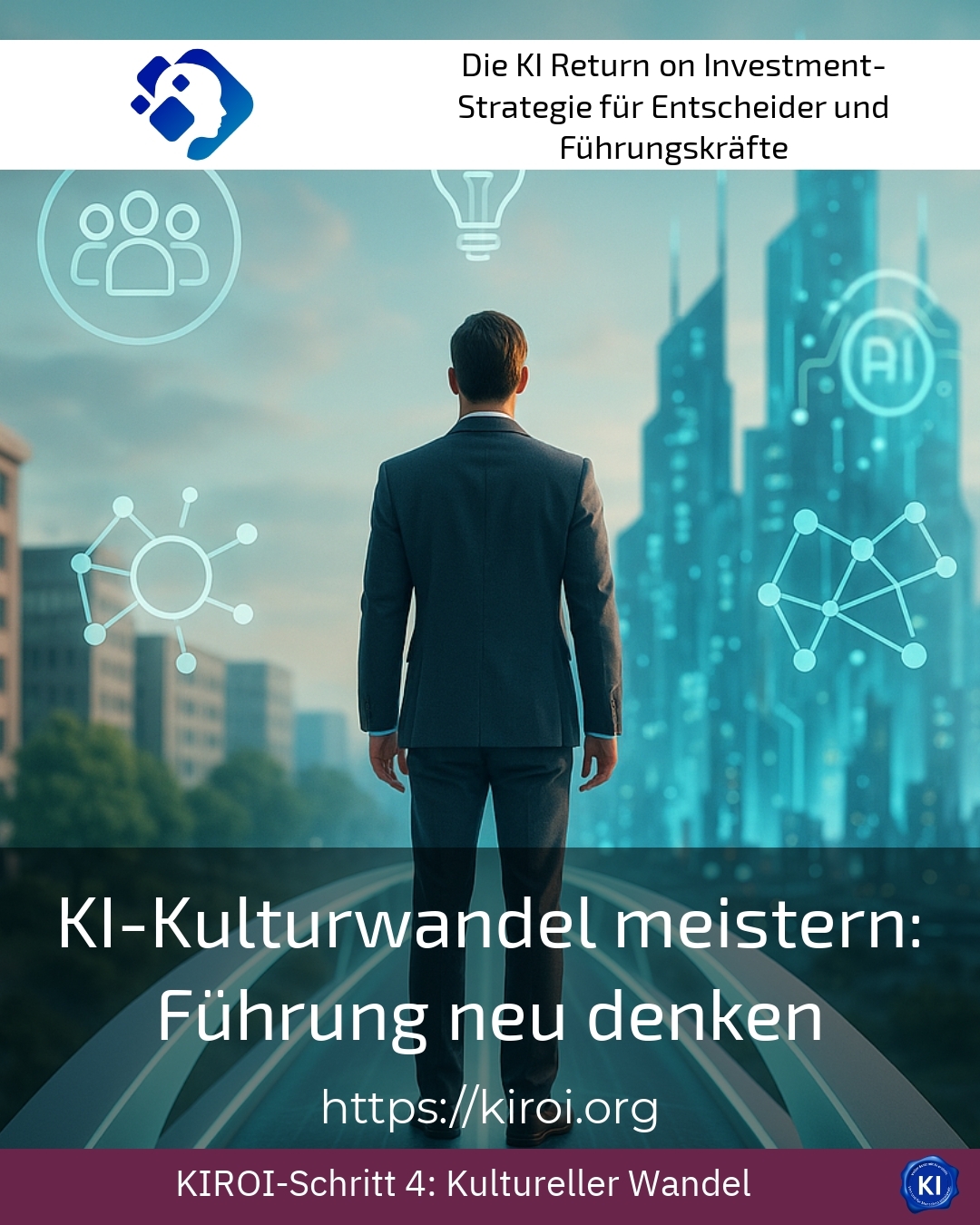
The digital revolution has long since begun, and it is changing everything we thought we knew about leadership. Companies face an unprecedented challenge: they must adapt to the new realities of the digital age. Mastering AI cultural change, While doing so, they also take their employees on this journey and inspire them. Many leaders report on uncertainty, resistance within teams, and the question of how they can remain authentic as the rules of the game fundamentally change. It is no longer just about technological implementation; it is about fundamentally reshaping corporate culture, communication, and the image of the people within organizations. Those who get the right things right today will be among the winners tomorrow because they have understood that real transformation always begins with the people and never ends with the machine.
Why traditional leadership models are reaching their limits
The classic view of leadership is based on hierarchy, control, and the principle of information dominance. For a long time, leaders were considered those who knew more than their employees. This model no longer works in a world of intelligent systems. Algorithms can now analyze data faster than any human. They can detect patterns that remain invisible to the human eye. Therefore, leaders must fundamentally rethink their role.
In many organizations, we are currently witnessing an interesting dynamic. Younger employees are using new technologies intuitively and efficiently. At the same time, experienced leaders struggle with uncertainty and sometimes even with fear. This tension can be destructive, but it also offers opportunities. Teams can learn from each other when the culture allows for it.
Clients often report feeling torn between innovation and preservation. They want to lead in a modern way, but they don’t know the new tools well enough. They want to empower their teams, but they’re afraid of losing control. This is where transruptive coaching can provide valuable guidance.
Best practice with a AIROI customer
A medium-sized company with about three hundred employees faced the challenge of fundamentally transforming its leadership culture. The management team had realized that traditional decision-making processes had become too slow. At the same time, the pressure to integrate innovative technologies more quickly was growing. As part of a transruptive coaching process, we supported the senior management team over several months. First, we jointly analyzed the existing leadership patterns and their impact on the corporate culture. It became clear that many leaders were unconsciously clinging to outdated control mechanisms. They did so not out of malice, but because they did not know alternative models. Through targeted reflection exercises and practical experiments, the participants developed a new self-concept. They learned to understand trust as a strategic resource and to delegate decision-making competencies more effectively. After six months, the employees reported a noticeably improved level of cooperation and greater self-responsibility.
Mastering the transformation of AI culture: New competencies for leaders
Modern leadership requires an expanded skill set. Technical knowledge is only one component among many. Much more important are emotional intelligence, ambiguity tolerance, and the ability to continuously self-reflect. Leaders must learn to deal with uncertainty productively. They must accept that they don’t know everything.
A core competency is so-called systemic thinking. Leaders should understand how different elements of an organization interact. They should be able to recognize the impact that changes in one area have on other areas. This understanding is especially important when new technologies are introduced.
Furthermore, the ability to inspire meaning is becoming increasingly important. Employees are asking more than ever before why they are doing what they do. They want to understand the contribution their work makes to the greater whole. Leaders must be able to answer these questions of meaning. They must develop and communicate a compelling vision.
Communicative excellence is also becoming increasingly important. In times of change, people need clear, honest, and inspiring messages. Leaders should learn to explain complex relationships in a comprehensible way. They should also be able to convey difficult news with empathy and respect. The quality of leadership communication significantly influences whether changes succeed or fail [1].
Trust as the foundation of cultural change
Without trust, any transformation fails. Employees must be able to trust that changes are not primarily directed against their interests. They must feel that their management communicates honestly and transparently. This trust does not arise automatically; it must be actively built.
Building trust requires consistency between words and actions. Leaders should keep their promises. They should openly admit mistakes and learn from them. They should also stand by their teams in difficult situations.
Another important aspect is psychological safety. Employees should feel free to ask questions and express concerns. They should be allowed to experiment without being punished for failure. Leaders can foster this safety by demonstrating vulnerability and authenticity themselves.
Practical approaches for organizational change
Cultural change cannot be imposed, but it can be shaped and accompanied. Successful organizations combine different approaches. They invest in continuing education and create experimental spaces. They reward desired behavior and regularly reflect on their progress.
A proven method is the establishment of pilot projects. Small teams can try out new working methods. Their experiences are documented and shared. Successful practices are then gradually transferred to other areas. This approach reduces risks while simultaneously creating opportunities for learning.
The physical and virtual work environment also influences culture. Open spaces can promote collaboration. Digital tools can improve transparency and the flow of information. Leaders should consciously shape these influencing factors.
Best practice with a AIROI customer
A service company wanted to strengthen its innovation culture and approached us for transruptive coaching. The starting point was challenging: employees were afraid to introduce new ideas because they feared negative consequences. The management recognized that this culture represented a massive obstacle to the necessary development. Together, we developed a multi-stage program for cultural change. In the first step, we conducted anonymous surveys to identify the actual obstacles. The results were surprising and, in some cases, disappointing for many leaders. In the second step, we established so-called innovation circles, where employees from all levels of the hierarchy worked together on improvement proposals. These circles received explicit protection from the management. No idea could be rejected without being thoroughly examined first. In the third step, we trained the leadership in constructive feedback and appreciative communication. After one year, the number of improvement suggestions submitted tripled, and employee satisfaction significantly increased.
Master the AI cultural transformation through continuous learning
Learning organizations have a crucial advantage. They can adapt more quickly to changed conditions. They use mistakes as opportunities for development. They promote knowledge exchange between different areas and hierarchical levels [2].
Leaders play a central role in establishing a learning culture. They should be visible as learners themselves. They should provide time and resources for further education. They should also encourage and recognize informal learning in the workplace.
Modern learning formats combine various elements. Traditional training is complemented by mentoring programs and peer learning. Digital learning platforms enable self-directed learning. Reflection rounds and after-action reviews help to systematically learn from experiences.
Don't forget the human dimension
With all the enthusiasm for technological possibilities, the human dimension must not be neglected. Changes evoke emotions. Some employees react with enthusiasm, others with concern or resistance. All of these reactions are legitimate and deserve attention.
Leaders should schedule time for personal conversations. They should listen before arguing. They should show understanding for fears and concerns. At the same time, they should also provide clear direction and radiate confidence.
The balance between empathy and determination is challenging. Too much understanding can be interpreted as weakness. Too much severity can increase resistance. Experienced leaders develop a sense of the right balance in different situations [3].
My AIROI Analysis
The transformation of leadership and corporate culture is one of the greatest challenges of our time. Organizations that successfully manage this change will remain competitive in the long run. Those who hesitate or cling to outdated models risk their future viability. My experience from numerous consulting projects shows that success depends less on the chosen technology and more on the quality of leadership and corporate culture.
What seems particularly important to me is the realization that true Mastering AI cultural change It means putting people at the center. Technology is a tool, nothing more and nothing less. It can expand and support human capabilities. But it can never replace human leadership qualities such as empathy, inspiration, and ethical judgment.
Leaders should see themselves as guides, not all-knowing authorities. They should create spaces where people can grow and realize their potential. They should be brave enough to question old certainties and explore new paths. At the same time, they should be wise enough not to throw tried-and-true values and principles overboard lightly.
Transruptive coaching can provide valuable support during this demanding process. It helps leaders recognize and reflect on their own patterns. It provides impulses for new ways of thinking and acting. It accompanies the practical implementation and offers a safe space for experimentation and learning. Those who take the cultural change seriously and approach it consistently will not only transform their company but also grow personally.
Further links from the text above:
[1] Harvard Business Review – Leadership Insights
[2] McKinsey – People and Organisational Performance
[3] MIT Sloan Management Review – Leadership Research
For more information and if you have any questions, please contact Contact us or read more blog posts on the topic Artificial intelligence here.









 Deutsch
 English (UK)