
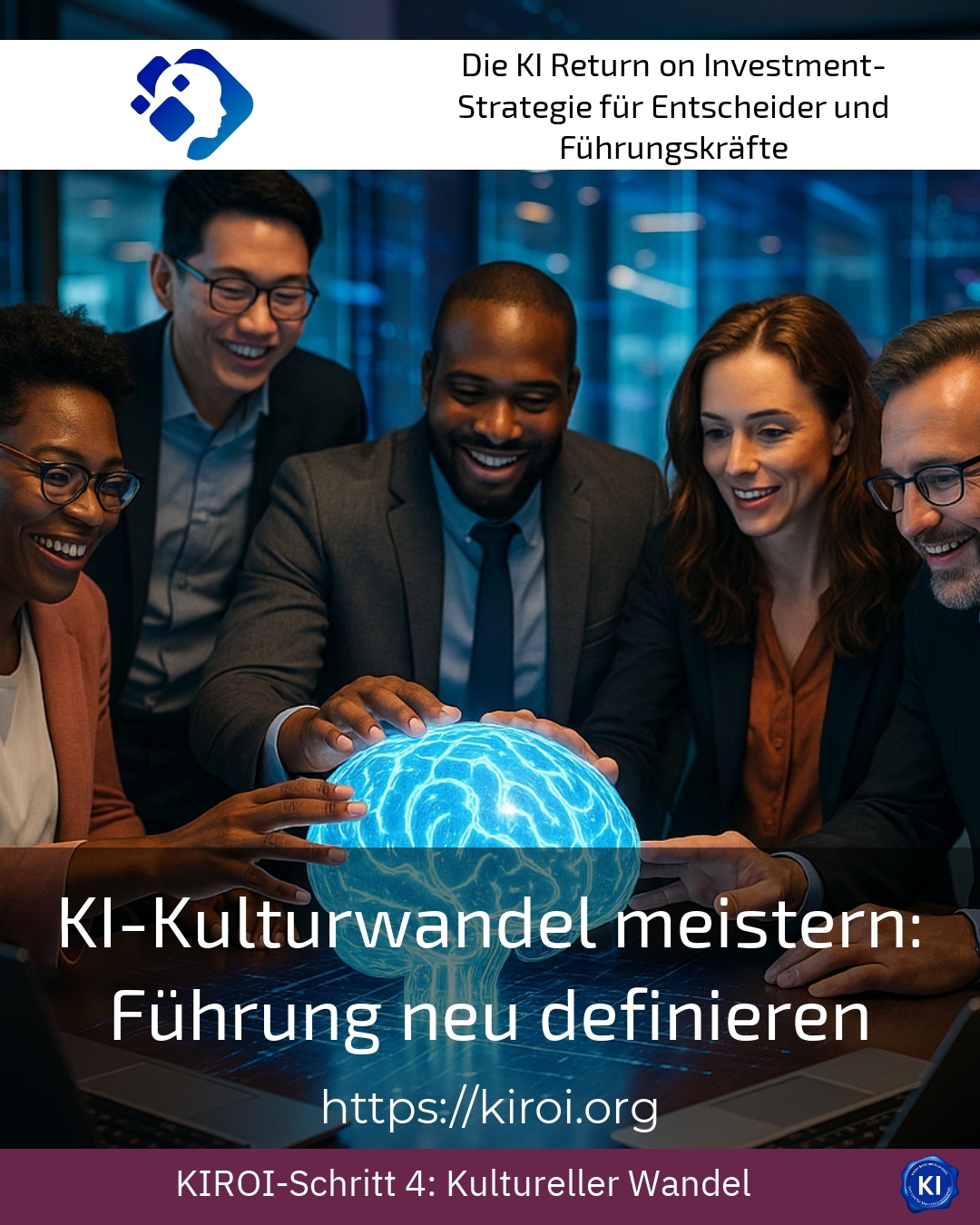
The world of business is changing faster than ever before. Algorithms are taking over decisions that used to require months of analysis. Executives are facing the biggest transformation of their careers. The Mastering AI cultural change This becomes a core competency that determines success and failure. Anyone who believes that technological implementation alone is sufficient underestimates the fundamental human dimension. Employees fear for their positions, while new role models are emerging at the same time. This tension between tradition and innovation requires a completely new way of leadership. In the next few minutes, you will learn how forward-thinking organizations are tackling this challenge.
The transformation of leadership in the digital age
Traditional hierarchies are increasingly losing their relevance in a connected work world. Leaders must fundamentally rethink and redefine their role. Instead of issuing instructions, they become facilitators and mentors. A medium-sized manufacturing company in the mechanical engineering sector recognized this need early on. The management team consistently invested in the development of its leadership level. This involved not only technical knowledge but also emotional intelligence. The results surprised even skeptical observers. A logistics company with multiple locations underwent a similar process. The branch managers learned to let teams work independently. Trust gradually replaced the strict control of past days. A financial services provider, in turn, trained its department managers in agile methods. This investment paid off through higher employee satisfaction.
The ability to tolerate uncertainty is becoming a key competence of modern leadership. Decisions often have to be made based on incomplete information. At the same time, employees expect guidance and clear communication. This apparent contradiction requires a new understanding of leadership. It involves accompanying processes rather than presenting results. The Mastering AI cultural change It also means understanding mistakes as learning opportunities. Organizations that establish a constructive culture of error benefit in the long run. They develop innovation power and resilience alike. Leaders must lead by example and address their own uncertainties.
Mastering communication as the foundation of AI cultural transformation
Open and transparent communication forms the foundation of any successful transformation. Employees must understand why changes are necessary. However, even more important is the question of personal benefit. A retail company therefore began regular dialogue rounds with all employees. These formats enabled genuine exchange instead of one-sided information. Concerns and fears found a protected space. A healthcare provider used similar formats for its caregivers. The response exceeded all expectations significantly. A technology company established weekly team discussions without a fixed agenda. This gave spontaneous topics the necessary space.
The quality of communication determines acceptance or resistance. Abstract visions rarely reach the operational level. Concrete examples and personal stories, however, have a lasting effect. Therefore, leaders should continuously develop their communication skills. Professional guidance can provide valuable impulses in this regard. transruptions coaching specifically supports leaders in addressing such communication challenges. The methodology combines proven approaches with innovative elements. Often, clients report noticeable improvements within a few weeks.
Best practice with a AIROI customer An internationally operating industrial company with over three thousand employees faced a comprehensive digital transformation that affected all business areas and required fundamental changes in the way of working. The management recognized early on that technological implementation alone would not be sufficient. Therefore, it decided on intensive support through transruptive coaching over a period of eighteen months. The focus was initially on the leadership level, who had to learn to actively shape changes instead of merely managing them. The coaches worked closely with the department managers and developed individual development plans. Regular reflection rounds enabled continuous adjustments to the approach. Cross-departmental workshops, which broke down silo thinking, proved particularly valuable. Employee satisfaction increased measurably, while productivity simultaneously increased. At the end of the process, the leaders reported a completely new understanding of their role. They felt empowered to independently lead and shape future changes.
Understanding and constructively using resistance
Every change generates resistance, and that is completely normal. Resistance often signals underlying needs or unspoken fears. Wise leaders use these signals as valuable sources of information. An insurance company made this experience when introducing automated claims processing. The claims officers initially feared losing their expertise. However, intensive discussions revealed other concerns. It was about recognition and professional identity. A construction company experienced a similar situation when digitizing its planning processes. The experienced construction managers initially felt devalued. A media company, on the other hand, faced resistance in the editorial department. Journalists felt their creative work was threatened.
Constructive handling of resistance requires patience and empathy. Quick solutions rarely work sustainably. Instead, it takes continuous relationship-building. Leaders must show authentic interest in their teams’ concerns. At the same time, they must not delay necessary changes indefinitely. Finding this balance presents many significant challenges. Professional guidance can provide crucial support in this regard. Clients often report new perspectives on stuck situations.
New skills for a changing work world
The requirements for employees are fundamentally changing. Routine tasks are losing importance, while creative problem solving becomes more important. Managers must actively accompany and encourage this development. A chemical company invested heavily in the further training of its laboratory staff. They learned to monitor and optimize automated analysis systems. A retail company trained its purchasing managers in data-driven decision making. The combination of experience and analytical skills proved to be successful. An energy provider developed completely new job profiles for its grid planning. Technical understanding and communicative skills were equally important.
The development of new competencies requires time and adequate resources. Many organizations significantly underestimate this aspect. They expect quick results without sufficient investment. This attitude regularly leads to frustration at all levels. To overcome this Mastering AI cultural change To be able to do this, long-term perspectives are needed. Leaders must enable and protect learning processes. They should create spaces for experimentation and development. transruptions coaching supports organizations in designing such learning environments.
Best practice with a AIROI customer A medium-sized family business in the field of precision mechanics faced the challenge of integrating its traditional corporate culture with modern working methods. The third generation had taken over the management and wanted to introduce changes carefully without alienating long-standing employees or devaluing their valuable expertise. The company decided to collaborate with transruptions-Coaching to professionally accompany this sensitive process. First, detailed discussions were held with employees at all levels of the hierarchy to gain a comprehensive picture of the existing culture. Building on this, the coaches worked with the management to develop a step-by-step transformation plan that combined tradition and innovation. Particularly important was the involvement of experienced skilled workers as mentors for new processes and technologies. This appreciation of her expertise had a positive impact on the entire workforce and created a constructive atmosphere for change. After about a year, both management and employees reported a noticeably improved collaboration and a higher level of innovation.
The importance of psychological safety
Psychological safety describes a climate in which people can take risks. They dare to ask questions and admit mistakes. This safety forms the foundation for innovation and learning [1]. A software company made this experience when switching to agile development methods. Only when team members could speak openly about difficulties could collaboration improve. A pharmaceutical company established similar structures in its research departments. The willingness to share even failed experiments accelerated the acquisition of knowledge. A consulting firm, in turn, fostered an open feedback culture at all levels. Junior consultants dared to constructively question their partners.
Creating psychological safety requires consistent leadership behavior. Individual breaches of trust can undo years of building work. Therefore, leaders must handle critical situations with particular care. They should not punish mistakes, but use them as learning opportunities. This attitude must be lived authentically, because employees immediately notice inconsistencies. The Mastering AI cultural change This can only be achieved in an environment that allows experimentation. Professional guidance helps leaders create such environments.
Ethical Dimensions of Technological Transformation
Technological changes always raise ethical questions that need to be answered. Who is responsible for automated decisions? How are jobs designed and maintained [2]? A mobility company developed a comprehensive ethical framework for its digital services. Engaging with various stakeholders proved valuable. A grocery store addressed data transparency questions for customers. The decision to maximize openness significantly strengthened customer confidence. A telecommunications company established an ethics committee for fundamental technological issues. This committee deliberately included external perspectives.
Leaders must understand ethical reflection as part of their responsibility. It is not enough to delegate decisions to specialist departments. The management team must set clear values. At the same time, there should be room for dialogue and critical discussion. Finding this balance requires maturity and self-reflection. transruptions coaching also supports leaders in dealing with these challenging issues.
My AIROI Analysis
Coaching numerous transformation projects has given me deep insights into success factors and stumbling blocks. Organizations that achieve sustainable change are characterized by common characteristics that I would like to summarize here. They consistently invest in the development of their leadership. They create spaces for open dialogue and constructive discussion. They understand that technological implementation is only one part of the overall task. The human dimension receives at least equal attention. Resistance is not combated but used as a valuable source of information. Communication takes place transparently, continuously, and at eye level with all stakeholders.
At the same time, I observe typical mistakes that endanger or lead to the failure of transformations. Excessive time pressure prevents the sustainable anchoring of new behaviors. The lack of resources for competence development generates frustration and overwork. Inconsistent leadership behavior undermines the trust of the workforce. These findings are continuously integrated into my consulting work. The AIROI-approach combines systematic analysis with practice-oriented implementation support. Leaders receive concrete tools for their daily work. At the same time, underlying patterns and beliefs are reflected. This combination of pragmatism and depth enables sustainable change.
Further links from the text above:
[1] Harvard Business Review: High-Performing Teams Need Psychological Safety
[2] World Economic Forum: The Future of Jobs and AI
For more information and if you have any questions, please contact Contact us or read more blog posts on the topic Artificial intelligence here.











 Deutsch
  English (UK)