
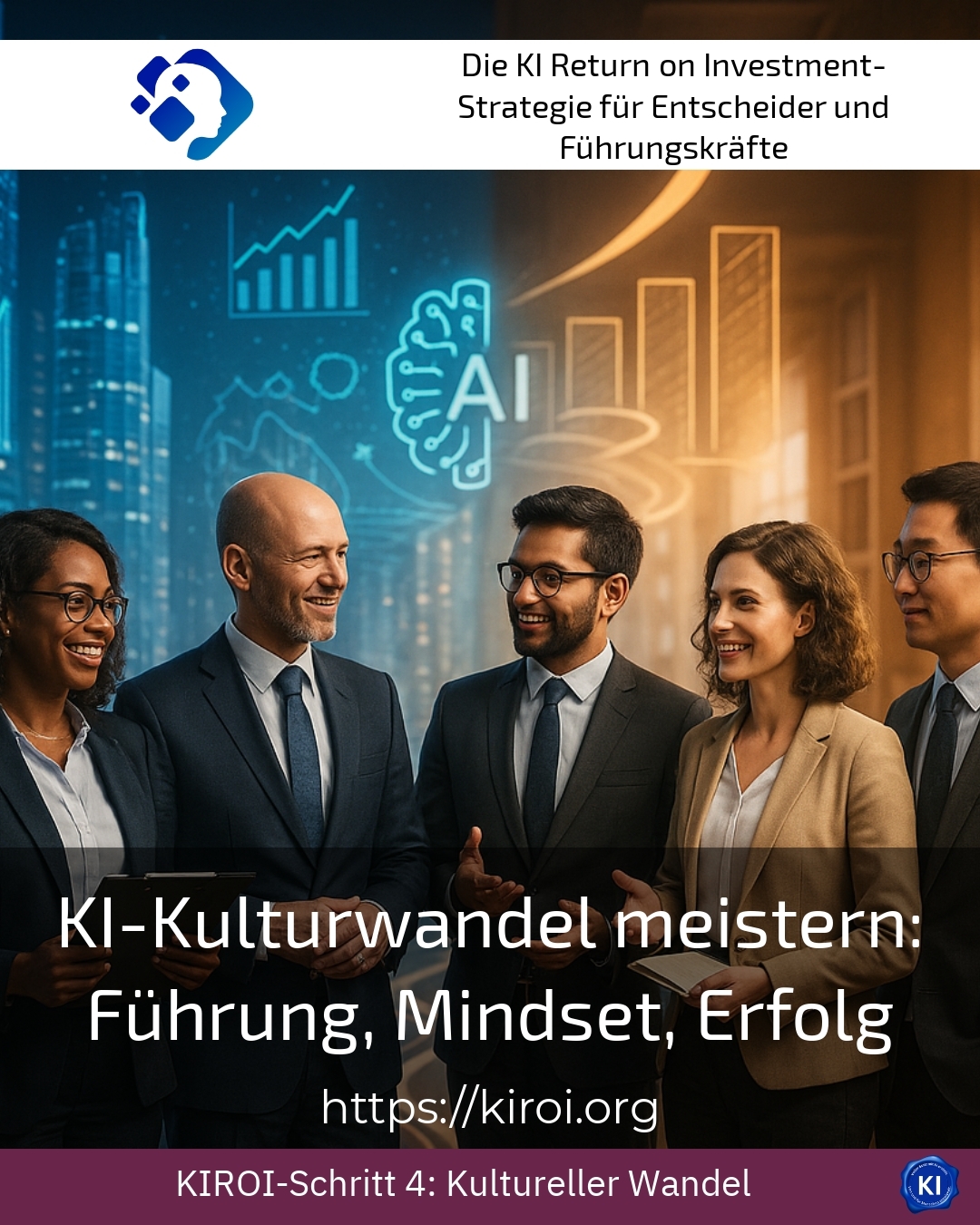
Imagine your entire organization is at a crossroads that will determine the future viability of your company. The integration of intelligent technologies not only changes processes, but also people, teams, and entire corporate cultures. This is exactly where the topic comes into play. Mastering AI cultural change: leadership, mindset, success Because without the right attitude and proactive leadership, any technological innovation remains ineffective. Clients often report that they feel overwhelmed by the speed of change. They are looking for guidance and concrete impulses for their daily work. This article will guide you through the essential aspects of a successful transformation.
Understanding the fundamentals of a new corporate culture
Any profound change in a company begins with an understanding of one’s current situation, because only those who know their current status can formulate realistic goals and initiate the right steps. Many organizations underestimate the importance of the cultural dimension and focus exclusively on technical implementations. However, technology alone does not change mindsets and create new behaviors among employees.
In the manufacturing industry, this is particularly evident. For example, a medium-sized machine manufacturer introduced predictive maintenance systems. The technology worked flawlessly, but the service technicians did not trust the predictions. They continued with their usual inspection routines. Only when management began actively involving employees did the behavior change. In the financial sector, we observe similar patterns in the introduction of automated credit decision systems. The employees initially felt threatened and replaced by the new systems. They developed resistance to the changes. However, through open communication and clear role redefinitions, this resistance could be reduced.
Retail also offers enlightening examples of cultural challenges in digitalization. A large department store chain implemented intelligent inventory management systems. The store managers should have followed the algorithmic recommendations. However, many ignored the suggestions and relied on their own experience. The solution lay not in stricter regulations but in training and evidence of success.
Best practice with a AIROI customer A traditional family-run food production company faced the challenge of modernizing its quality control, with long-standing employees initially being very skeptical about the change. The company chose a cautious approach and initially formed internal ambassadors who were to act as a bridge between the new technology and the existing workforce. These ambassadors received intensive training and understood both the technical possibilities and the concerns of their colleagues. In weekly discussion sessions, concerns could be openly addressed, and the employees were given the opportunity to contribute their expertise. After six months, acceptance had significantly increased, as people had understood that the new technology supported their work and not replaced it. The error rate in production decreased measurably, and employee satisfaction even increased. This example impressively demonstrates how important a culturally sensitive approach to transformation is for the sustainable success of technological changes.
Mastering AI cultural change through effective leadership
Leaders play a key role in every transformation process, because their own behavior and communication significantly shape how changes in the organization are accepted and implemented. An authoritarian leadership style, which mandates new changes from above, leads in most cases to resistance and passive refusal on the part of employees. Modern leadership instead relies on participation, transparency, and an open culture of error.
This is particularly evident in the healthcare sector. Hospitals that introduce diagnostic support systems need chief physicians who use these tools themselves. If the management level remains skeptical, the subordinate physicians also do not adopt the new systems. A network of clinics in southern Germany took the lead with a good example. The clinic directors presented case studies in person where the new systems had provided valuable insights. The acceptance rate increased significantly as a result.
The importance of exemplary leadership is also evident in the logistics industry. A major package delivery service introduced optimized route planning systems. The dispatchers were supposed to adopt the algorithmically calculated routes. However, many doubted the usefulness of the new route guidance. The branch managers then drove some of the new routes themselves and documented their experiences. This practical demonstration convinced many doubters.
The insurance industry offers further instructive examples of effective leadership in a changing world. One insurance company implemented automated claims processing systems. The claims handlers feared that their expertise would be devalued. The department heads responded by showing new career paths. They created specialist roles for complex claims cases that required human expertise. This strategic communication took away the employees’ fears about their future.
Developing the right mindset for change
In addition to the top management level, the individual attitude of each employee plays a crucial role in the success of transformation projects, because even the best strategy fails if the people in the organization are not willing to take new paths and abandon old habits. A growth-oriented mindset that understands challenges as learning opportunities forms the foundation for successful change processes.
In the media industry, this is particularly evident. Journalists at major publishing houses had to learn to work with automated research tools. Some viewed this as a threat to their journalistic integrity. Others recognized the opportunity to gain more time for in-depth research. The newsrooms that specifically fostered a positive mindset recorded higher satisfaction and better results.
The education sector also provides insightful insights into the topic of mindset. Teachers in schools and universities face the challenge of integrating adaptive learning systems into their teaching. Some educators see this as undermining their authority. Others use the insights gained about learning progress to improve their teaching. The difference lies not in the technology, but in the internal attitude.
We are also seeing interesting developments in the legal sector regarding the mindset. Law firms are increasingly relying on automated contract analysis and document review. Young lawyers who have grown up with digital tools adapt faster. Experienced partners often show more skepticism. Successful law firms create intergenerational teams where both parties can learn from each other.
Mastering AI cultural change: Making success measurable
Defining and measuring success presents significant challenges for many organizations, because traditional metrics often are not sufficient to reflect the actual progress of a cultural transformation, and because qualitative changes are not always expressed in numbers. It is therefore advisable to develop a balanced set of quantitative and qualitative indicators.
The automotive industry provides instructive examples here. Suppliers that implement intelligent manufacturing systems first measure classic production metrics. But employee satisfaction and innovation readiness are also recorded. One southern German automotive supplier introduced regular pulse surveys. These revealed early on where cultural barriers hindered the technological implementation.
In the banking sector, we can observe how differentiated performance measurement works. In addition to the processing speed of customer inquiries, advanced institutions also measure the quality of customer interactions. They analyze how well employees and automated systems work together. An international bank developed its own transformation index that combines technical and cultural factors.
The pharmaceutical industry demonstrates how complex performance measurement works in regulated environments. Companies that deploy automated systems in research and development must meet regulatory requirements. At the same time, they want to increase acceptance among scientists. Therefore, they measure not only compliance metrics, but also the usage intensity and feedback from researchers.
Best practice with a AIROI customer An international energy provider faced the challenge of modernizing its entire network control system while familiarizing experienced engineers with the new capabilities without losing their valuable expertise. The challenge was to initiate a cultural change that would involve both younger, technology-savvy employees and experienced professionals. The company developed a multi-stage transformation program with us that combined various learning formats and participation opportunities. Particularly successful was the establishment of innovation labs where mixed teams could test and optimize new applications. The experienced engineers brought their process knowledge, while the younger colleagues contributed technical expertise. This collaboration not only led to better technical solutions, but also to a deeper mutual understanding and respect between the generations. After a year, the executives reported a significantly improved collaboration and a higher level of innovation in all departments.
Understanding and constructively using resistance
Resistance to change is a natural human response and should not be viewed as an obstacle, but as valuable feedback that points to unresolved problems or overlooked concerns. Wise leaders learn to read resistance and understand the underlying needs. They use critical voices as a resource for improvement.
In the construction industry, this is evident in the introduction of Building Information Modeling and related technologies. Experienced construction managers expressed concerns regarding the practicality of digital planning tools. Instead of dismissing these concerns, a large construction company invited skeptical employees to join the development teams. Their practical objections led to important improvements in the systems.
The tourism sector offers further examples of how to deal constructively with resistance. Travel agencies that introduce automated booking support initially experience skepticism from experienced travel consultants: they fear that personal advice will be devalued. One tour operator reacted by involving the consultants in system optimization. Their expertise made the automated recommendations significantly better.
Lessons can also be found in the restaurant industry. A restaurant chain implemented intelligent ordering systems. The waiters criticized that the systems interfered with the atmosphere and personal contact. The management took this criticism seriously and adjusted the system configuration accordingly. The technology now specifically supports where relief is desired and takes a back seat when important interactions with guests occur.
The accompaniment through transruptional coaching
In complex transformation projects, professional guidance can make the crucial difference, because external perspectives can reveal blind spots and bring in proven methods that may not be available internally. Transruptions coaching positions itself as a reliable companion for projects involving cultural and technological changes. It provides inspiration and support without imposing ready-made solutions. [1]
The telecommunications industry demonstrates how external support can work. A network operator wanted to transform its customer service. Internal attempts had failed repeatedly. Only the inclusion of external support brought about the breakthrough. The coaches helped break down hardened attitudes and establish new communication channels.
In the trade sector, we observe similar dynamics. A tradesman’s business with several branches introduced digital tools for order management and customer communication. The older masters were skeptical. External guidance helped to bring together the different perspectives and find a common path.
Non-profit organizations also benefit from professional support in transformation processes. A large aid organization wanted to modernize its donation management system. The employees feared that their personal relationship with donors would suffer. Coaching support helped address these concerns and develop a value-aligned transformation path. [2]
My AIROI Analysis
The examination of the topic Mastering AI cultural change: leadership, mindset, success It clearly shows that technological innovations, without accompanying cultural change, rarely can reach their full potential, and that the human dimension should be at the center of all transformation projects. From my perspective as a consultant and mentor to numerous organizations, I can confirm that the most successful transformations are those in which people are viewed not as an obstacle to implementation, but as a central resource. The examples from various industries impressively demonstrate that cultural challenges occur across industries and require similar solutions.
What seems particularly important to me is the realization that resistance to change should not be combated but understood and used constructively. The critical voices within an organization often bring important knowledge about practical challenges and unresolved problems. Leaders who learn to value and integrate this feedback create more sustainable and better solutions. The role of leadership cannot be overstated here, as employees orient themselves on the behavior of their superiors and not on their words. A growth-oriented mindset at all levels of the organization forms the foundation for successful change. I therefore recommend that all organizations facing profound transformations invest sufficient time and resources in the cultural dimension of their projects. The technical implementation is often the easier part. Sustainable success is decided in the minds and hearts of people.
Further links from the text above:
[1] Transruptions Coaching – Support for change projects
[2] AIROI-Master plan for sustainable transformation
For more information and if you have any questions, please contact Contact us or read more blog posts on the topic Artificial intelligence here.










 Deutsch
  English (UK)