
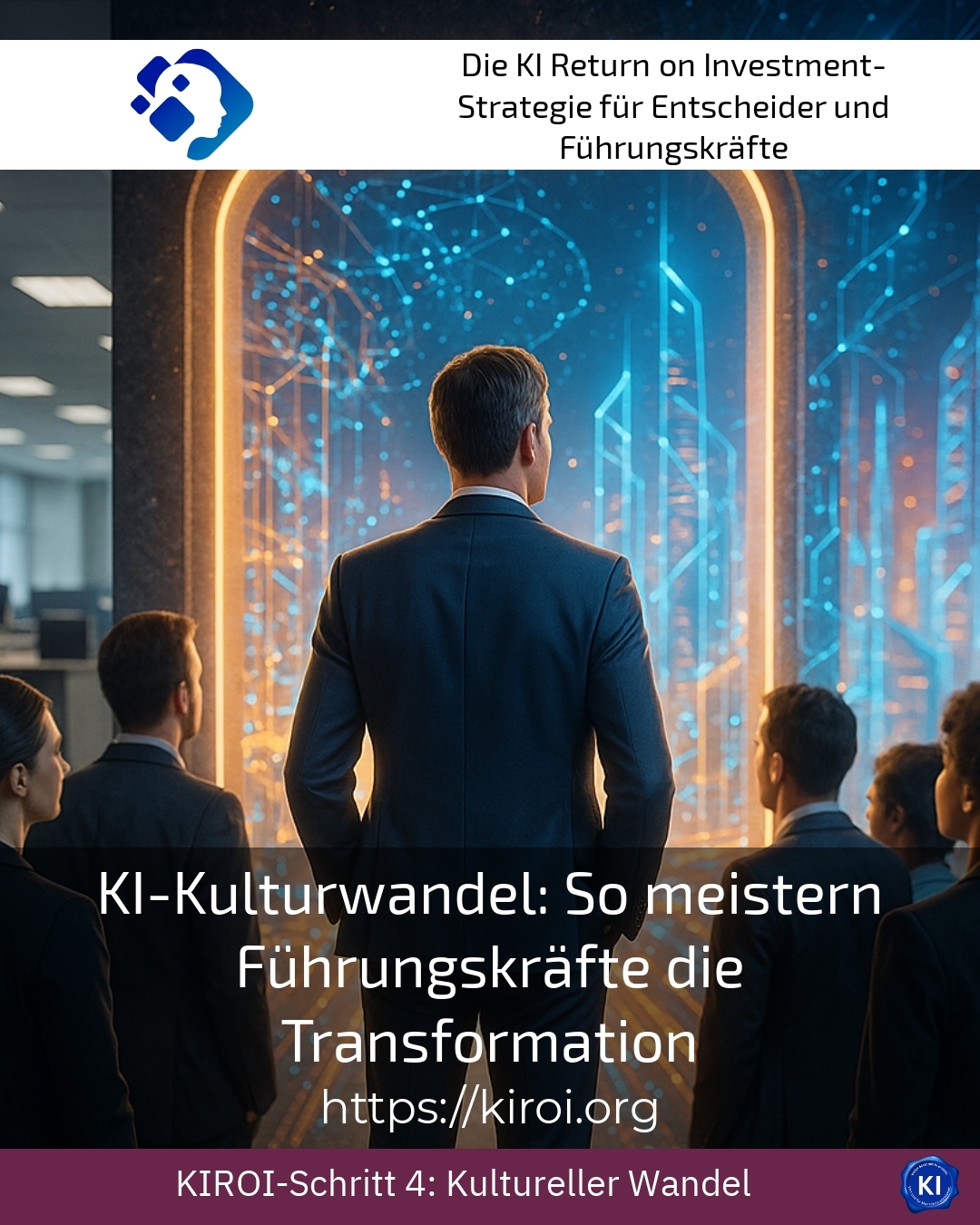
Imagine that you enter your office in the morning and everything has changed. Your employees suddenly work with intelligent systems that were unthinkable just a few years ago. The AI cultural change It is capturing companies of all sizes at a speed that even experienced executives are surprised by. Yet while some organizations perceive this transformation as a threat, others see it as a unique opportunity for reinvention. The crucial question is no longer whether change is coming, but how you can actively shape it. Many leaders come to us with this very issue. They are seeking guidance in a time of upheaval and need concrete impulses for their organization.
Understanding and accepting the new reality
Change always starts in the minds of those responsible. Leaders must first reflect on their own attitude towards technological changes. Often, an interesting pattern emerges. Those who themselves have fear of change unconsciously transfer it to their team. Transruptive coaching helps leaders recognize and overcome their internal resistance. In practice, many clients report initial overwhelm and a sense of losing control. These emotions are completely normal and even serve as the starting point for real change.
Take the example of a medium-sized machine engineering company. The management realized that intelligent systems could revolutionize quality control. At the same time, long-standing employees feared for their jobs. A trading company faced similar challenges when implementing automated warehouse management. And in an insurance company, experienced claims handlers resisted algorithmic decision support. These examples show that resistance occurs across industries and must be professionally managed [1].
Best practice with a AIROI customer A traditional family business in the manufacturing sector approached us with a specific challenge. The third generation had taken over the management and wanted to introduce modern technologies. However, this wish met with considerable resistance from the long-standing workforce. As part of our support, we first analyzed the existing corporate culture and identified the most important drivers. We jointly developed a communication strategy that took both the opportunities and concerns seriously. Particularly important was the involvement of experienced professionals as knowledge providers for the new systems. After six months of intensive support, the working atmosphere had noticeably improved. The employees now understood that their expertise remained indispensable and was even enhanced through technological support. Productivity increased by twelve percent, while turnover decreased significantly.
AI cultural change requires new leadership skills
Classical management methods are reaching their limits in times of profound transformation. Executives today require a completely new skill profile that combines technical background with emotional intelligence. They must be visionary and listener at the same time, set direction and create space for experimentation. Finding this balance poses significant challenges even for experienced managers. That is why transruptions coaching accompanies leaders in developing these new skills.
An example from the financial sector illustrates this requirement. A regional bank’s branch manager was tasked with driving the digital transformation of her department. Technically she was well prepared, but the interpersonal aspects overwhelmed her. A logistics company experienced a similar situation when introducing predictive route planning. And a hospital struggled with the acceptance of diagnostic support systems among doctors. In all cases, it was evident that technical excellence alone is not enough [2].
Communication as a key factor in the AI culture shift
Transparent and authentic communication forms the foundation of any successful transformation. Leaders must learn to explain complex technological contexts in a way that is understandable without simplifying them or fueling fears. They should speak openly about uncertainties, because no one can accurately predict the future. At the same time, it is important to convey a motivating vision that provides direction and purpose. This delicate balance of communication requires practice and professional guidance.
Consider a retail company that equipped its stores with intelligent inventory management systems. Communication initially took the form of impersonal emails, leading to confusion. An advertising agency experienced similar problems when introducing generative creative tools. And an energy provider underestimated the need for conversation among its technicians as it transitioned to predictive maintenance systems. These examples underscore the importance of thoughtful communication strategies.
Best practice with a AIROI customer A large tax advisory firm faced the challenge of introducing intelligent document analysis without alienating its experienced tax advisors. The firm’s partners approached us because initial pilot projects had met with massive rejection. Together we developed a multi-stage communication plan that included all hierarchical levels. We first organized confidential one-on-one meetings with the key opinion leaders in the workforce. Concerns were raised that would never have been expressed in formal meetings. Based on these findings, we organized informational events that specifically addressed the concerns expressed. Particularly effective was the idea of personally presenting successful case studies from other firms. After implementation, over eighty percent of the employees reported feeling well informed and included. The utilization rate of the new systems exceeded all expectations and was ninety percent after three months.
Adapt structures and processes for change
Cultural change manifests itself not only in attitudes and behaviors, but also in organizational structures. Hierarchies, decision-making processes, and collaboration models must be fundamentally overhauled. Rigid silo structures hinder the exchange of knowledge, which is essential for the successful deployment of intelligent systems. Agile work methods and cross-functional teams are therefore gaining in importance. These structural changes cannot be imposed from above; they must be developed collaboratively.
One pharmaceutical company completely reorganized its research department to take advantage of data-driven analytical methods. An automotive supplier created new interfaces between IT and production. And an insurance company established internal innovation labs to create experimental spaces. These structural adjustments required significant investments in time and resources, but they paid off in the long run [3].
Constructively use resistance
Resistance to change is not a weakness; it contains valuable information. Experienced employees are aware of the weaknesses of existing processes and the potential risks of new approaches. Management should not silence these critical voices, but actively involve them. Clients often report that it is precisely the initial skeptics who later became the most committed advocates. Transruptive coaching provides impulses on how this dynamic can be used constructively.
A medium-sized textile manufacturer made this experience when introducing automated design support. The most experienced designers initially resisted vehemently against the new tools. A engineering firm experienced a similar situation when implementing computer-aided design optimization. And in a business advisory firm, senior partners rejected algorithmic project matching systems. In all cases, the constructive confrontation with the resistance led to better solutions.
Ensuring the sustainability of the AI cultural shift
Unique transformation projects are not enough to achieve lasting cultural change. Leaders must establish continuous learning processes and promote a culture of continuous development. This requires systematic reflection and regular assessments of the situation. Successes must be celebrated, setbacks analyzed, and corrective actions taken. Only in this way can a resilient organization be created that can successfully master future transformations.
A telecommunications company established quarterly retrospectives to evaluate its progress in transformation. A hotel chain introduced an internal mentoring program in which technically skilled employees supported their colleagues. And a media house created a platform for the exchange of experience about successful and failed experiments. These measures contributed significantly to the consolidation of the change [4].
Best practice with a AIROI customer An international mid-sized company in the food industry sought our guidance for a comprehensive transformation project. The company wanted to not only optimize individual processes but also establish a fundamentally new innovation culture. We began with an extensive culture analysis that included both quantitative and qualitative elements. We identified three key areas of action that needed to be addressed with priority. In the first step, we collaborated with the leadership team to develop a vision for the desired corporate culture. Subsequently, we defined concrete behavioral anchors that were observable and measurable in the workday. Particularly important was the introduction of a continuous feedback system that made progress visible and indicated corrective needs early on. After a year of intensive support, the company’s rate of innovation doubled, while employee satisfaction reached record levels. The company has since been repeatedly recognized for its exemplary transformation culture.
My AIROI Analysis
In my opinion, most companies are still in an early stage of cultural transformation, even though the technological possibilities are already well advanced. The biggest challenge lies not in the technology itself, but in the human dimension of the transformation. Leaders often underestimate the emotional effort that deep-rooted changes require and focus too much on technical aspects. My experience shows that successful transformation always starts with the people and should only follow after technological implementation.
The discrepancy between the pace of technological development and the adaptability of organizational cultures is particularly striking. This gap will continue to widen in the coming years unless companies take proactive action. The AI culture transformation therefore requires a holistic approach that integrates strategic, structural, and above all cultural aspects. Executives who recognize this complexity and embrace professional guidance have the best chances of successfully leading their organizations through the transformation. The time for hesitation is over; the change is not waiting for those who are still hesitant. Act now and actively shape the future of your organization.
Further links from the text above:
[1] McKinsey: The State of Organizations
[2] Harvard Business Review: Insights on Leadership
[3] BCG: Digital Transformation
[4] Gartner: Organizational Culture
For more information and if you have any questions, please contact Contact us or read more blog posts on the topic Artificial intelligence here.











 Deutsch
 English (UK)