
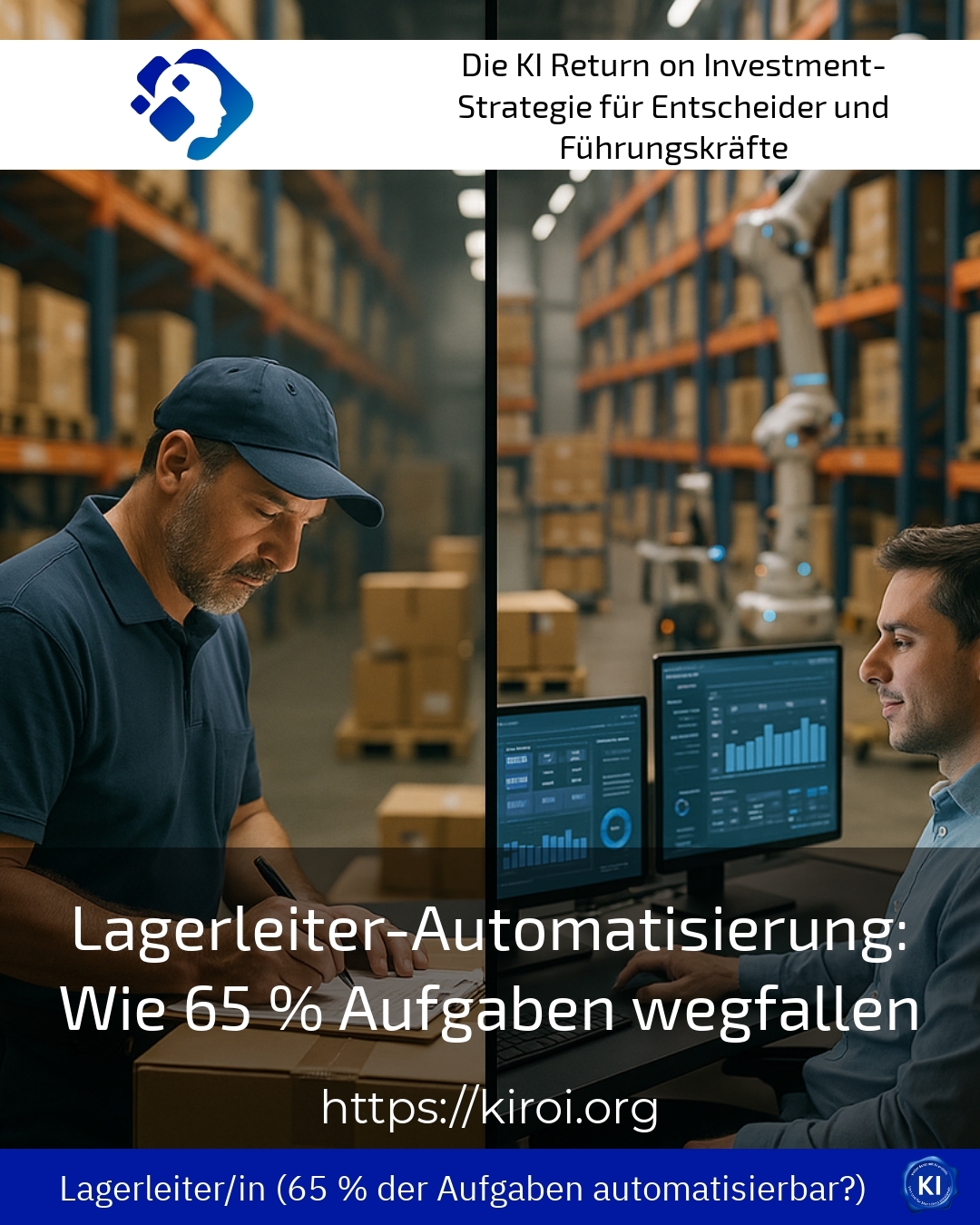
What happens to your career when intelligent systems suddenly become capable of taking over two-thirds of your daily work? And how do you prepare for this fundamental change that is already taking place in German companies today? Warehouse management automation is currently transforming an entire industry in a way that many professionals have not yet fully grasped, while at the same time creating new opportunities that those who prepare themselves in time can take advantage of. In a time when machine learning and algorithmic decision-making are taking on more and more routine tasks, logistics executives face the significant question of how to redefine their role and what competencies they need to develop in order to remain indispensable.
The findings in this article are based, among other things, on data from the Job Future Observatory of the Institute for Employment Research [1], which provides scientifically based analyses of the substitutability of various occupational profiles. These figures impressively illustrate which fields of activity are particularly affected by technological changes. If you are working in this field yourself, the data presented here will help you understand the impact of these changes on your own work environment. AIROI seminars A practical way to prepare for this transformation. The current dates can be found at the address of AIROI the educational portal [2], where you can register for lectures, workshops, and intensive training courses tailored specifically to the needs of professionals and executives.
Understanding the technological revolution in the warehouse of the future
The progressive digitalization has developed a dynamic in recent years that has surprised even experienced industry experts, because the speed at which new technologies are penetrating distribution centers and logistics facilities far exceeds all previous forecasts. Autonomous transport systems now navigate autonomously through kilometer-long warehouse environments. They transport goods from point A to point B without the need for human intervention. This development not only affects simple transport tasks; rather, intelligent algorithms are increasingly involved in planning and coordination tasks.
Let’s consider a concrete scenario from practice: A large shipping company operates several fulfillment centers in Germany. Intelligent systems continuously monitor inventory levels there and automatically trigger reorders. The classic task of inventory control, which used to take hours of daily work, now runs completely automatically. Another example can be found at a medium-sized electronics retailer. They have converted all their picking operations to a robot-based system. The pick robots achieve an error rate of less than 0.1 percent. Finally, a food logistics specialist from southern Germany shows how temperature monitoring and quality control can be revolutionized through sensor technology and machine learning. These three examples impressively illustrate the breadth of warehouse automation.
Best practice with a AIROI customer
A leading company in the consumer goods industry faced the challenge of fundamentally modernizing its warehouse processes while at the same time ensuring that long-standing employees were not put in existential fear. The management decided to use the strategy as the foundation for a structured transformation process and began with a comprehensive analysis of all the activities AIROI involved in receiving and processing goods. As part of the accompanying project, the team initially identified all the repetitive tasks that could benefit from technological support, and at the same time developed training programs for the affected employees. It is particularly noteworthy that none of the twelve directly affected employees had to leave the company; all were able to be transferred to new roles with higher added value. The former warehouse supervisor now coordinates a team of human and machine operators. He bears more responsibility than before and receives a correspondingly higher salary. This success was based significantly on the early involvement of all stakeholders and on transparent communication throughout the entire process.
Which activities will disappear through warehouse management automation?
The scientific analyses clearly show that certain areas of work are particularly affected by automation, with standardized and rule-based activities showing a high potential for substitution. For example, the documentation of goods movements today is carried out almost entirely automatically in modern facilities. RFID chips, barcodes, and intelligent sensors capture every step of the goods journey. Manual recording and maintenance of inventory lists is therefore increasingly a thing of the past.
A look at three more concrete use cases illustrates this development: First, an international fashion company has automated its entire return processing. Cameras and sensors check returned items for damage. Second, a pharmaceutical wholesaler relies on fully automated picking with maximum speed. It achieves throughput rates that would never be achieved with human labor. Third, a home improvement chain operator uses intelligent systems to optimize its warehouse layouts. These systems analyze movement patterns and continuously suggest improvements.
Classical shift planning is also increasingly being taken over by algorithms that can predict workload more precisely than experienced managers because they can rely on historical data, weather forecasts, seasonal patterns, and current order intakes. However, this development does not automatically mean that human expertise becomes redundant. It shifts to other, more complex areas of responsibility.
The new role of the leader in automated environments
As repetitive tasks are increasingly taken over by machines, completely new areas of responsibility are emerging that require human judgment, emotional intelligence, and strategic thinking. The coordination between human teams and automated systems, for example, requires a deep understanding of both worlds. Leaders must understand how algorithms work and where their limits lie.
To illustrate this, let’s consider three practical everyday scenarios: a manager of a logistics unit at an online retailer reports that he now has more time for strategic discussions with the management because operational routine tasks are automatically handled. A team leader at an automotive supplier uses the time gained to develop process improvements that algorithms alone could not detect. Another practitioner from the beverage industry has become an expert in the interface between humans and machines. He solves complex problems when automated systems reach their limits.
Strategic competence development as a response to change
The crucial question for every affected person is not whether change is coming, but how to prepare for it; and this is where the AIROI strategy with its holistic approach, which takes into account both technological and human factors, comes into play. The seminars and workshops not only provide theoretical knowledge about automation. They also guide participants in practical implementation in their professional environment. This involves more than just imparting knowledge; rather, participants receive insights for their individual career development.
Experience shows that professionals who address these changes early on have significantly better career prospects than those who wait and hope for the best. Participants in AIROI the programs often report that after attending the events, they see their professional situation with completely different eyes. They recognize opportunities where they previously perceived only threats.
Three examples from current practice illustrate this effect: A 52-year-old logistics expert changed jobs after AIROI attending a workshop. He now works as a consultant for medium-sized companies that are facing automation. A young executive has specialized in managing hybrid teams. Today, she is more sought after than ever before because companies are looking for just this kind of expertise. A third participant has created a completely new position within his or her company. He or she is responsible for the continuous optimization of human-machine collaboration.
Best practice with a AIROI customer
A medium-sized logistics service provider with about three hundred employees recognized early on that warehouse management automation would fundamentally change its business model and sought a structured way to implement this transformation. The company decided on comprehensive support through the AIROI strategy, which initially included a detailed analysis of all operational activities. The results were initially disappointing: more than half of the tasks at that time were theoretically suitable for automated processing. However, rather than falling into panic, management, together with the AIROI consultants, developed a three-year transformation plan that included both technological investments and extensive training measures for the workforce. What is particularly noteworthy is the way the company involved its employees in the process: Every employee was given the opportunity to participate in qualification programs and acquire new skills. Today, after completing the first transformation phase, the company employs even more people than before because it was able to open up new business areas through increased efficiency and offer additional services to its customers.
Practical steps for preparing for warehouse management automation
The transformation of the working world requires concrete actions, not just theoretical considerations. Therefore, practical recommendations are given below that can be derived from the experience of numerous projects. First and foremost, it is important to conduct an honest assessment of one’s own activities. Which tasks could theoretically be taken over by machines? Which require human judgment? This self-reflection forms the basis for all further steps.
In the field of warehouse management, three concrete development paths can be identified: The first path leads towards technical expertise. Professionals specialize in the maintenance and optimization of automated systems. They become indispensable experts when machines do not operate as expected. The second path emphasizes leadership skills in hybrid environments. These specialists coordinate the interplay between human teams and automated processes. The third path focuses on strategic tasks such as process design and continuous improvement. Roles are emerging that did not exist in this form before.
My AIROI Analysis
Warehouse management automation represents a fundamental change that cannot be stopped or reversed; rather, it should be seen as an opportunity to redefine one’s professional role and elevate it to a higher level. The data from the Job Future Machine and comparable scientific analyses clearly show that approximately 65 percent of traditional tasks in this area are theoretically capable of being automated. However, this number should not be interpreted as a threat but as a starting point for strategic considerations.
The experience from numerous accompanying projects within the AIROI-strategy shows that those professionals who actively shape change rather than passively await it have the best future prospects. The examples from practice presented in this article impressively demonstrate that new technologies do not necessarily lead to job losses. Often, companies even report an increase in staff numbers, because automated processes enable the opening up of new business fields.
What is crucial is the willingness to continuously develop and the ability to perceive technological changes not as an enemy but as a tool. The AIROI-Seminare provide a structured framework for this, imparting both theoretical knowledge and practical skills for action. Those who set the right course today will be among the winners of the transformation tomorrow. The AIROI-Strategie, as a proven guide, supports navigation through unfamiliar terrain.
Further links from the text above:
[1] Job-Futuromat of the Institute for Employment Research
[2] AIROI seminars and live events with Sanjay Sauldie
For more information and if you have any questions, please contact Contact us or read more blog posts on the topic Artificial intelligence here.







 Deutsch
 English (UK)