
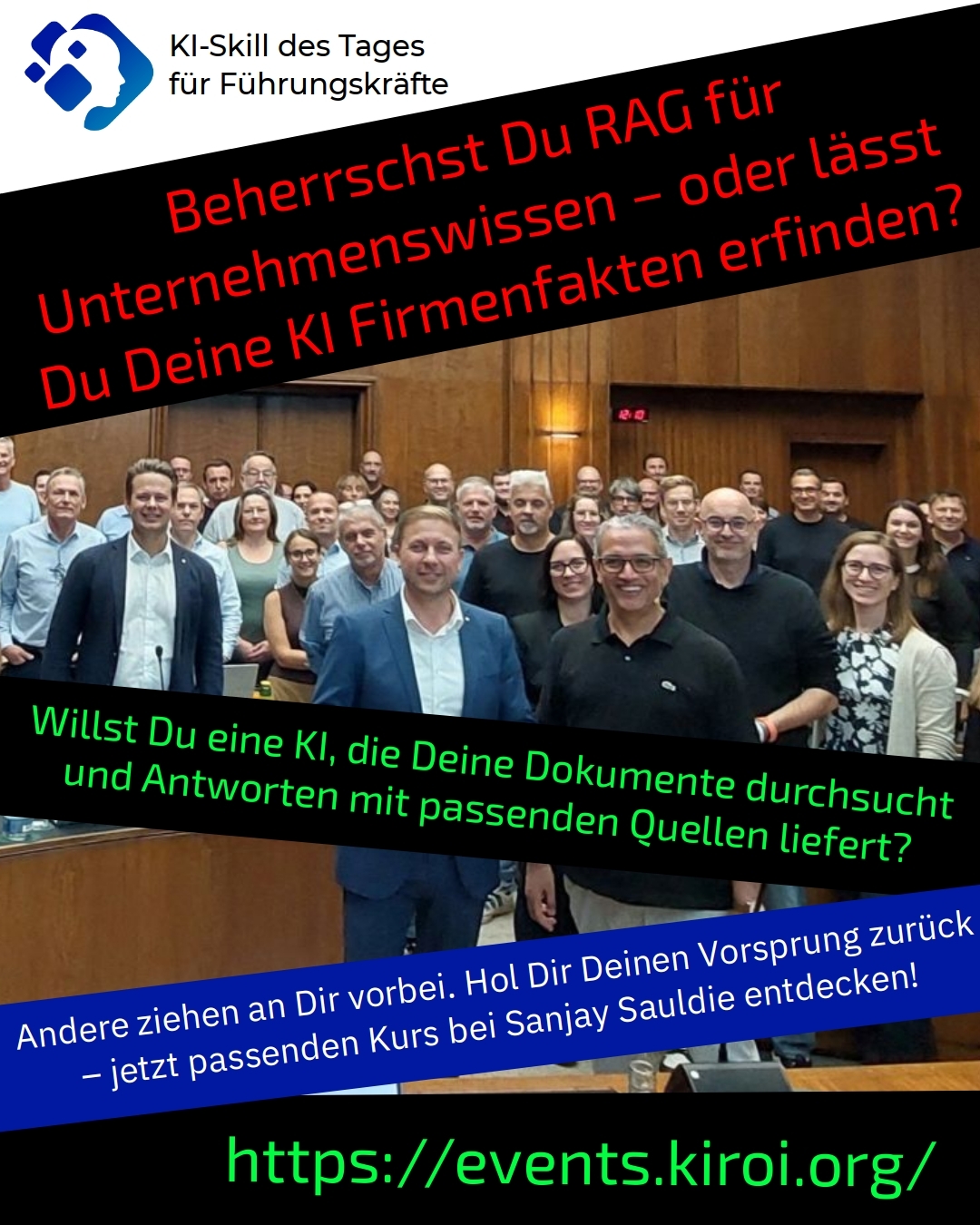
Have you ever wondered why your intelligent systems sometimes present information that simply does not exist and sound so convincing that even experienced employees get confused? This is precisely where one of the biggest challenges of modern business digitalization lies hidden; because when machine assistants are supposed to access internal data repositories, the right architecture determines whether reliable answers emerge or whether creative hallucinations are the result. The question of whether you RAG for business knowledge mastery is not merely of a technical nature, but touches upon fundamental aspects of the trustworthiness and efficiency of your entire digital infrastructure.
Why conventional approaches to corporate knowledge fail
Many companies deploy intelligent voice systems without understanding their limitations. These systems were trained on publicly available text. They do not know your internal processes or your product specifications. Therefore, they invent plausible-sounding answers to knowledge gaps. For example, a mechanical engineering company experienced that customer inquiries about spare part numbers were answered with fabricated codes. The result was incorrect orders and angry customers. A pharmaceutical company reported false dosage information generated by the system. Such scenarios highlight the urgency of structured knowledge management.
The solution lies in systematically linking language models with authentic company data, where the Retrieval-Augmented-Generation principle bridges the gap between general language understanding and specific expertise. A logistics company implemented this method for its customer service. Agents could suddenly make precise statements regarding delivery times. They relied on real-time data from the inventory management system. An insurance company used the same approach for claims processing. Employees received relevant policy details without having to manually search for them.
Best practice with a AIROI customer A medium-sized manufacturer of industrial fittings faced a significant challenge, as its technical sales representatives needed an average of forty minutes to answer complex customer requests regarding product compatibility due to the scattered information across various databases, PDF documentation, and historical email correspondence. After implementing a structured knowledge management system, the system was able to independently access over twenty thousand technical documents and analyze them contextually, reducing the average response time to under three minutes and reducing the error rate for technical specifications from fifteen to less than two percent. The sales representatives have reported since then on significantly higher customer satisfaction, because inquiries can be answered more precisely and quickly, while at the same time the technical support team has been relieved of tasks and can focus on more complex projects.
The architecture behind reliable RAG for enterprise knowledge
The technical structure of such systems follows clear principles. First, corporate documents are broken down into searchable fragments. These fragments are given mathematical representations, so-called vector embeddings. When asked a question, the system searches for relevant passages. Only then does the language model generate its answer. It uses the found information as a basis. An energy provider applied this principle to maintenance logs. Technicians obtained historical error patterns in conjunction with current disruptions. An automotive supplier linked quality reports with production data. Deviations were automatically compared with previous incidents.
The quality of the results depends largely on the data processing, which is why companies should invest significant resources in structuring their knowledge assets before even considering technical implementation. One chemical company spent three months cleaning up its safety data sheets. Only after that did the actual system integration begin. This preliminary work paid off. The hit rate was over ninety percent from the very beginning. A financial services provider initially standardized its contract templates. This enabled more precise responses to customer requests regarding terms and conditions.
Common stumbling blocks in implementation
Many projects fail due to underestimated complexities. Fragmenting documents requires precision. Too small units lose context. Too large units make precise assignments difficult. A construction company initially organized tender documents into paragraphs. The results were unsatisfactory. After switching to semantic units, the responses improved. A telecommunications provider struggled with multilingual documents. German and English passages were mixed together. A language-specific indexing solved the problem.
The handling of updates is particularly critical, as corporate knowledge changes continuously, and outdated information can be as harmful as fabricated information. A medical technology manufacturer updated product approvals monthly. The system had to automatically capture these changes. A retail corporation adjusted price lists daily. Real-time connectivity was essential here. A consulting firm archived project reports with expiration dates. Outdated methodologies were automatically removed from the active index.
Strategic advantages of controlling RAG for corporate knowledge
Organizations that master this technology gain significant competitive advantages. Knowledge is democratized and accessible. New employees achieve greater productivity faster. The expertise of long-time colleagues remains intact. An engineering office preserved the specialized knowledge of retired experts. Complex bridge designs were made accessible to emerging talent. A software house systematically documented architectural decisions. Developers understood legacy systems without time-consuming onboarding.
The efficiency gains extend across all business areas and manifest themselves in shorter lead times, reduced error rates, and increased employee satisfaction through the relief of repetitive research tasks. A staffing provider reduced the processing time for employment contracts by sixty percent. Relevant clauses were proposed contextually. A food company accelerated product development. Recipe databases were linked to ingredient availability. A steelworks optimized maintenance intervals. Historical failure patterns informed preventive measures.
Best practice with a AIROI customer An international law firm with branches in twelve countries implemented a knowledge-based assistance system that could access over two million legal documents, precedents, and internal memos, with the main challenge being to correctly differentiate between country-specific legal norms and not accidentally apply German law to Austrian cases or vice versa. The solution consisted of a multi-stage context recognition process, in which first the jurisdiction of a request was determined, before the system retrieved relevant documents from the corresponding legal area, and additionally cross-references to EU law were automatically added if they appeared relevant to the specific case. The firm’s partners report a halving of the time required to research complex cross-border mandates, while at the same time the quality of initial drafts has measurably improved, as relevant precedents are now identified more reliably than through manual research.
Human expertise remains indispensable
Despite all technological advances, these systems do not replace human judgment. They support decision-making processes. They provide relevant information faster. The final evaluation remains the responsibility of professionals. An architectural firm used the system for building regulations research. The architects validated each statement. An auditor used it for balance sheet analyses. Partners reviewed all generated assessments. A hospital implemented it for treatment guidelines. Doctors retained control over therapy.
Take your existing skills to the professional level, as already 8,000 people from over 500 companies have done with Sanjay Sauldie! Under https://events.kiroi.org/ You will find opportunities to deepen your understanding of these technologies and learn practical implementation strategies.
RAG for business knowledge: The path to implementation
Getting started does not require a revolutionary transformation. Pilot projects in limited areas are recommended. A machine manufacturer started with spare parts catalogs. Success paved the way for further applications. An insurer began with damage forms. Clerks tested the system intensively. A trading company piloted supplier documentation. Buyers provided valuable feedback.
The gradual expansion minimizes risks and maximizes learning effects, with each iteration deepening understanding of enterprise-specific requirements and strengthening acceptance among employees. A logistics service provider expanded its system quarterly. New document types were continuously integrated. A chemical manufacturer successively connected sites. Local specifics were incorporated into the configuration. A media house gradually accessed archives. Historical content was systematically digitized.
My AIROI Analysis
The mastery of knowledge-based language systems is evolving into a core competency of future-oriented organizations, with the crucial difference not in the technology itself but in the strategic approach to its implementation. Companies that structure their knowledge assets and connect them with modern language models create a sustainable competitive advantage that manifests itself in faster decision-making, more precise customer interactions, and more efficient knowledge retention. The investment in clean data architectures and sophisticated retrieval mechanisms often pays off, as it not only prevents costly hallucinations but also unlocks previously untapped potential within historically accumulated document collections.
Organizations that have taken this path often report surprising side effects, such as the discovery of redundant processes or inconsistent information flows that have apparently emerged during data processing. The human component remains central, as these systems only reach their full potential in collaboration with competent professionals who can critically assess and contextualize their outputs. Transruptions coaching accompanies companies in precisely these projects, providing impetus for structured implementations and supporting the development of sustainable knowledge strategies. The journey from experimental use to enterprise-wide integration requires patience, expertise, and strategic foresight, but the results justify this investment in a sustainable way.
Further links from the text above:
[1] AIROI Events – Further training with Sanjay Sauldie
[2] Contact Sanjay Sauldie
[3] AIROI Blog about Artificial Intelligence
For more information and if you have any questions, please contact Contact us or read more blog posts on the topic Artificial intelligence here.








 Deutsch
 English (UK)