
Will more than half of all management tasks in industrial production soon be taken over by machines, and what does that mean for people who still coordinate entire factories today?
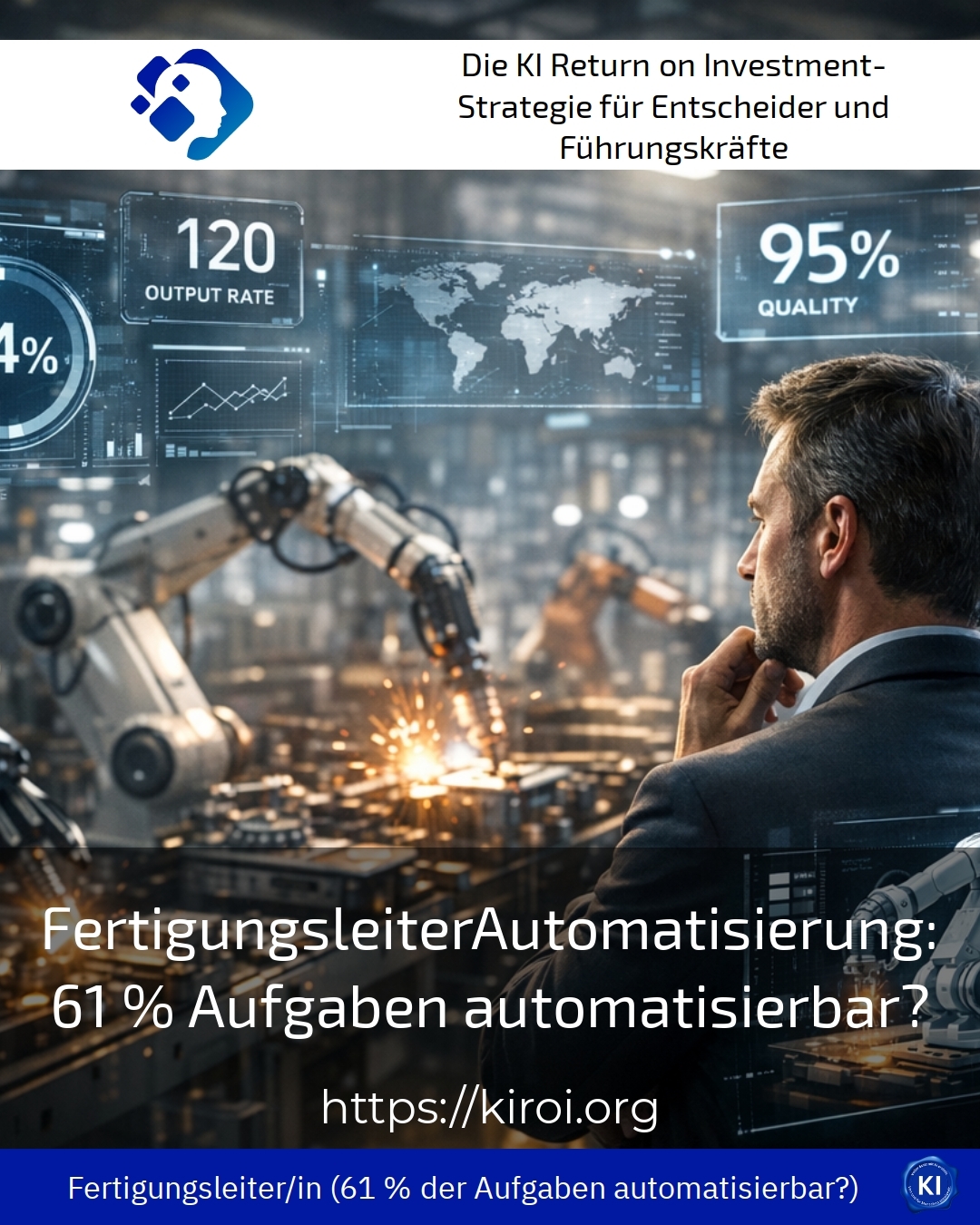
This question is currently of interest to many professionals in manufacturing companies, as current data from the Job Future Observatory of the Institute for Employment Research reveal surprising figures [1]. The platform systematically analyzes which job profiles could be replaced by technological developments. In doing so, management positions in industrial manufacturing achieve remarkable figures that inspire thought. Production ManagerAutomation It is a topic that is on the agenda, and the figure of 61 percent of potentially automatable tasks seems frightening at first. However, behind this statistic lies a differentiated reality that we should consider together. Transruptive coaching accompanies companies and executives through exactly such transformation processes, and experience often shows that the fear of change is greater than the actual effects.
Understanding the reality behind the numbers
Considering the potential for automation requires a differentiated view of the actual areas of activity. In a typical production facility for automotive parts, for example, a manager coordinates shift schedules, monitors quality metrics, and communicates with suppliers. Some of these tasks can indeed be supported by intelligent systems, while others still require human intuition and experience. Shift planning, for example, can be optimized through algorithms that take into account disease patterns, order intakes, and personnel availability. At the same time, the motivation of a disoriented employee after an industrial accident remains a deeply human task.
In food production, a similar picture emerges: hygiene monitoring and temperature controls are long since automated. However, the decision as to whether a batch is released despite minor deviations is still made by an experienced person. Machine engineering companies are already using predictive maintenance systems that predict failures and optimize maintenance intervals. Nevertheless, communicating with an angry large customer whose delivery is delayed requires emotional intelligence and negotiating skills. These examples illustrate that Production ManagerAutomation it does not represent a binary concept, but rather describes a shift in the focus of tasks.
Best practice with a AIROI customer
A medium-sized metal processing company faced the challenge of managing increasing production volumes with a stable workforce. The management commissioned us with a comprehensive analysis of the existing processes and structures. As part of the transruptive coaching, we identified with the team various areas where technological support seemed useful. Production planning was previously predominantly manual in Excel spreadsheets, which consumed considerable time resources. We supported the implementation of an intelligent planning system that analyzed historical data and optimized production sequences. Particularly important was not replacing the management but relieving them of their workload. The time gained was henceforth invested by this person in the further development of the employees and the strategic direction of the department. After six months, the company reported an 18 percent increase in productivity while improving employee satisfaction. The manager herself described the change as liberating, because she finally had time for value-creating activities.
Which tasks are actually capable of being automated
A detailed examination of individual areas of activity reveals interesting patterns and connections. Routine documentation tasks such as recording production metrics can now be fully automated. In the pharmaceutical industry, sensors already record every temperature profile, pressure value, and batch number without human intervention. The creation of production reports, which used to take hours, is now generated by modern systems in seconds. Monitoring machine parameters is also increasingly being handled by artificial intelligence, which detects anomalies faster than any human eye.
In electronics manufacturing, automated systems already coordinate complex material flows between different production lines. Order release occurs automatically when minimum stock levels are reached, taking into account delivery times and price fluctuations. Quality checks using camera systems and image recognition algorithms surpass human inspectors in speed and consistency. The textile industry uses automated pattern recognition to identify web defects, while in the chemical industry complex formulations are automatically adjusted.
Nevertheless, numerous tasks that are beyond automation remain, and this is precisely where the future of human work lies. The development of new production methods requires creativity and experimental thinking that machines cannot replicate. Conflict resolution between departments or with external partners requires empathic communication skills. Training new employees in complex contexts remains a human domain.
The human component in the transformation of production lines automation
The transformation fundamentally changes the requirements for leadership in production. In the past, technical expertise and operational experience defined the success of a leader. Today, strategic thinking, change management, and emotional intelligence are increasingly gaining importance. The ability to lead employees through uncertain times becomes a core competency. In a packaging company, we recently led a transformation process where the leadership had to completely redefine their role.
The plastics processing industry exemplifies how rotational images can shift. Instead of manually optimizing injection molding machines, executives today interpret data analysis and make strategic decisions. The glass industry is undergoing a similar transformation, as automated melting processes require different monitoring capabilities than in the past. In woodworking, digital twins coordinate production, while humans manage exceptions.
Best practice with a AIROI customer
A food industry company approached us with a specific challenge regarding the future viability of its leadership structures. The long-standing production management was on the verge of retirement, and succession planning was proving difficult. As part of our support, we developed a hybrid leadership model that combined technological support with human expertise. We initially identified all the activities that the departing leader was spending the most time on. Many of these tasks could be supported by digital tools or taken on entirely. This enabled the succession to be successfully managed with fewer years of experience, because the system preserved much of the predecessor’s tacit knowledge. At the same time, we created space for new competencies such as data interpretation and change management. The company reports today about a successful generational change that would have been significantly more bumpy without technological support. The young executive particularly appreciates the ability to make data-based decisions, rather than relying solely on gut instinct.
Strategies for successful transformation
Constructive handling of the automation potential requires a proactive approach from all involved parties. Companies benefit when they involve their employees early in change processes. The printing industry shows positive examples where traditional craftsmanship blends with digital control. Executives who continuously develop their skills remain relevant and valuable to their organizations. The paper industry is increasingly investing in the qualification of their senior management regarding digital skills.
Transruptions coaching accompanies companies and individuals in this transformation with individually tailored concepts. Often clients come to us with uncertainty regarding their professional future. We provide guidance for the realignment of competency profiles and support the development of future-oriented strategies. The ceramics industry offers interesting case studies where artisanal tradition and modern production control coexist harmoniously. In building materials production, we see similar developments that offer hope for other industries.
The Production ManagerAutomation It also offers opportunities that should not be overlooked. Eliminating monotonous routine tasks creates space for value-adding and fulfilling work. The furniture industry shows how creative design can be brought back to the forefront. Leather processing is experiencing a renaissance of skilled craftsmanship as routine tasks are automated.
Practical steps for preparing for production managers automation
The concrete implementation begins with an honest assessment of one’s own activities and competencies. Leaders should regularly reflect on which of their tasks create real added value. The rubber industry provides examples of successful self-reflection and repositioning of leadership roles. Continuing education in areas such as data analysis, communication, and change management strengthens one’s own position. The cement industry is investing heavily in leadership development with a focus on digital transformation.
Networking and sharing experiences with colleagues from other companies significantly broaden horizons. The recycling industry showcases innovative approaches that can be relevant to other industrial sectors as well. Mentoring programs where experienced and younger executives learn from each other are gaining in importance. The battery manufacturing industry, an emerging sector, successfully combines experience with technological innovation.
My AIROI Analysis
The analysis of the available data and our practical experience lead to a differentiated assessment of the situation. The figure of 61 percent of tasks that can be automated sounds initially threatening, but it does not tell the whole story. Automation does not automatically mean replacement, but often support and relief. Human leadership skills remain indispensable, even as their nature changes. Our experience with numerous transformation projects shows that the human factor remains crucial for success. Technology is a tool, not a substitute for leadership personality.
Successful navigation through this change requires courage, openness, and a willingness to learn throughout life. Companies that accompany their leaders on this journey invest in their own future viability. The manufacturing industry will also need people in the coming decades to coordinate teams, manage crises, and drive innovation. These people will use different tools than today, but their role remains central. Transruptive coaching supports the development of individual strategies for this transformation. We often observe that fear of change gives way to an increased understanding of the actual developments. The future belongs to those who understand technology as a partner and cultivate their unique human abilities.
Further links from the text above:
[1] Job-Futuromat of the Institute for Employment Research
For more information and if you have any questions, please contact Contact us or read more blog posts on the topic Artificial intelligence here.







 Deutsch
 English (UK)