
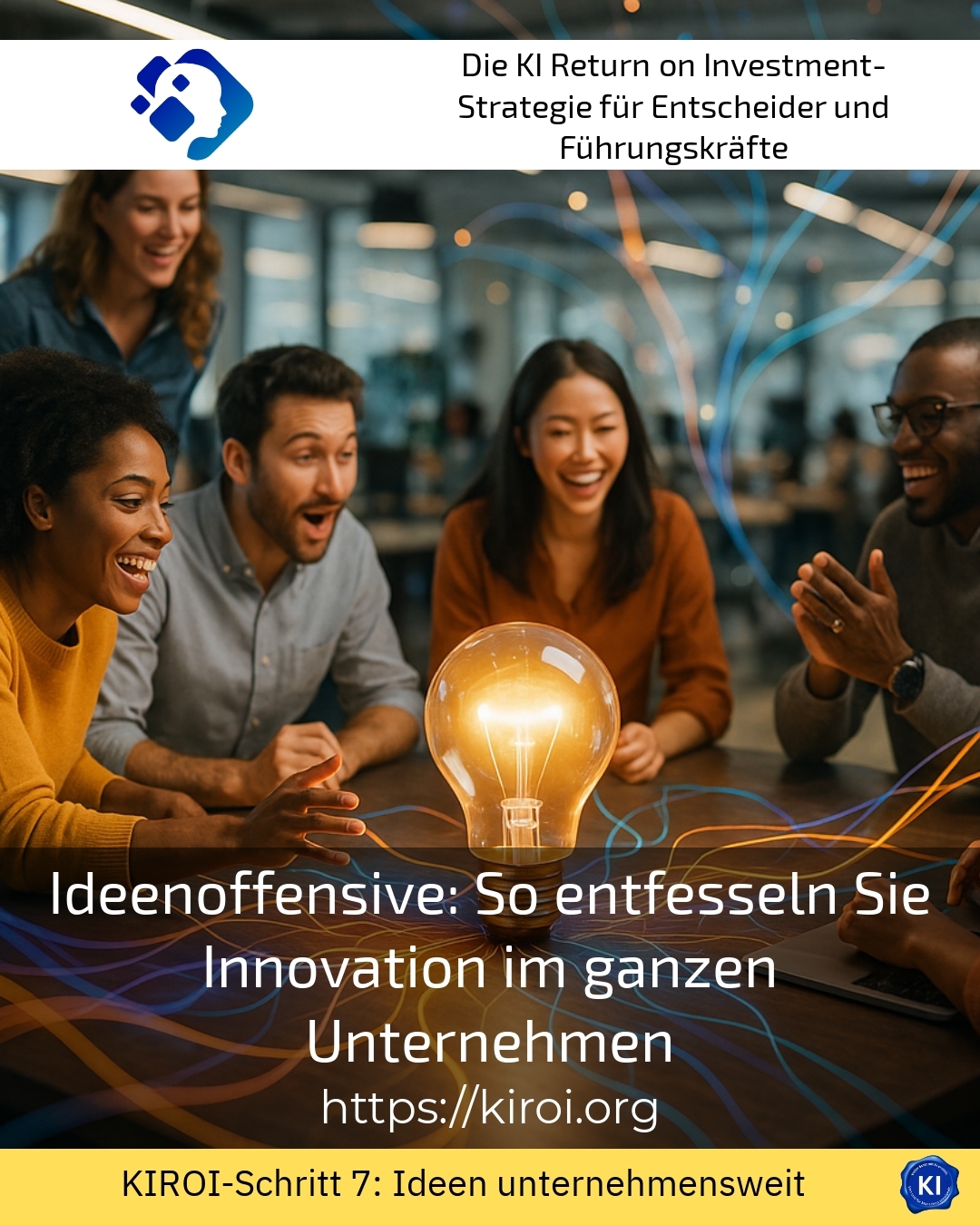
Why do some organizations seemingly achieve groundbreaking innovations with seeming ease, while others, despite enormous efforts, remain stagnant? The answer often lies not in a lack of resources or talent, but rather in the systematic development of creative potential at all levels. A well-thought-out Ideas Offensive: How to Unleash Innovation Throughout Your Company It begins where traditional structures end and real participation begins. In an era of rapid technological disruption, relying solely on the research department is no longer enough. Rather, the most valuable insights often lie in the minds of the people who interact with customers daily, optimize processes, or experience challenges firsthand.
Uncovering the hidden sources of creative power
Every organization possesses a remarkable treasure trove of untapped knowledge and creative approaches that are just waiting to be tapped. In the automotive industry, for example, workshop employees regularly report on customer requests that could inspire entirely new service concepts. At the same time, engineers in production develop small improvements daily that are rarely captured systematically. A leading supplier from Bavaria has recognized this phenomenon and is now using digital platforms to collect such insights. Moreover, experience from the mechanical engineering sector shows that service technicians gain valuable insights into optimization potential through their immediate proximity to the product. In retail, sales consultants, on the other hand, possess a deep understanding of consumer needs that often remains untapped.
The challenge lies in creating suitable channels and structures that bring this decentralized knowledge together. Psychological safety and an open culture of error play a crucial role in this. People are only willing to share their thoughts if they do not have to fear negative consequences. A medium-sized chemical company from North Rhine-Westphalia has therefore introduced anonymous submission options that reduce initial inhibitions. Moreover, executives from the pharmaceutical industry report that regular creative workshops can significantly reduce the barrier to expressing ideas. In the insurance industry, agile formats such as design-thinking sessions have helped break down entrenched thinking patterns.
Best practice with a AIROI customer
A traditional family business in the field of precision mechanics faced the challenge of securing its competitiveness in an increasingly digitized market environment, where the hierarchies that had developed over decades significantly hindered the free flow of creative impulses. In the context of a transruptive coaching process, we supported the management and selected key personnel in developing a corporate-wide idea management system that took into account both technological and cultural aspects. First, we jointly analyzed the existing communication structures and identified those barriers that had previously prevented valuable improvement proposals from reaching the decision-making bodies. Subsequently, we implemented a digital platform that enabled all employees to contribute their ideas in a low-key manner while simultaneously keeping the progress of their proposals transparent. The introduction of quarterly innovation days, in which teams from different departments came together to further develop promising concepts, proved particularly effective. Within the first six months, over two hundred proposals were submitted, of which thirteen led to concrete pilot projects. Since then, the responsible parties have frequently reported that not only the number of submitted ideas has increased, but also the quality and the degree of implementation have significantly improved.
Establishing structures for sustainable creativity
A successful Ideas Offensive: How to Unleash Innovation Throughout Your Company It requires more than sporadic brainstorming sessions or one-off competitions. Rather, it requires thoughtful processes that make creativity a natural part of everyday life. In the logistics industry, several freight forwarders have recognized that regular improvement cycles enable the continuous optimization of transport routes. Similar experiences are being made by hospitals that employ interdisciplinary teams to develop patient-centered treatment pathways. In the construction industry, on the other hand, the systematic exchange between architects, engineers, and tradespeople creates entirely new approaches to sustainable construction.
The establishment of suitable structures often begins with the appointment of innovation ambassadors in various business areas. These multipliers act as bridge builders between operational teams and strategic decision-makers. A large energy provider has successfully implemented this concept and now has a network of over fifty internal innovation coaches. Furthermore, practice in the telecommunications industry shows that dedicated time quotas for creative work can significantly increase the innovation potential. Leading manufacturers in the food industry are also increasingly relying on cross-departmental project teams that develop new product concepts.
The role of digital tools in the idea offensive
Modern technologies open entirely new possibilities for the systematic collection, evaluation, and development of creative approaches. Collaboration platforms enable geographically distributed teams to work together on concepts. Artificial intelligence can help identify connections between different proposals and suggest promising combinations. A leading textile company is already using machine learning to automatically categorize submitted ideas and link them to similar concepts from the past. In the financial services industry, several banks have established virtual idea labs where employees can work asynchronously on solutions to customer needs. The game development industry is also demonstrating how gamified elements can significantly increase participation in innovation processes.
At the same time, technology must never become an end in itself. It should always serve the overarching goal of fostering and channeling human creativity. Our experience in transruptive coaching shows that careful implementation of digital tools is crucial for their acceptance. In doing so, we help companies find the right balance between technological support and personal interaction.
Leadership as a catalyst for creative unfolding
The attitude and behavior of leaders significantly shape whether creative impulses flourish or are stifled in their infancy. Managers who themselves exhibit curiosity and openness inspire their teams to think more boldly. In the hotel industry, directors often report that their own willingness to experiment directly radiates to their employees. Similar observations are made by managers in the advertising industry, where creative leadership traditionally holds high value. In software development, too, technical leaders who bring their own ideas and at the same time value those of others lead particularly innovative teams.
One Ideas Offensive: How to Unleash Innovation Throughout Your Company It is only sustainable when leaders are willing to relinquish control and grant autonomy. This requires a fundamental change in many organizations that have been highly hierarchical until now. In the steel industry, several plants have successfully implemented flatter structures that enable faster decision-making processes. It has been shown that employees take on more responsibility when they are given appropriate trust. In healthcare, we support hospitals in establishing a culture of constructive disagreement in which critical voices are also heard.
Best practice with a AIROI customer
A medium-sized manufacturer of packaging machines had unsuccessfully tried for years to increase its rate of innovation, with various internal initiatives repeatedly failing due to the skeptical attitude of the middle management. As part of our support as a transruptions coach, we first worked intensively with the senior management to develop a shared understanding of the importance of creative spaces, before moving on to the operational processes. A workshop format proved particularly effective, in which department heads themselves assumed the role of ideators and thus experienced first-hand the challenges their employees faced when submitting proposals. This perspective shift led to a profound change in the leadership culture, manifested in shorter response times for submitted concepts and significantly more appreciative communication. Furthermore, we established a mentoring program in which experienced executives supported younger talents in developing and presenting their ideas, simultaneously fostering knowledge transfer between generations. After about a year, the leaders reported on a noticeably changed atmosphere in which critical questioning is seen as an enrichment rather than a threat and even unconventional proposals receive a fair review.
From idea to implementation: the crucial step
The best idea remains ineffective if it is not implemented into action. Many organizations fail precisely at this transition from concept to reality. Therefore, several manufacturers in the furniture industry have introduced rapid prototyping processes that enable new designs to be physically experienced within a few days. Similarly, software companies that develop minimally functional products act in a similar way, quickly testing hypotheses in the market. In the restaurant industry, too, restaurants that initially offer new dishes as daily specials can gather valuable customer feedback.
The speed of implementation depends significantly on the availability of suitable resources. Therefore, we often recommend our clients to establish dedicated innovation budgets that teams can access without lengthy approval processes. One electronics manufacturer from southern Germany has implemented this recommendation and now provides each team with an annual experimentation budget. In the media industry, several publishing houses have established so-called innovation labs where new formats can be tested under real conditions. Additionally, educational institutions report positive experiences with pilot classes where innovative teaching methods are tested.
Overcoming resistance and engaging sceptics
Every change initiative faces resistance, and innovation projects are no exception here. However, critical voices deserve to be heard, as they often point to real risks and vulnerabilities. In the aviation industry, it has been shown that the early involvement of security experts in innovation processes leads to more robust solutions. The chemical industry is experiencing similar experiences, where strict regulatory requirements steer creative work in structured channels. In banking, compliance officers have provided valuable impetus for the development of innovative and at the same time compliant financial products [1].
Constructive handling of resistance requires strong communication skills and a long patience. Professional guidance can provide valuable impulses in this regard. In transruptive coaching, we support organizations in understanding the motives of critical voices and guiding them in productive directions. Often it turns out that supposed blockers can become valuable allies if their concerns are taken seriously. A mechanical engineering company was able to transform a long-time production manager from a skeptic into an engaged innovation ambassador. In the insurance industry, executives report similar transformations after critical employees were actively involved in pilot projects.
My AIROI Analysis
The systematic release of creative potential represents one of the most demanding leadership tasks of our time, but it also offers enormous opportunities for future-oriented organizations. My experience from numerous mentoring projects shows that the success of a Ideas Offensive: How to Unleash Innovation Throughout Your Company Less depends on spectacular individual measures than on the consistent work on cultural foundations and structural frameworks. The combination of technological support and human proximity proves particularly effective in this context, as digital tools can indeed speed up processes and create transparency, but they never replace the personal exchange and the emotional appreciation of creative contributions.
Those approaches that view innovation not as an isolated project but as an integral part of the corporate culture appear particularly promising to me. Organizations that take this path develop remarkable resilience to disruptive changes while simultaneously gaining attractiveness for talented employees. The accompaniment of such transformation processes requires patience, empathy, and methodological expertise; the fruits of this work often become fully visible only after months or even years have passed. Nevertheless, the investment is worthwhile, because organizations that understand how to mobilize the collective potential of their members will also find their way in turbulent times. The central insight of AIROI my analysis is therefore: Innovation is not an individual ability, but the result of a carefully cultivated interplay of people, structures, and technologies.
Further links from the text above:
[1] BaFin – Supervision of FinTech companies and innovative financial products
For more information and if you have any questions, please contact Contact us or read more blog posts on the topic Artificial intelligence here.











 Deutsch
 English (UK)