
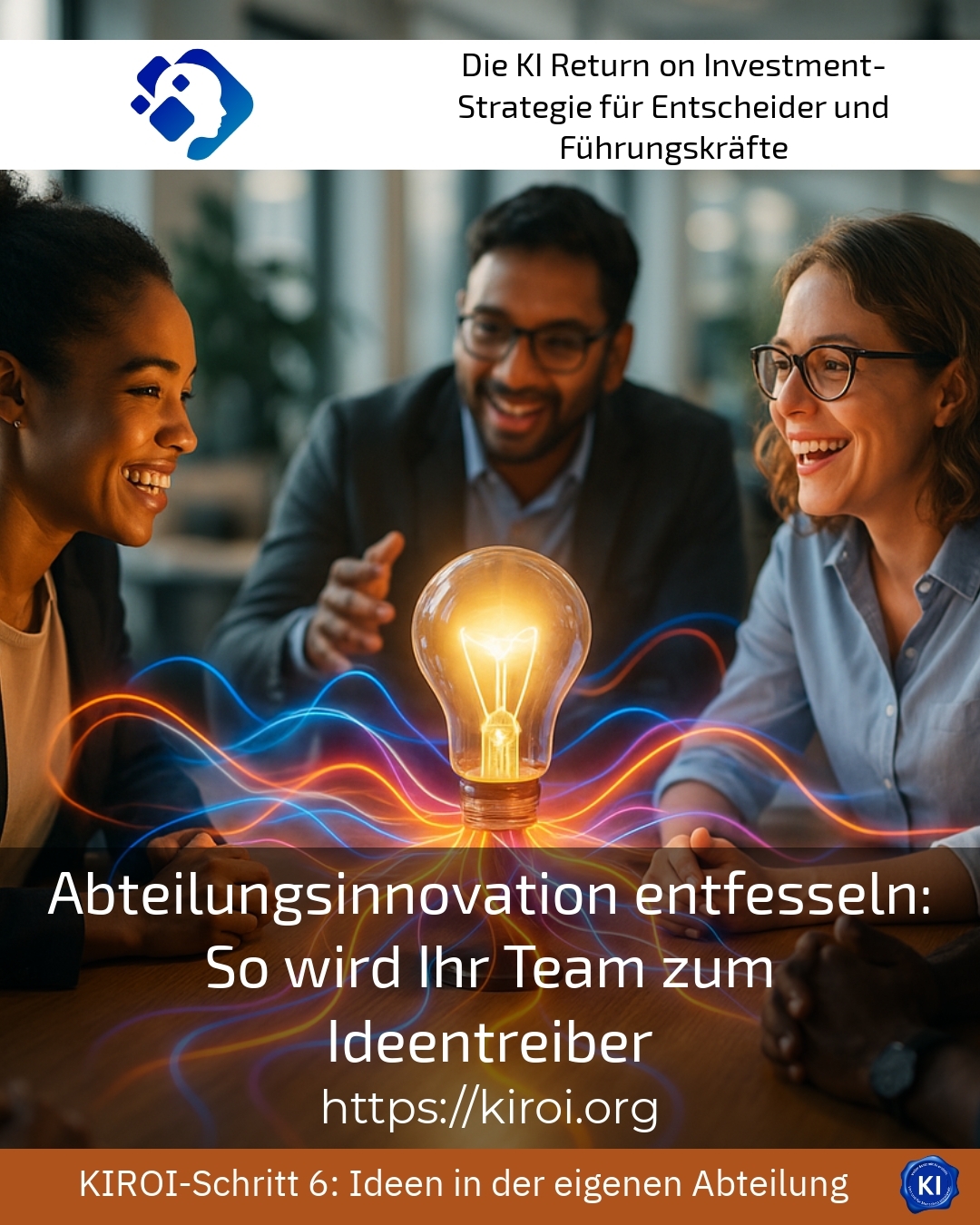
Imagine your department becoming the centerpiece of corporate change. Every day, fresh concepts and bold approaches are developed there. Employees independently bring forward improvement proposals and implement them together. This vision sounds enticing, but many leaders wonder how they can make it happen. Unleashing departmental innovation You can. The path to achieving this goal involves conscious cultural work, smart structures, and trusted guidance. In this article, you will learn what concrete steps your team can take to become an ideator. You will also learn proven methods that have already shown their effectiveness in various industries. This is not about theoretical concepts; it is about practical insights that can be applied to your daily work.
Why creative team dynamics have become indispensable today
The world of work is changing at a rapid pace. Companies face challenges that seemed unimaginable just a few years ago. Digital transformation, changing customer expectations, and global competition require continuous adaptability. In this situation, individual leaders can no longer provide all the answers. Rather, it takes the collective intelligence of entire departments to remain competitive. Teams that independently develop ideas react faster to market changes and find more creative solutions. They detect problems earlier and address them proactively.
In healthcare, this need is particularly evident. Caregivers there often develop autonomous workflow optimizations for patient transfers. These arise directly from day-to-day practice and are initiated by the people themselves. In the logistics industry, warehouse teams create new picking routes because they personally travel the routes every day. Financial service providers benefit when account managers propose process improvements for customer requests. These examples illustrate that valuable insights often arise at the operational level.
The hidden treasure in your departments is waiting to be discovered
Every department has untapped potential that is just waiting to be activated. Employees observe inefficiencies every day that management often keeps hidden. They know the small obstacles that have a major impact on productivity and satisfaction. However, this knowledge often remains unused because appropriate channels for sharing information are lacking. Many people do not dare to make suggestions for improvement because they fear negative reactions. Others simply do not believe that their ideas will be heard.
Clients often report that initial changes occur surprisingly quickly. A medium-sized manufacturing company activated the potential of its production department within a few weeks. The machine operators proposed maintenance intervals there that significantly reduced downtime. In retail, sales teams are optimizing their product presentation independently because they experience customer reactions immediately. IT departments are developing internal tools that noticeably facilitate the work processes for colleagues.
Unleashing psychological safety as the foundation for department innovation
Before ideas can flow, a safe framework must exist. Psychological safety describes the feeling of being able to speak without fear of negative consequences. In such environments, people dare to express unfinished thoughts and admit mistakes. They ask critical questions and question established practices without fear of rejection. This atmosphere does not arise spontaneously; it requires conscious design by leadership. transruptions-Coaching can help you systematically build such spaces.
Specifically, this means that leaders themselves show vulnerability and communicate their own uncertainties. In hospitals, chief physicians foster this culture by speaking openly about treatment dilemmas. This also encourages young resident doctors to voice concerns about therapeutic decisions. In software companies, team leaders admit when they do not understand a technical approach. This attitude signals to the team that ignorance is not a weakness. Insurance companies establish feedback rounds in which claims handlers openly discuss challenges in claims handling.
Best practice with a AIROI customer
A service company with several hundred employees faced a particular challenge. The departments worked in isolation from each other and rarely exchanged ideas. Management complained of a lack of commitment to change projects. As part of a transruptive coaching process, we first analyzed the existing communication culture. It turned out that previous improvement proposals had been drowned out without feedback. Employees had subsequently stopped contributing ideas because they felt they were not being heard. We initially established a structured feedback system that rewarded each submitted idea within five working days. At the same time, we introduced monthly departmental dialogues in which teams shared their observations. The management learned in workshops how to respond constructively to critical comments. Within six months, the number of submitted improvement proposals tripled. Particularly noteworthy was the quality of the ideas, which now often addressed cross-departmental processes. The company subsequently implemented a digital idea management system that made the progress of implementation transparent. Employees could now see specifically which proposals were taken up and which impact they had.
Rethinking the culture of error and perceiving it as a learning opportunity
Innovation requires a willingness to experiment, and experiments inevitably involve failure. Organizations that punish mistakes stifle creative impulses at their very inception. Instead, departments should understand and utilize failures as valuable learning opportunities. In pharmaceutical companies, failed series of experiments are part of the learning process because they show which approaches do not work. Marketing departments deliberately test different campaign variants, even though some of them will fail. Engineering firms encourage their teams to experiment with unconventional design approaches, even though some of them will be rejected.
Distinguishing between avoidable and unavoidable errors helps find a healthy balance. Serious negligence deserves different responses than bold experiments that did not turn out as hoped. In architectural offices, project managers distinguish between craft errors and creative experiments gone wrong. Banks differentiate between compliance violations and innovative product ideas that did not prove successful in the market. This distinction creates clarity and encourages constructive risk-taking.
Creating structures that channel creative energy
Good intentions alone are not enough to Unleashing departmental innovation To be able to innovate. It takes concrete formats and processes to channel creative energy into productive channels. Without such structures, ideas wither before they can have an impact. Regular brainstorming sessions, innovation workshops, or hackathons provide spaces for concentrated creative work. The frequency is more important than the duration of individual events. Short, frequent impulses are more sustainable than rare large events.
In the automotive industry, development departments establish weekly short formats for idea exchange. Engineers present observations they have made during work in five minutes there. Consulting firms use internal wikis where consultants document and share project experiences. Health insurance companies organize quarterly innovation days where employees from different departments work together. These formats create continuity and signal that idea development is part of the regular work routine.
Understand the role of the leader as a facilitator
Leaders who Unleashing departmental innovation They want to, and must, reinterpret their role. They are transforming from decision-makers into facilitators, from those who know the answers into those who ask questions. This transformation is difficult for many because they have been rewarded for their expertise over the years. However, modern leadership means opening up spaces where others can grow. transruptions-Coaching supports leaders in developing and practicing this new attitude.
Specifically, this manifests itself in altered conversation styles during meetings. Instead of presenting solutions, executives ask open-ended questions such as: What possibilities do you see? In advertising agencies, creative directors moderate brainstorms without even contributing their own ideas. Hotel managers ask receptionists for their observations on guest requests. School principals ask teachers for suggestions on lesson planning, rather than presenting concepts from above. This attitude requires patience and confidence in the team’s abilities.
Best practice with a AIROI customer
A senior executive from the technical field sought support in transforming their department. The employees were technically excellent, but brought little original ideas. During the coaching, it became apparent that the senior executive dominated discussions and presented quick solutions. The team members had become accustomed to waiting for instructions rather than taking initiative themselves. We initially worked on perceiving this dynamic and then developing alternative behaviors. The senior executive practiced listening in meetings first and asking questions. She learned to take breaks that gave the team space to think. At the same time, she established a rotation principle where different team members alternately moderated meetings. After a few weeks, employees began to independently put topics on the agenda. The quality of the discussions improved significantly as different perspectives were incorporated. The leader reported an initially unfamiliar but increasingly liberating feeling. She was now able to focus on strategic questions, while the team solved operational challenges independently.
Using diversity as a fuel for fresh perspectives
Homogeneous teams tend to produce similar ideas and repeat familiar patterns. Diversity in terms of age, background, thinking style, and experience, on the other hand, significantly enriches the pool of ideas. When different perspectives meet, friction and creative tension arise. It is from this tension that the most original solutions often emerge. Therefore, leaders should consciously pay attention to diverse team compositions and invite different voices.
In publishing houses, editorial teams benefit from members of different generations who know different reading habits. Telecommunications companies involve customer service employees in product development processes because they authentically represent the perspective of the users. Museums invite volunteer guides to strategy workshops because they maintain direct contact with visitors. These examples show how valuable it is to look beyond the usual decision-making circles.
Methods and tools for systematic idea generation
Creativity can be systematically promoted and supported through appropriate methods. Design Thinking, brainstorming variations, or the SCAMPER technique offer structured approaches to idea generation [1]. These methods help teams leave established thinking patterns and explore new directions. It is important to try different techniques and find out which ones suit the team culture best. Not every method works equally well for every team.
In architecture firms, planning teams use perspective-switching exercises in which they put themselves in the shoes of different building users. Advertising agencies rely on reverse brainstorming, in which teams first gather ideas for how to worsen a problem. Energy providers use analogy techniques and ask how other industries have solved similar challenges. Pharmaceutical companies combine expert knowledge from different disciplines in interdisciplinary workshops [2]. This diversity of methodological approaches expands the repertoire of each department.
Turning ideas into action and ensuring implementation
The best idea is useless if it sits in a drawer gathering dust. Many organizations fail not because of a lack of ideas, but because of a weakness in implementation. Teams lose motivation when they see that their suggestions have no consequences. Therefore, clear processes that lead from idea to implementation are necessary. Transparency about the progress of each submitted idea creates trust and maintains participation.
Craft businesses are introducing idea boards that make the progress of various proposals visible. Logistics companies are establishing pilot phases in which promising ideas are initially tested on a small scale. Media companies are forming temporary project teams that drive specific ideas forward within defined timeframes. Authorities are experimenting with sandboxes where new approaches can be tested under protected conditions. These structures bridge the gap between concept and reality.
My AIROI Analysis
Transforming a department into a driving force for ideas is a multifaceted process that requires time, patience, and consistent action. My experience from numerous mentoring projects shows that the biggest obstacles are rarely of a technical nature. Rather, they lie in ingrained cultures, unconscious behavioral patterns, and a lack of trust. Leaders often underestimate how strongly their own attitude influences and shapes team behavior. A single remark that undermines an idea can undo months of hard work.
At the same time, I constantly observe how quickly positive dynamics can emerge when the right impulses are set in motion. Teams that experience for the first time that their ideas are taken seriously and implemented develop remarkable self-motivation. They begin to proactively seek out opportunities for improvement and implement them on their own. This change often unfolds faster than expected when the basic prerequisites are in place.
The combination of cultural change and structural support is particularly effective. Neither the right attitude alone nor good processes in isolation lead to the desired result. Both are needed in a coordinated manner, adapted to the specific situation of each organization. transruptions coaching can help find this balance and develop both dimensions in parallel. The results I observe in my clients reinforce my conviction that every department has the potential to be an ideational driver. It is simply a matter of creating the right conditions for this potential to unfold.
Further links from the text above:
[1] Design Thinking Methods and Applications
[2] Harvard Business Review – Innovation Insights
For more information and if you have any questions, please contact Contact us or read more blog posts on the topic Artificial intelligence here.











 Deutsch
  English (UK)