
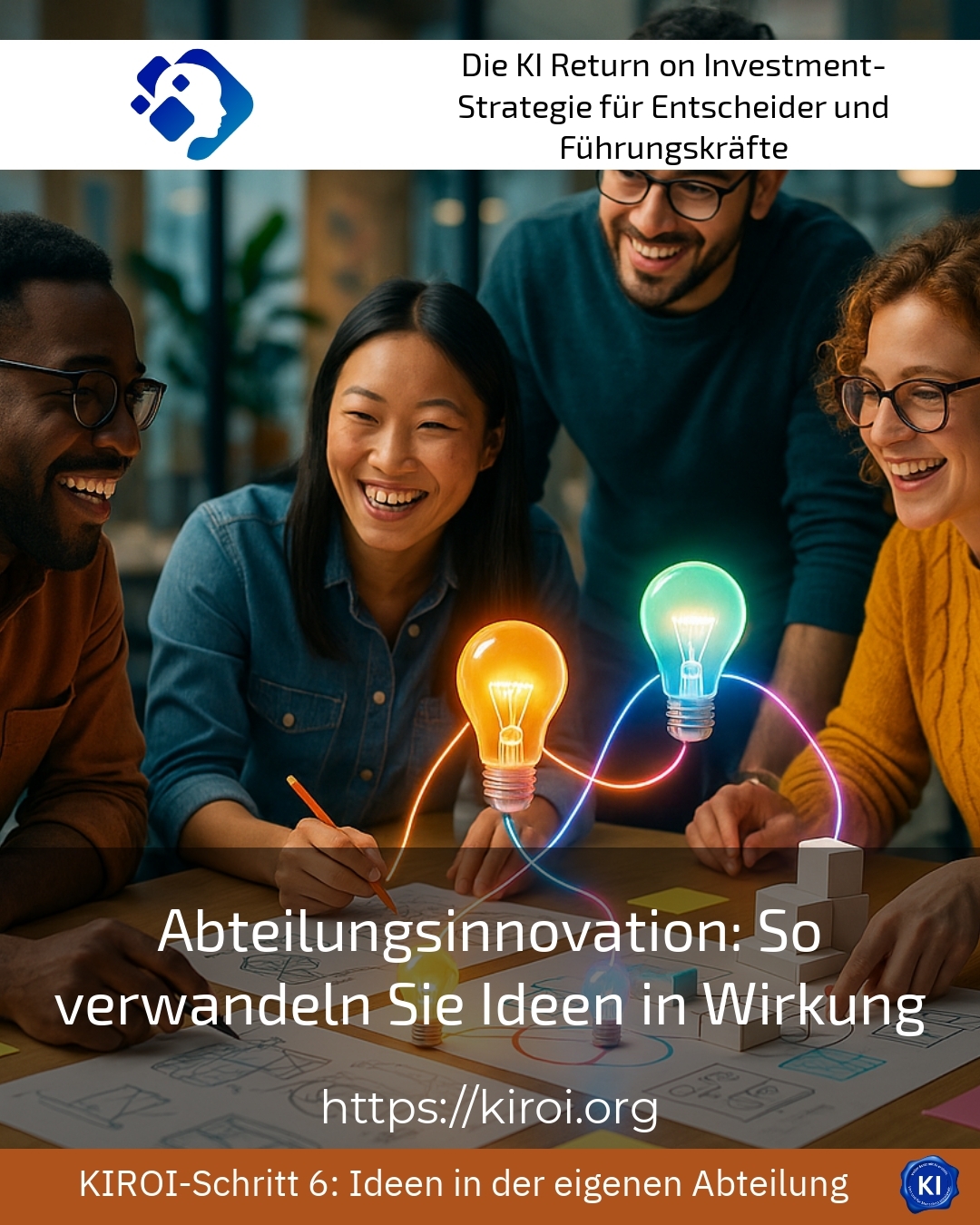
Imagine that dozens of brilliant ideas that never see the light of day lie dormant in your organization every day. Most companies struggle not with a lack of creativity, but rather with the systematic implementation of existing potential. Departmental Innovation: Turning Ideas into Impact It describes exactly this transformation process, which transforms abstract concepts into tangible results. But why do so many initiatives fail already in the initial phase? The answer often lies in missing structures and a lack of support from experienced initiators. transruptions coaching offers valuable support in realizing complex change projects.
Understanding the fundamentals of effective departmental innovation
Before teams can drive sustainable change, they need a deep understanding of the underlying mechanisms. Innovation rarely arises through random events or brilliant individual efforts. Rather, it results from systematically designed frameworks. These enable employees to bring their expertise to bear. Leaders often report similar challenges. They see enormous potential in their teams. At the same time, clear paths for implementation are often lacking. The question of the „how“ dominates many strategy discussions.
In the manufacturing industry, this is particularly evident at the intersection between production and development. When machine operators recognize optimization opportunities daily, they need channels for communication. For example, an automotive supplier established digital idea platforms for its shift workers. Within a few months, these platforms collected over three hundred improvement suggestions. In retail, progressive companies systematically utilize the knowledge of their sales staff. They regularly ask those who have direct contact with customers. In healthcare, groundbreaking process improvements often arise through nursing staff. They see daily where processes could be optimized.
Creating structures for sustainable department innovation
The establishment of viable structures forms the foundation of any successful transformation initiative. Without clear processes, even the best concepts become ineffective in day-to-day operations. Teams need defined timeframes for creative work. They also need resources for experimentation. Particularly important in this context is the legitimacy provided by the leadership level. Employees must know that innovation is desired.
A chemical company introduced so-called „innovation days“ where teams were allowed to pursue their own projects. The results significantly exceeded all expectations. A logistics service provider established cross-departmental working groups that brought together different perspectives. In the banking sector, similar initiatives created new digital services. Customer support representatives developed intuitive applications together with IT specialists.
Best practice with a AIROI customer
A medium-sized company in the food industry approached our team with a clear challenge in front of them. The management had recognized that numerous valuable improvement suggestions from the workforce had never been implemented. The employees were increasingly frustrated and withdrawing from the workplace. As part of a transruptive coaching process, we first analyzed the existing communication channels between the various hierarchical levels. We found that no structured channels existed for submitting and evaluating suggestions. Together with the management team, we developed a multi-stage system for idea evaluation that ensured transparency and fairness. The implementation took place gradually over a period of six months, with regular feedback loops enabling continuous adaptation. Upon completion of the mentoring program, both executives and team members reported a noticeably improved innovation culture. The number of submitted proposals tripled within a year. Particularly gratifying was the increased implementation rate from 10 percent to over 50 percent.
From the idea to the prototype through targeted support
The transition from theoretical concepts to practical implementations requires a methodical approach and patient guidance. Many organizations significantly underestimate this critical phase. They invest in idea generation and forget about implementation. Yet this is where the difference between success and failure lies. Successful companies establish mechanisms for rapid validation. They test early and fail small.
In software development, teams use agile methods for this process. They create minimal viable products within a few weeks. In the pharmaceutical industry, ideas undergo structured evaluation processes. Experts from various disciplines examine feasibility and potential. In mechanical engineering, prototypes are often created through additive manufacturing today. Three-dimensional printers enable rapid iteration cycles. These examples impressively demonstrate the importance of suitable tools.
Overcoming resistance in department innovation
Any change brings resistance, and this human reaction deserves understanding and respect. Employees often fear the loss of established routines. They worry about their competencies and positions. Leaders best address these fears with transparency. They communicate openly about goals and impacts. At the same time, they create spaces for concerns.
An insurance company encountered internal resistance through intensive dialogue formats. Skeptics were given the opportunity to contribute their perspectives. In the trade sector, reluctance towards digital tools is often evident. Successful companies rely on a gradual introduction and personal support [1]. In the hotel industry, resistance to innovation arose due to generational conflicts. Older employees felt outpaced by younger colleagues. Mentoring programs helped build bridges between the groups.
Best practice with a AIROI customer
A city administration sought support in modernizing its internal processes and therefore turned to our consulting team. The initial situation was characterized by significant tensions between different departments, with each unit insisting on its established working methods. Through transruptive coaching, we initially guided the management in developing a shared vision that included all involved parties and motivated them. In moderated workshops, mixed teams identified pain points and developed concrete solutions for the most pressing challenges of everyday life. Pilot projects, particularly effective in creating early successes and thus convincing more employees, proved particularly effective. Initial skeptics were converted into committed supporters of the change through positive experiences, which significantly accelerated the entire process. After eighteen months of intensive support, the processing time for citizen complaints had been reduced by an average of forty percent. Employee satisfaction had measurably increased, and the turnover rate had significantly decreased. These results confirm the value of professional support in complex transformation projects.
Measurable results through systematic evaluation
The effectiveness of innovation initiatives must be demonstrated through appropriate metrics. Only then can investments be justified. Furthermore, measurements enable continuous improvements. This requires taking into account both quantitative and qualitative aspects [2]. The mere number of submitted ideas does not provide much insight into their quality.
Technology companies often use elaborate scoring models for their evaluations. These take into account factors such as market potential and technical feasibility. In the education sector, institutions evaluate innovation projects based on pedagogical effectiveness. Schools measure learning progress and the engagement of students. In the energy sector, sustainability metrics play a central role. Companies evaluate new processes based on their ecological footprint.
Cultural embedding of department innovation
Long-term success requires the deep embedding of innovative practices in the corporate culture. Individual projects may succeed, but without a cultural foundation they remain exceptions. Leaders shape the organization’s norms through their behavior. When they themselves exhibit an attitude of experimentation, teams follow this example. Toleration of failure develops through consistent role modeling.
A media company established regular „Fail Forward“ sessions where teams analyzed failed experiments and learned from them. These events quickly became valued learning forums. In the construction industry, innovation circles were created that brought together tradespeople from different sectors. The participants exchanged experiences and jointly developed new solutions [3]. A telecommunications provider introduced innovation awards that distinguished particularly creative teams. This symbolic recognition significantly increased engagement.
The role of external support in transformation processes
Many organizations benefit significantly from external support for their change initiatives. Outsiders bring fresh perspectives and proven methodologies. They spot blind spots that insiders overlook. At the same time, they often enjoy greater neutrality in internal conflicts. transruptions-Coaching supports companies in various industries with such projects.
A textile manufacturer used external support for the digitization of its design processes. The combination of industry knowledge and methodological expertise significantly accelerated the transformation. In tourism, external impetus helped develop sustainable business models. Hotels and tour operators found new ways to differentiate themselves. A publishing house transformed its business model with professional support. The development of digital offerings was faster than originally planned.
Best practice with a AIROI customer
A traditional family business in the machinery and plant engineering sector faced the challenge of fundamentally modernizing its innovation processes without compromising the established corporate culture. The third generation of owners recognized the need for digital transformation, but encountered significant concerns from long-standing employees and executives. In an intensive transruptive coaching process, we developed a roadmap together with the company that combined tradition and progress while involving all stakeholders. Particularly important was the inclusion of experienced professionals as mentors for younger colleagues, ensuring the preservation of valuable tacit knowledge. In parallel, we established digital collaboration platforms that improved communication between locations and enabled new forms of collaboration. The implementation was carried out carefully over a two-year period with regular reflection loops and adjustments to changing conditions. At the end of this process, ninety percent of the respondents reported improved collaboration between generations and departments. The development cycles for new products were shortened by a third, while at the same time quality remained stable.
My AIROI Analysis
The systematic examination of numerous innovation projects reveals recurring success patterns and common stumbling blocks that organizations should be aware of. Companies that achieve sustainable change are characterized by several common characteristics that have proven themselves in different industries and contexts. First, they consistently invest in the empowerment of their employees and create spaces for experimentation and learning experiences. Second, they establish transparent processes for evaluating and prioritizing ideas so that all stakeholders understand and accept the decision criteria. Third, they embed innovation efforts in the corporate culture through symbolic actions and concrete allocation of resources, which sustainably strengthens the commitment of the teams.
The AIROI-methodology supports the structured analysis of an organization's innovation maturity level and identifies areas of action with the greatest leverage potential for positive change. It is repeatedly shown that technical solutions alone are not sufficient, but must always be combined with cultural interventions to fully realize their effectiveness. The human dimension of change processes deserves special attention, as it determines the success or failure of initiatives. transruptions coaching offers valuable support by addressing both strategic and emotional aspects, enabling holistic transformation. Organizations that embark on this path often report surprising positive side effects such as increased employee satisfaction and improved employer attractiveness, which go far beyond the original project objectives.
Further links from the text above:
[1] Bitkom – Digital Transformation in Small and Medium-sized Businesses
[2] Harvard Business Review – Innovation Management
[3] Fraunhofer Society – Innovation research
For more information and if you have any questions, please contact Contact us or read more blog posts on the topic Artificial intelligence here.








 Deutsch
 English (UK)