
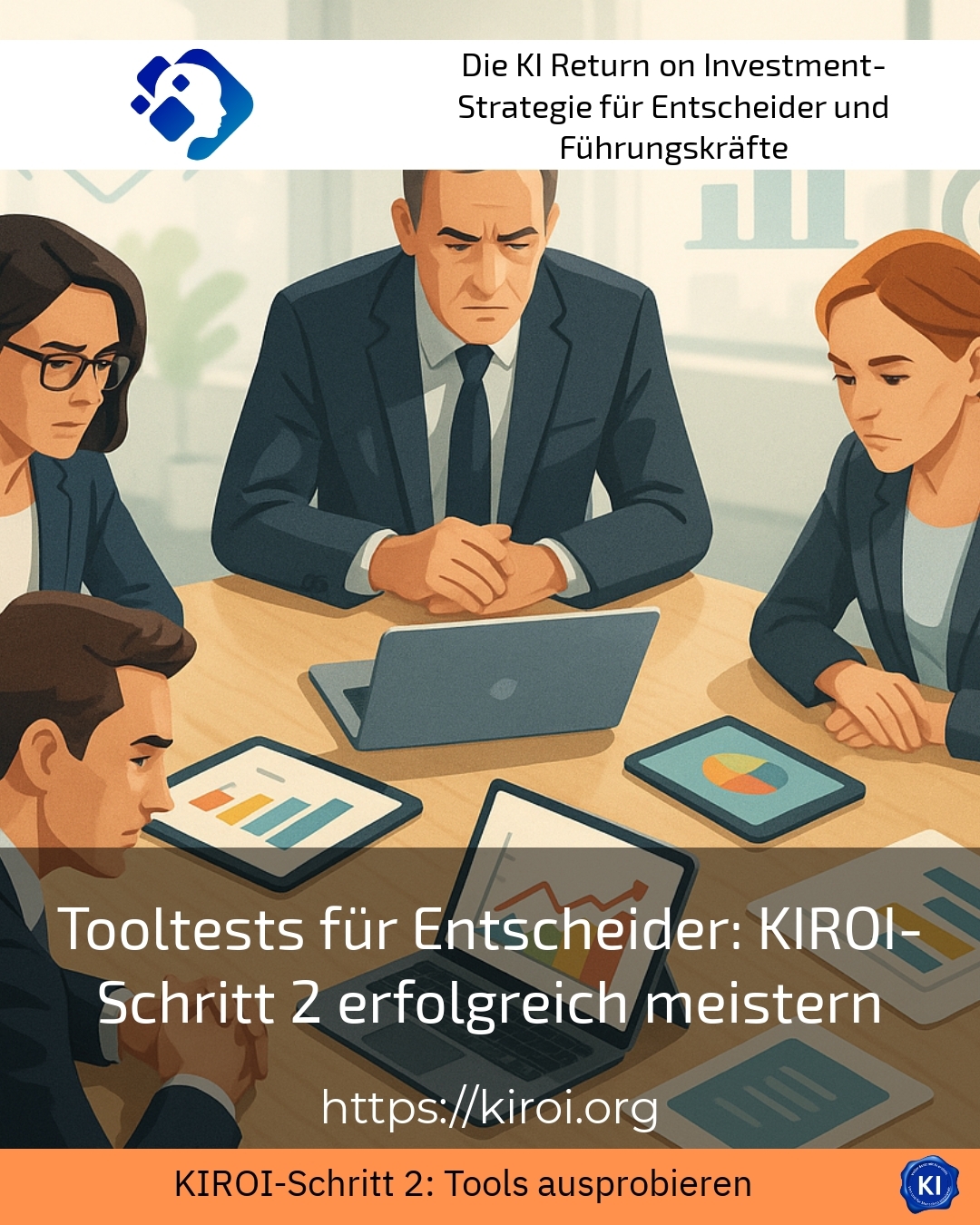
Tool tests are an essential component for many decision-makers to confidently select and successfully implement suitable digital tools. Particularly in the context of KIROI Step 2, targeted tool testing supports the pragmatic and goal-oriented design of digital transformation. This allows decision-makers to test various tools under real-world conditions and filter out those that best support and effectively assist the organisation's own processes.
Tool tests in the KIROI Step 2: Systematic and practice-orientated approach
In the second step of the KIROI model, tool testing is the main focus in order to thoroughly evaluate new technologies. This concerns not only the technical functionality but also user-friendliness and compatibility with existing systems. Successful tool tests are characterised by a clear structure: requirements are analysed in detail, concrete use cases are defined, and suitable tools are selected based on these. This is followed by practical tests in real-world environments to identify the actual benefits and potential challenges.
This approach is applied across various industries: for example, a logistics company tests different tracking and fleet management tools to assess their integration into its existing IT ecosystem. In the marketing sector, agencies evaluate automation tools directly on ongoing campaigns, thereby receiving immediate feedback on their effectiveness. Healthcare facilities also use tool testing to assess software solutions for patient data management, taking data protection and user-friendliness into account.
Practical examples from the industry
BEST PRACTICE with one customer (name hidden due to NDA contract) A medium-sized manufacturing company conducted a tool test with new planning systems, paying particular attention to usability and integration with existing ERP systems. Through workshops with various specialist departments, they gathered valuable feedback, enabling them to identify a perfectly tailored solution that will sustainably support their production process.
Financial service providers similarly used tool tests to test compliance-oriented document management systems under everyday conditions. This way, they ensured that the solutions met legal requirements while also making the work of employees easier. In the retail sector, checkout systems and merchandise management software, in turn, underwent intensive usability testing to ensure seamless integration into branch operations.
Tips for a successful tool test
Anyone implementing tool tests in KIROI Step 2 should consider some key recommendations:
- Define concrete use cases: The benefit of tools can only be objectively assessed if the use cases are clearly defined.
- Working with various stakeholders: Involve IT, specialist departments, and end-users early on to capture different perspectives.
- Conduct practical tests: Use real data and scenarios instead of theoretical examples.
- Document results systematically: Transparent feedback helps to make decisions understandable and to make adjustments.
- Using coaching for support Professional support provides structure and impetus, and promotes greater acceptance among users.
These points are found across a wide range of industries and strengthen the success of using digital tools. For example, a software provider for the construction industry conducts tool tests to ensure their on-site project management solutions are truly practical. In the education sector, schools test learning platforms with various teaching teams to optimise usability. Likewise, a delivery service provider evaluates automation tools for parcel tracking with a focus on high scalability and simple integration.
Benefiting from transruption coaching support
Transruptions-Coaching provides professional support for tool testing. It helps define the right evaluation criteria and focuses on the most important decision factors. This ensures no effort is wasted on unmanageable test runs, making the selection process transparent and easy to understand. Clients often report increased innovation capacity because the process combines agile methods with a needs-oriented approach.
Another advantage is the support in integrating different departments. This ensures that decision-makers consider not only technical aspects but also organisational and cultural factors. This has a positive effect on the later acceptance of the selected tools and minimises resistance during implementation.
My analysis
The tool test within KIROI Step 2 is an indispensable step for decision-makers who want to make well-founded and practically relevant decisions. Through a structured approach that incorporates concrete use cases, realistic tests, and systematic feedback, suitable tools can be reliably identified and successfully integrated. The inclusion of transruption coaching offers valuable support to shape the process purposefully and strengthen acceptance within the organisation. This results in solutions that provide real impetus for digital transformation projects and bring about sustainable improvements.
Further links from the text above:
Tool test in KIROI Step 2: Evaluating AI innovations in practice
Tool Test in KIROI Step 2: How Decision-Makers Find the Best
Tool Testing: How to Succeed with Step 2 of the KIROI Methodology
Tool test in KIROI step 2: How decision-makers get started
Tool Tests in KIROI Step 2: How Decision-Makers Find the Right Tool
For more information and if you have any questions, please contact Contact us or read more blog posts on the topic Artificial intelligence here.











 Deutsch
  English (UK)