
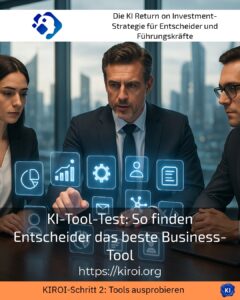
Many decision-makers face the challenge of finding the right digital tools for their projects. A tool test in AIROI Step 2 offers a structured approach to identify suitable solutions. Clients often report that they lose a lot of time and energy without a clear procedure. A targeted tool test allows requirements to be precisely captured and the selection to be objectively evaluated. This avoids a shot in the dark, instead fostering a focused approach that sustainably strengthens project success.
Was ist ein Tooltest und warum ist er wichtig?
A tool test is more than a quick glance at features. It is an iterative process that allows for continuous learning. Decision-makers first define clear use cases so they can specifically select suitable tools. Only then does the test remain relevant to practice and the feedback meaningful. The involvement of relevant stakeholders and the documentation of all steps are crucial for transparency and communication.
In tool testing, decision-makers don't just focus on technical features, but also on user-friendliness, compatibility with existing systems, and adaptability to individual processes. This ensures that the tool genuinely supports daily work and doesn't just present another hurdle.
Practical examples: Tool testing in various industries
In the manufacturing industry, tool testing is frequently used to evaluate early warning systems for machine faults. This helps to reduce downtime and boost production quality. In the area of office organisation, routine tasks are made easier by automation tools. Here, aspects such as easy integration into existing office applications and data security are at the forefront during a tool test.
In the healthcare sector, facilities specifically use tool testing to examine digital documentation systems under real working conditions. This increases efficiency and minimises potential errors. In retail, tool testing is used to test e-commerce solutions for performance and customer satisfaction. This enables targeted improvements to be made, which sustainably boost sales.
Tool test as support for projects
Transruptions-Coaching supports decision-makers on projects involving tool testing. Clients often report that such guidance provides crucial momentum and motivates the team to embrace and actively shape new technologies. Professional support helps to clearly define objectives, establish suitable metrics for evaluation and guide the team through the entire process.
In the tool test, practical scenarios are developed that depict realistic use cases. The documentation of the results ensures transparency and facilitates communication in the decision-making process. This leads to well-founded decisions that contribute to the long-term success of new system implementation.
BEST PRACTICE with one customer (name hidden due to NDA contract)
BEST PRACTICE with one customer (name hidden due to NDA contract) In a manufacturing company, a tool test was used to evaluate an AI-powered maintenance system. Support from transruption coaching enabled clear objective setting and helped to analyse the test results in a structured manner. This allowed technical challenges to be identified early on and adjustments to be made before the system went into series production. Employees reported a significant increase in process stability and higher acceptance of the new system.
Tips for a successful tool test
Always start with a thorough analysis of the requirements and the definition of concrete use cases. Select potentially suitable tools and test them in real projects or test environments. Pay attention not only to technical functions but also to user-friendliness, compatibility with existing systems, and adaptability to individual processes.
Integrate relevant specialist areas from IT, production, and management to develop practical scenarios. Document all steps and results to ensure transparency. Utilise external input and coaching to professionally support the process.
My analysis
The tool test in AIROI step 2 is an essential building block for informed decision-making in software and tool selection. Approaching this step in a structured manner with accompanying coaching increases the likelihood of finding and implementing suitable tools. Practical examples from various industries show how diverse the requirements are and how important a transparent testing phase is. Overall, the tool test supports decision-makers in carefully weighing the costs, effort, and benefits of digital technology, thereby sustainably strengthening project success.
Further links from the text above:
Tool Test in AIROI Step 2: How Decision-Makers Find the Best Solution
Tool Test in AIROI Step 2: How Decision-Makers Find the Best
Tool testing for decision-makers: Successfully using AIROI step 2
AIROI Step 2: Tool Testing – How Decision-Makers Test AI Solutions
Tool Test in AIROI Step 2: How Decision Makers Test AI Tools
Tool test for decision-makers: successfully mastering AIROI step 2
How decision-makers master AI tools in the AIROI Step 2
AIROI Step 2: Unleash AI Potential with the Tool Test
For more information and if you have any questions, please contact Contact us or read more blog posts on the topic Artificial intelligence here.










 Deutsch
  English (UK)