
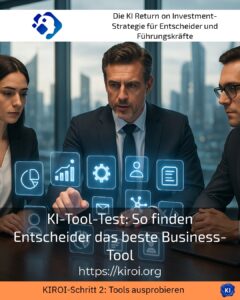
The path to the right solution: Tool test in AIROI Step 2
Choosing the best tool is a crucial step that can significantly influence the success of a project. The tool test in AIROI step 2 is about finding out which tool precisely matches one's own requirements and how it proves itself in practical, everyday use. Decision-makers often approach us with a variety of questions: Which software best supports digitalisation? How can a tool be integrated into existing workflows without great effort? And how can employees be supported in the best possible way so that the use of the tool brings about sustainable improvements?
Systematic approach to tool testing
The tool test in AIROI Step 2 begins with a precise analysis of the requirements and the definition of use cases. Only after this is done is the selection of potentially suitable tools made, which are then tested in real projects or test environments. In doing so, decision-makers consider not only the technical functions but also user-friendliness, compatibility with existing systems, and adaptability to individual processes. These criteria help to find a tool that genuinely supports the daily workflow and is not just another software solution.
Many users report from practical experience that the effectiveness of a tool increases significantly with regular use and targeted customisation. This means that a tool test is not a one-off event, but is understood as a dynamic process. Continuous testing and optimisation yield valuable insights for long-term integration.
Practical examples from various industries
AIROI BEST PRACTICE at company XYZ (name changed due to NDA contract) In a medium-sized company in the technical services sector, it became apparent that an SEO tool with a strong focus on competitor analysis and keyword gap analysis offers significant added value. The tool made it possible to specifically improve one's own rankings against competitors and identify gaps in keyword coverage. This impetus was experienced as particularly valuable, especially for the development of digital strategy.
In manufacturing companies, tool testing is frequently used to evaluate early warning systems that enable fault detection even before downtime. This allows production processes to be stabilised and downtimes to be reduced.
In the area of office organisation, routine tasks are made easier by automation tools. During a tool test, aspects such as simple integration into existing office applications and data security are paramount.
Incorporation of user feedback and documentation
A central component of tool testing in AIROI Step 2 is collecting user feedback. This feedback is systematically incorporated into the evaluation and helps to identify potential and obstacles early on. This prevents the tool from only being a theoretical fit but not being adopted in practice.
The documentation of test results also makes it possible to make decisions transparent and to create traceability. For project managers, this is an important basis for ensuring sustainable use.
Support through accompaniment in tool testing
To make these processes safe and targeted, AIROI coaching offers support. This does not involve making promises about the full effect of a tool, but rather provides targeted impulses and ensures guidance during the testing phase. Companies often report increased innovation, improved process quality, and greater team acceptance through this support.
This way, the tool test remains not just a technical review, but becomes a strategic element for sustainable development and growth.
My analysis
A tool test within a structured process, such as in AIROI Step 2, provides practical insights that go far beyond mere functionality. It helps decision-makers make the best choice from the vast array of available tools, optimise their use, and sustainably promote acceptance within the company. Comprehensive analysis, the incorporation of user feedback, and ongoing support are important building blocks for success.
Further links from the text above:
[1] Mastering tool evaluation: AIROI step 2 – Try out AI tools
[2] Tool test in AIROI step 2: The best tools for decision-makers
For more information and if you have any questions, please contact Contact us on or read further blog posts on the topic Artificial Intelligence Blog here.










 Deutsch
  English (UK)