
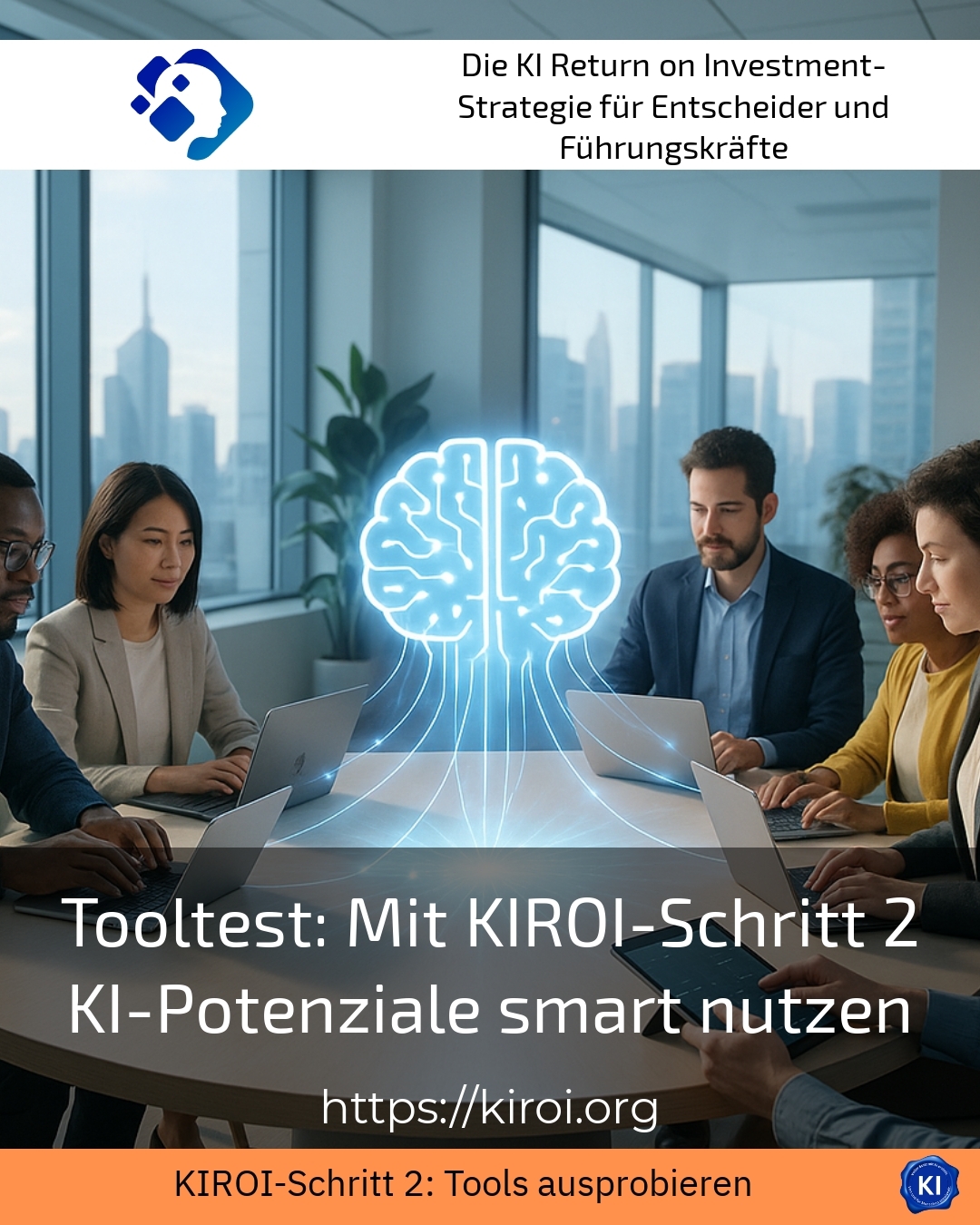
The term Tooltest In the context of the KIROI Step 2, it stands for a structured approach that companies can use to specifically identify and practically test the potential of AI solutions. The focus is not just on selecting tools, but on testing them in a practical way to truly assess their suitability for individual requirements. This approach supports decision-makers in strengthening their company's innovative capacity through perfectly tailored technologies.
How the tool test adds value in KIROI step 2
The Tooltest This is not a mere functional test. It guides users from the analysis of requirements and the selection of suitable tools to practical testing in real work scenarios. Several aspects play a role here, including user-friendliness, technical integration into existing systems, and adaptability to individual company processes. This provides companies with a reliable assessment of which AI solutions will truly advance them.
For instance, a manufacturing company runs the Tooltest through, to test an AI-based maintenance software for its ability to detect faults early and thus minimise downtime. In the service industry, through the Tooltest checks whether marketing automation tools improve target group analysis and increase efficiency. In contrast, an agency tests workflow tools to see if they reliably automate routine tasks while ensuring simple integration into existing office applications.
Practical steps and success factors for tool testing
A successful Tooltest requires systematic planning. Crucially, precise use cases must be defined to accurately reflect how the tool will be used in the specific company environment. Only then can realistic test results be achieved. Equally important is the involvement of various departments: IT, business departments, and management should be involved early on to gather diverse feedback and promote acceptance.
For concrete implementation, the following tips are recommended:
- Use real data and practice-relevant scenarios to test functionality under real-world conditions.
- Capture user feedback systematically and document the results transparently.
- Utilise supporting experts such as transruption coachings, which provide impulses and moderate the process.
These measures help to avoid wrong decisions and promote the sustainable integration of AI tools.
BEST PRACTICE with one customer (name hidden due to NDA contract)
Best practice with a client The tool test was used here to proactively check an AI-supported maintenance system. Through systematic monitoring, technical weaknesses were recognised early and solution approaches were developed. Employees were convinced by the improved process stability, and the introduction went significantly more smoothly than would have been possible without such a targeted trial phase.
Industry examples: How companies benefit from tool testing
The Tooltest is proven to be successful in many industries and brings specific advantages. In healthcare, it is used to test digital documentation systems under load in order to reduce error rates and improve workflows. In retail, companies benefit from targeted testing of e-commerce platforms, which not only increases performance but also enhances customer satisfaction through targeted optimisations. In the manufacturing industry, it allows for the identification of Tooltest Quickly, which early warning systems can minimise downtime - with noticeably more stable production processes as a result.
Why the tool test is useful as an accompaniment
Many companies report that technical testing alone is not sufficient. Support from professional coaches or special methods like transruption coaching is particularly helpful during change processes. They provide impetus, structure the process, and promote clear goal formulation, which simplifies the introduction of the tools. After all, projects often fail not because of the technology, but due to a lack of acceptance or unclear requirements.
My analysis
The Tooltest KIROI Step 2 is an indispensable tool for the intelligent utilisation of AI potential. It offers a transparent, practical platform for evaluating new digital tools. The systematic integration of user feedback and documented analysis make poor decisions less likely. This ensures in a sustainable way that new technologies are not only technically impressive but also create real added value in everyday work. Accompanying coaching supports the management of complex introduction processes and increases acceptance within the team.
Further links from the text above:
Tool testing in KIROI Step 2: Practical KI innovations
Tool Test in KIROI Step 2: How Decision-Makers Find the Best
Tool test in KIROI step 2: How decision-makers get started
For more information and if you have any questions, please contact Contact us or read more blog posts on the topic Artificial intelligence here.











 Deutsch
  English (UK)