
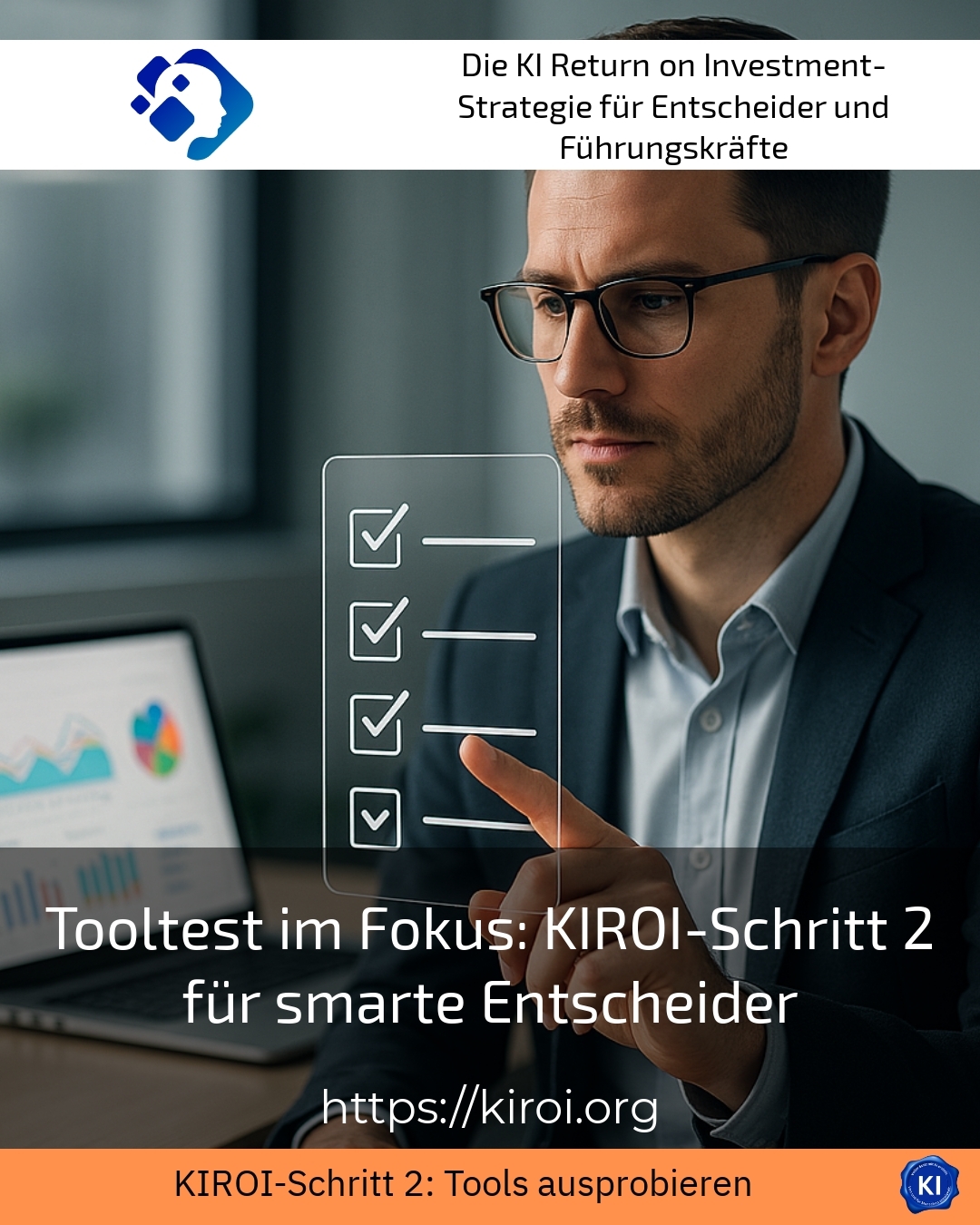
The term Tooltest is at the heart of the second step in the KIROI process, which is gaining particular importance for smart decision-makers. It supports executives in selecting precisely those digital tools from the multitude of available options that optimally match their company strategy and practical requirements. A successful Tooltest begins with a systematic analysis of individual needs and a clear definition of concrete use cases. This ensures that the tested tools are not only functionally convincing but also excel in terms of integration and user-friendliness.
Tool Test in KIROI Step 2: Foundation for Smart Decisions
In the KIROI process, the Tooltest In the second step, a structured basis is established for selecting software solutions that are intended to support companies long-term. The precise determination of requirements helps to keep the testing phase focused. Only then does the selection of potential tools take place, which are then put through their paces in real or simulated projects with defined use cases. In addition to technical criteria, decision-makers pay particular attention to compatibility with existing systems and the possibility of individual adaptation to company processes.
So, for example, in the manufacturing industry, it has been shown that early error warning systems have, through the Tooltest can be successfully evaluated. Companies are testing AI-powered diagnostic tools that help to predict machine failures and prevent production downtimes. In marketing, companies are also using Tooltest to check automation tools that allow for competitive analysis and uncover keyword gaps. Office administration teams, in turn, evaluate tools that automate routine tasks and can be seamlessly integrated into office environments.
Practical applications of tool testing in different industries
The process Tooltests thrives on practical experience and continuous learning. In the manufacturing industry, companies use the test to evaluate digital early warning systems for machine operation. This allows them to increase efficiency and reduce downtime. A medium-sized service company also gained significant impetus for its digital strategy development thanks to an SEO tool that, as part of the tool test, was focused on competitor analysis.
In office organisation, a carefully conducted tool test facilitates the implementation of automation solutions that take over administrative tasks safely and efficiently. By specifically examining user-friendliness and data security, companies can ensure that the software used truly supports everyday work and does not lead to increased burdens.
BEST PRACTICE with one customer (name hidden due to NDA contract) In a technical services company, the tool test enabled a targeted selection of an SEO tool with a strong focus on competitor and keyword analysis. This allowed for a sustainable improvement of the digital presence and a strengthening of the market position against competitors. The support from transruptions-coaching assisted the company with the professional evaluation of the test results and the targeted derivation of measures.
Key benefits through structured tool testing
A structured Tooltest is more than just a functional testing phase. It is an iterative process that promotes continuous learning and sustainable integration. It not only checks the software for technical properties, but also incorporates requirements such as user-friendliness, adaptability to internal processes, and data security. This allows decision-makers to reduce uncertainty and create a transparent, documented basis for evaluation.
Tool testing also proves its worth in sectors such as retail and healthcare: for example, a retail company tested various e-commerce platforms to compare performance and customer satisfaction. In healthcare, testing digital documentation systems helps to make processes more efficient and reduce error rates.
It is important to Tooltest not to be understood as a one-off event. Rather, the continuous readjustment and further development of the tools used are crucial in order to anchor them sustainably within the company and to maximise their benefits in everyday life.
Tips for a successful tool test
Successful decision-makers recommend developing a clear requirement profile at the start of tool testing and linking it to the defined use cases. Relevant stakeholders should be involved early on to incorporate different perspectives. The test environment should be designed to be as practical as possible to simulate real work situations. Continuous documentation of test results facilitates transparent decision-making.
Furthermore, it is advisable to utilise external stimuli and coaching services, such as transruptive coaching, for process support. This helps to focus on the essentials and to professionally manage the testing process. In this way, the tool test can not only facilitate software selection but also contribute to the further development of corporate strategies.
My analysis
The Tooltest In KIROI Step 2 is an essential element for companies that want to choose digital solutions with sustainable benefits. It helps to systematically identify the right tools based on technical functions, user-friendliness, and process integration. Practice shows that a structured and iterative testing process forms the basis for successful digitalisation. Furthermore, support and coaching provide additional impetus to actively support topics such as integration and change management. Overall, it promotes the Tooltest the quality of decisions and significantly contributes to the success of digital projects.
Further links from the text above:
Tool testing in KIROI step 2: How leaders can find their AI tool
Tool Testing in Focus: How to Succeed in Step 2 of the KIROI Process
Tool Test in KIROI Step 2: How Decision-Makers Find the Best
Tool Testing in the KIROI Step 2: How Decision-Makers Find the Best Tools
Tool Test: Selecting KIROI Step 2 KI Innovations Successfully
KIROI Step 2: Tool Test – How Decision-Makers Evaluate AI Solutions
Tool-Test: Master KIROI Step 2 the smart and efficient way
For more information and if you have any questions, please contact Contact us or read more blog posts on the topic Artificial intelligence here.











 Deutsch
  English (UK)