
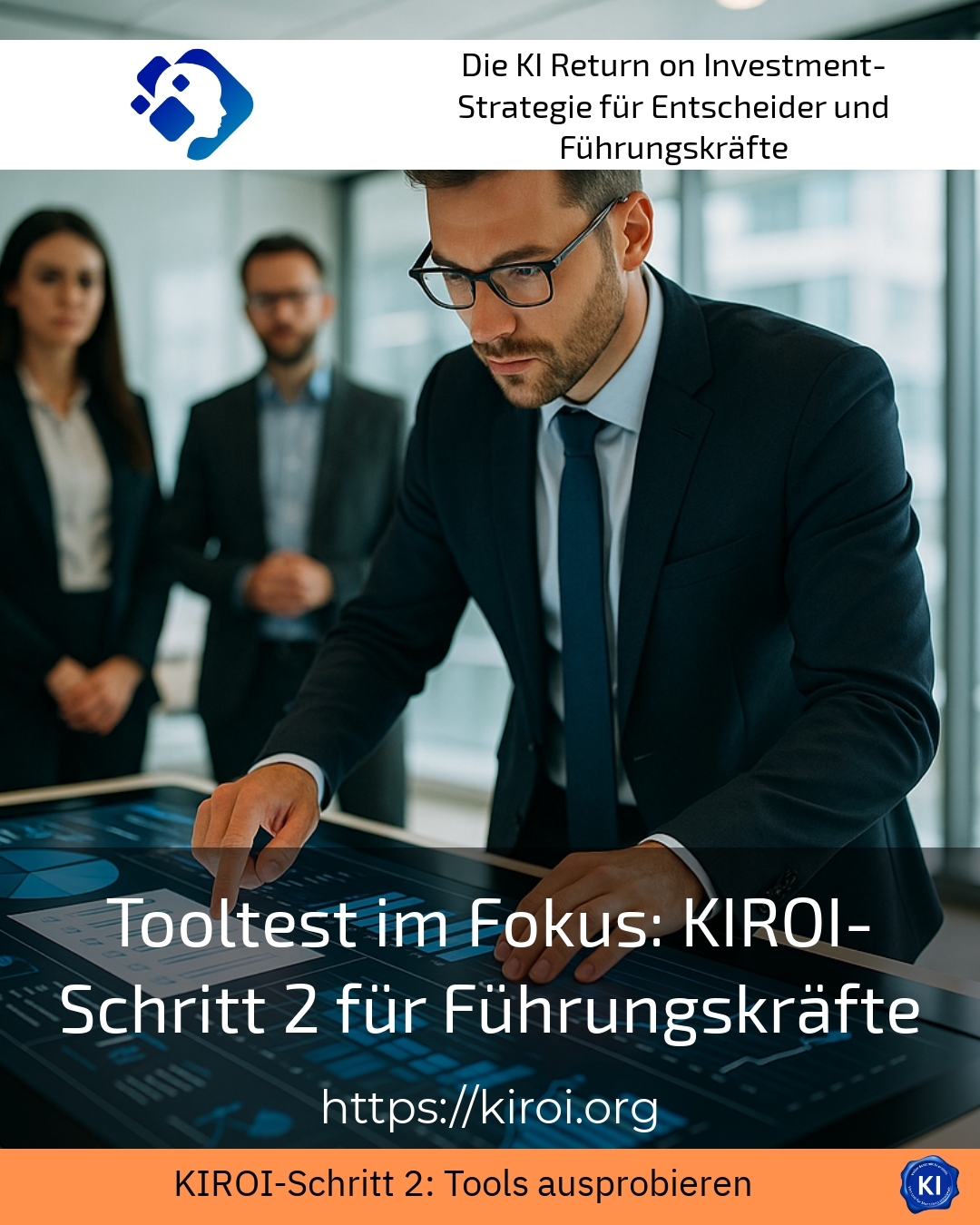
In the age of digital transformation, the term Tooltest increasingly important – especially within the scope of KIROI Step 2 for executives. The tool test supports the structured selection of suitable software solutions and digital tools. This allows projects to be designed more efficiently and valuable resources to be conserved.
How the tool test supports managers in KIROI Step 2
Managers are often faced with a multitude of technical tools. Tooltest provides a systematic method to organise this diversity and find individually suitable solutions. The starting point is a detailed definition of the requirements within one's own work environment and project.
For example, a manufacturing company can carry out a tool test as part of the KIROI process to evaluate software for process monitoring. This involves not only checking functionality but also integration into existing production lines and user-friendliness for employees. This helps to reduce false alarms and optimise maintenance times.
The effect of the tool test is also evident in sales: one team tested an AI-powered chatbot. Via the Tooltest It has been revealed that the bot's customisability for individual customer requests is essential for success, and counts for more than purely standard functions. This leads to better customer loyalty and efficiency in communication.
Furthermore, user acceptance by employees is a key aspect. A service company faced the challenge of introducing a new CRM system. The tool test enabled a comparison of various candidates based on real scenarios. The choice fell on a solution that offered intuitive user guidance and could be flexibly adapted during ongoing operations.
Practical implementation of tool testing: How to achieve successful selection
Getting started with tool testing involves a precise analysis of your own requirements and the inclusion of various stakeholders. Managers should also specifically seek feedback from end-users. Test criteria can be established based on these inputs.
An example from the marketing industry: A company tested campaign automation tools. The tool test examined how well the software integrates with existing systems, whether the automation rules can be flexibly adjusted, and how intuitive the user interface is.
In another case, a gym used the tool test to select a customer management system. In addition to functionality, users primarily evaluated the integration into everyday training and the manufacturer's support. As a result, a solution was chosen that meets individual needs and improves the customer experience.
Another example can be found in the accounting department of a medium-sized company. A tool test was carried out there for the introduction of digital invoice processing. It emerged that, in addition to the technical interface, the training programmes also had a decisive influence on acceptance.
Best Practice: Tool Testing as a Holistic Process
BEST PRACTICE with one customer (name hidden due to NDA contract) and then the example with at least 50 words.
In a successful project, the tool test proved to be an integrative element. From initial contact to the final verdict, managers and users were closely involved. This participatory approach fostered acceptance and significantly reduced risks during implementation.
Why the tool test in KIROI step 2 is so important
The Tooltest This allows decisions to be made based on transparent criteria, minimising mistakes and easing budgets. At the same time, it supports managers in actively shaping digital transformation and selecting the right partners for complex projects.
In practice, many leaders report that the tool test provides them with transparency and enables them to better master complexity. The combination of technical assessment, user focus, and strategic integration makes the tool test a valuable instrument.
My analysis
The Tooltest In the KIROI Step 2, a vital component for leaders aiming to make successful decisions in dynamic environments. Structured testing, involving relevant stakeholders and practical evaluation, creates a solid foundation for sustainable software selection. Companies benefit from improved efficiency, greater acceptance, and a future-proof digital infrastructure.
Further links from the text above:
Tool test in focus: KIROI Step 2 for managers
Tooltest: Step 2 with KIROI Successful AI Innovations…
KIROI Step 2: Unleash AI Potential with the Tool Test
For more information and if you have any questions, please contact Contact us or read more blog posts on the topic Artificial intelligence here.











 Deutsch
  English (UK)