
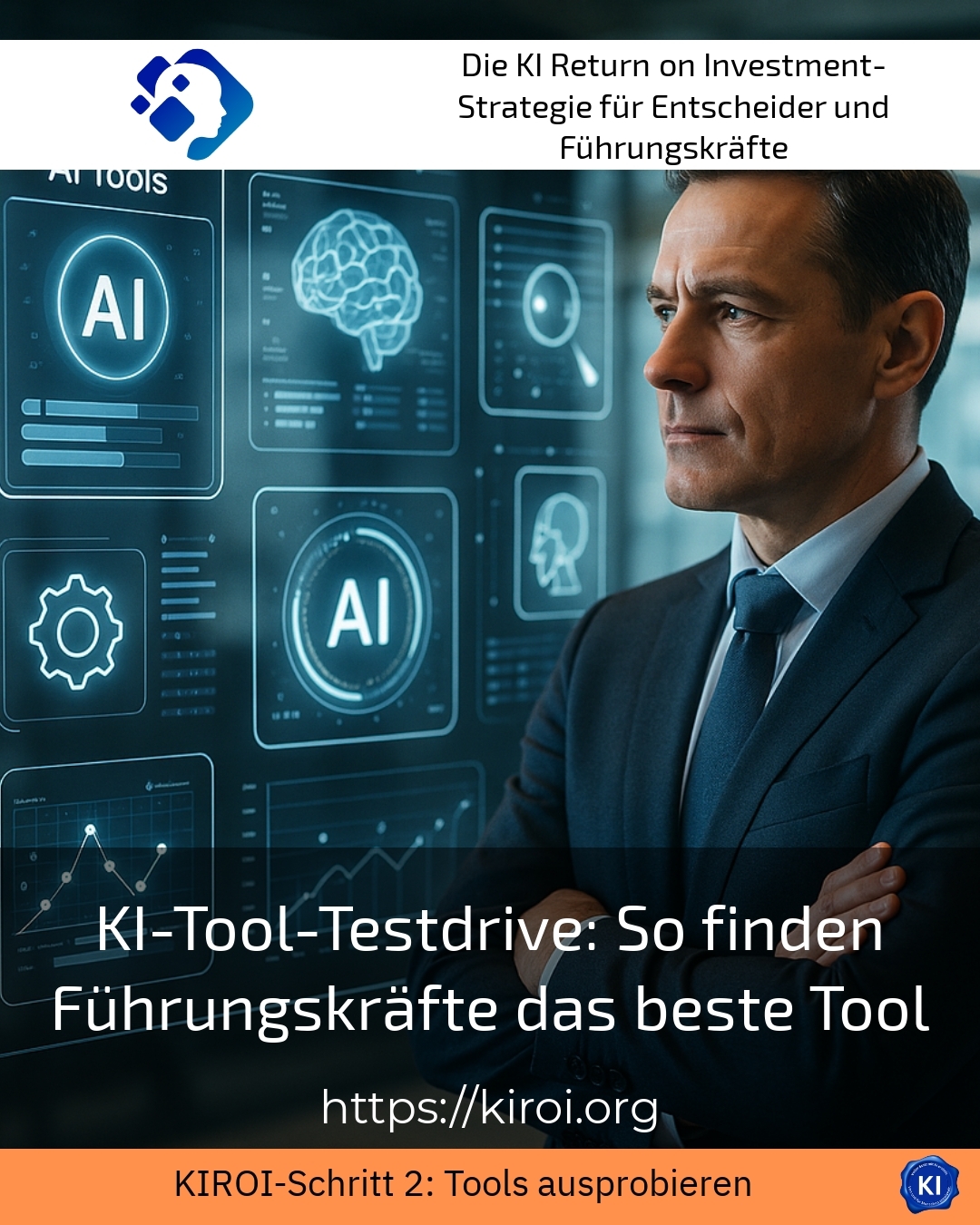
Digital transformation presents leaders with a key challenge that goes far beyond technical understanding. Those making strategic decisions for a company today are faced with an almost unmanageable wealth of tools, all promising to optimise processes, reduce costs, and secure competitive advantages. But how does one find, amidst this flood of offerings, precisely the solution that fits their own business model? AI Tool Test Drive: How leaders can find the best tool offers a structured approach that helps decision-makers make informed assessments and avoid costly mistakes. In an era where technological missteps can cost millions, systematic testing is becoming an indispensable management skill. This article will show you in a practical way which methods have proven effective and what you should pay particular attention to.
Why systematic testing has become indispensable
The times when technology decisions were made solely by IT departments are well and truly over. Today, executives must understand what possibilities modern tools offer and where their limitations lie. This competence cannot be delegated because strategic implications affect the entire company. A logistics company that relies on automated route planning is not just changing its dispatch operations, but also customer relationships, employee satisfaction, and ultimately its business model. The same applies to financial service providers who want to integrate algorithmic decision support into their consulting processes. Each of these decisions requires a deep understanding of the technology, which can only arise from hands-on experience.
Clients often report that after complex implementations, they discovered that the chosen solution did not fit their processes. Such experiences show how important a structured testing approach is before the final decision. A manufacturing company invested considerable sums in a quality control solution that worked impressively in theory. In practice, however, it became apparent that the lighting conditions in the production hall drastically reduced recognition rates. An upstream test run would have revealed this problem early on and saved the company a lot of money.
Best practice with a AIROI customer
A medium-sized retail company with multiple branches faced the challenge of modernising its inventory planning. Management had already shortlisted three different providers and was prepared to invest a six-figure sum. As part of our transruptions coaching support, we jointly developed a structured test drive process that ran for six weeks. All three solutions were fed in parallel with real sales data from two test branches, allowing for a direct comparison of forecast accuracy. The results considerably surprised management, as the supposed favourite performed worst in practice. The least expensive solution, on the other hand, delivered the most accurate predictions for the company's specific product range. This systematic approach not only saved the company investment costs but also provided valuable insights into its own data structures and process gaps.
AI Tool Test Drive: How Managers Can Find the Best Tool Through Clear Criteria
Before the actual testing process begins, managers should precisely define their evaluation criteria. This preliminary work is crucial to the success of the entire undertaking and prevents gut feelings from taking over. Firstly, it is important to identify the specific use cases for which technological support is required. An insurance company will focus on different priorities than a manufacturing business or a service company. The criteria should encompass both functional aspects and soft factors such as usability and integration capability.
In healthcare, for example, data protection and certifications play a prominent role, while in retail, scalability during peak loads can be crucial. A hospital evaluating diagnostic support systems must pay close attention to compliance with medical regulations. At the same time, the system should be designed so that doctors can operate it intuitively without having to interrupt their workflow. These differing requirements illustrate why standardised evaluation grids alone are insufficient and individual adaptations are necessary.
Another interesting field of application can be seen in the automotive industry, which illustrates the complexity of such decisions. Suppliers increasingly need to automate their quality assurance processes to meet manufacturers' growing demands. An optical inspection system that detects surface defects must not only be precise but also be integratable into existing production lines. Therefore, managers should also consider technical compatibility with existing systems as an evaluation criterion.
Setting up the test environment correctly
A realistic test environment forms the foundation for meaningful results and should therefore be prepared with appropriate care [1]. It is advisable to define a sub-area of the company as a pilot area where solutions can be tested under practical conditions. This area should be representative of the company as a whole, but at the same time manageable enough to limit testing effort. For example, an energy supplier could select a single region as a test area in which various forecast tools for energy demand run in parallel.
Banks and financial institutions often make use of so-called sandboxes, where new technologies can be tested in isolation from production systems [2]. This approach minimises risks while enabling realistic experiments. A credit institution evaluating automated creditworthiness checks can run historical application data through various systems and compare the results with actual credit histories. Such retrospective tests provide valuable insights into the predictive power of different approaches.
Involve employees and don't forget change management
Even the best tool will fail if the people who are meant to work with it cannot accept it or operate it correctly. Leaders should therefore involve the future users in the testing process from the outset. This involvement not only creates acceptance but also provides valuable insights from a practical perspective. A sales representative might identify weaknesses in a customer segmentation solution that a technician would never notice.
The recruitment sector highlights particularly clearly just how important the human element is when it comes to technological change. Recruiters who are suddenly expected to work with automated pre-selection systems must understand the criteria these systems use for evaluation. Only then can they critically assess the results and make corrections where necessary. Clients often report that the training phase takes longer than originally planned and requires additional resources. This experience should be taken into account from the outset when calculating the costs of implementation projects.
Similar challenges arise in the education sector when teachers are expected to use adaptive learning systems. Technology can suggest personalised learning paths, but pedagogical assessment remains the responsibility of the human. A successful AI Tool Test Drive: How leaders can find the best tool takes these human factors into account from the outset and systematically integrates them into the assessment process.
Best practice with a AIROI customer
An international mechanical engineering company wanted to support its technical customer service with intelligent maintenance predictions and was evaluating several predictive maintenance solutions simultaneously. As part of the transruptions coaching support, we developed a testing process that actively involved service technicians and systematically captured their experience-based knowledge. The technicians not only evaluated the accuracy of the predictions but also the clarity of the recommended actions and their integration into their daily work. A crucial success factor was the establishment of a weekly feedback format where technicians could share their experiences in a structured manner. This feedback was directly incorporated into the evaluation matrix, leading to a significantly more informed decision by management. In the end, the company chose a solution that did not achieve the highest technical scores but performed best in the overall assessment, including user acceptance.
To document the test process in a structured manner
Comprehensive documentation of all test results and observations forms the basis for later decisions and protects against subsequent biases [3]. Managers should determine in advance which metrics will be recorded and who is responsible for the documentation. This systematic approach prevents subjective impressions from overshadowing objective evaluation. In the pharmaceutical industry, such documentation is required anyway, but other sectors also benefit from this structured approach.
In the field of media production, it becomes apparent how different the evaluation criteria can be. A publisher evaluating automated text creation will focus on different aspects than a broadcaster comparing subtitling solutions. Nevertheless, the same fundamental principles of systematic documentation apply, which later enables traceable decision-making. The documentation should also capture unexpected observations and issues, as these often provide important clues to hidden risks.
AI Tool Test Drive: How Managers Can Find the Best Tool Despite Limited Resources
Not every company has the capacity to carry out extensive test series, which is why pragmatic approaches are in demand. Smaller organisations, for example, can make use of free trial versions that many providers offer for a limited period. These trial phases should be used intensively to gain as much insight as possible. A craft business that wants to automate its offer creation can test various solutions in parallel and compare the results directly.
In the catering and hotel industry, intelligent booking and reservation systems are becoming increasingly important. A restaurant evaluating a new table reservation system can gain valuable experience during a trial period without entering into long-term commitments. The trial period should also include peak times and special situations such as holidays or events to obtain a realistic picture.
Farms face similar challenges when looking to evaluate precision farming technologies. Seasonal cycles make comprehensive testing difficult, which is why careful planning is particularly important. A trial run during the planting phase will provide different insights than one during the harvest, so ideally, multiple cycles should be covered [4].
Making sensible use of external expertise
The complexity of modern technology solutions often exceeds internal expertise, which is why external support can be beneficial. Consultants and coaches can provide valuable impetus and highlight typical pitfalls with their experience from various projects. This support does not replace one's own decision-making competence but complements it with an external perspective. Within the scope of a transruption coaching process, managers systematically develop the ability to carry out such evaluations independently.
For example, architectural firms and engineering companies face the question of which BIM tools with intelligent functions can support their planning processes. The technical complexity of this decision often requires external expertise that bridges the gap between professional requirements and technological possibilities. A similar situation applies to law firms evaluating legal research tools, where both technical and professional expertise are needed.
My AIROI Analysis
The systematic evaluation of technological solutions is developing into a core competency of modern leadership, determining the success of digitalisation initiatives. My experience from numerous consulting projects shows that companies that follow a structured testing approach achieve significantly better results than those that make decisions based on glossy presentations and reference visits. The crucial difference lies in the systematic connection of technical assessment and human factors.
Particularly noteworthy is the observation that seemingly more complex testing processes ultimately save time and resources by avoiding incorrect decisions. AI Tool Test Drive: How leaders can find the best tool While it requires initial investment, it generally pays for itself many times over through avoided misinvestments and faster implementations. Leaders who develop this competency give their organisations a sustainable competitive advantage in an increasingly technology-driven economy.
Collaborating with external coaches, as in the transruptions coaching approach, significantly accelerates skills development and prevents costly beginner mistakes. It’s not about delegating decisions but about honing one's own judgment and learning proven methods. Once someone has successfully navigated a test process, they will be able to transfer this experience to future decision-making situations, thereby benefiting in the long term.
Further links from the text above:
[1] Federal Ministry for Economic Affairs – AI Strategy Germany
[2] BaFin – Information on FinTech and Sandboxes
[3] Bitkom – Practical Guides to Artificial Intelligence
[4] ifo Institute – Research on the Digital Economy
For more information and if you have any questions, please contact Contact us or read more blog posts on the topic Artificial intelligence here.









 Deutsch
  English (UK)