
The world of work is changing rapidly, and those who lead today must think completely differently tomorrow. Decision-makers face the challenge of understanding technological innovations while simultaneously navigating their teams through uncertain times. In doing so, Strengthening AI leadership skills deliberately a central role for sustainable corporate success. But how can this new type of leadership quality be developed? What skills do leaders really need to succeed in a digitally transformed world? This article examines in a practical way how modern leaders can position themselves and make their organisations resilient.
Why modern leadership demands new competencies
The requirements for leadership have fundamentally changed. Traditional management methods are no longer sufficient. Instead, leaders today need a deep understanding of algorithmic processes and data-driven decision-making. At the same time, they must motivate their employees and guide them through change processes, which requires a high degree of emotional intelligence. In many industries, leaders report similar challenges. For example, production managers grapple with connecting automated production lines with human expertise. In healthcare, hospital managers face the task of meaningfully integrating diagnostic systems into existing workflows. Retail companies, in turn, must empower their store managers to implement personalised customer engagement with the support of technology [1].
This development clearly shows that leadership today takes on a bridging function. Leaders connect technological possibilities with human needs. They translate complex issues into understandable instructions for action. And they create spaces where innovation can arise without employees feeling overwhelmed.
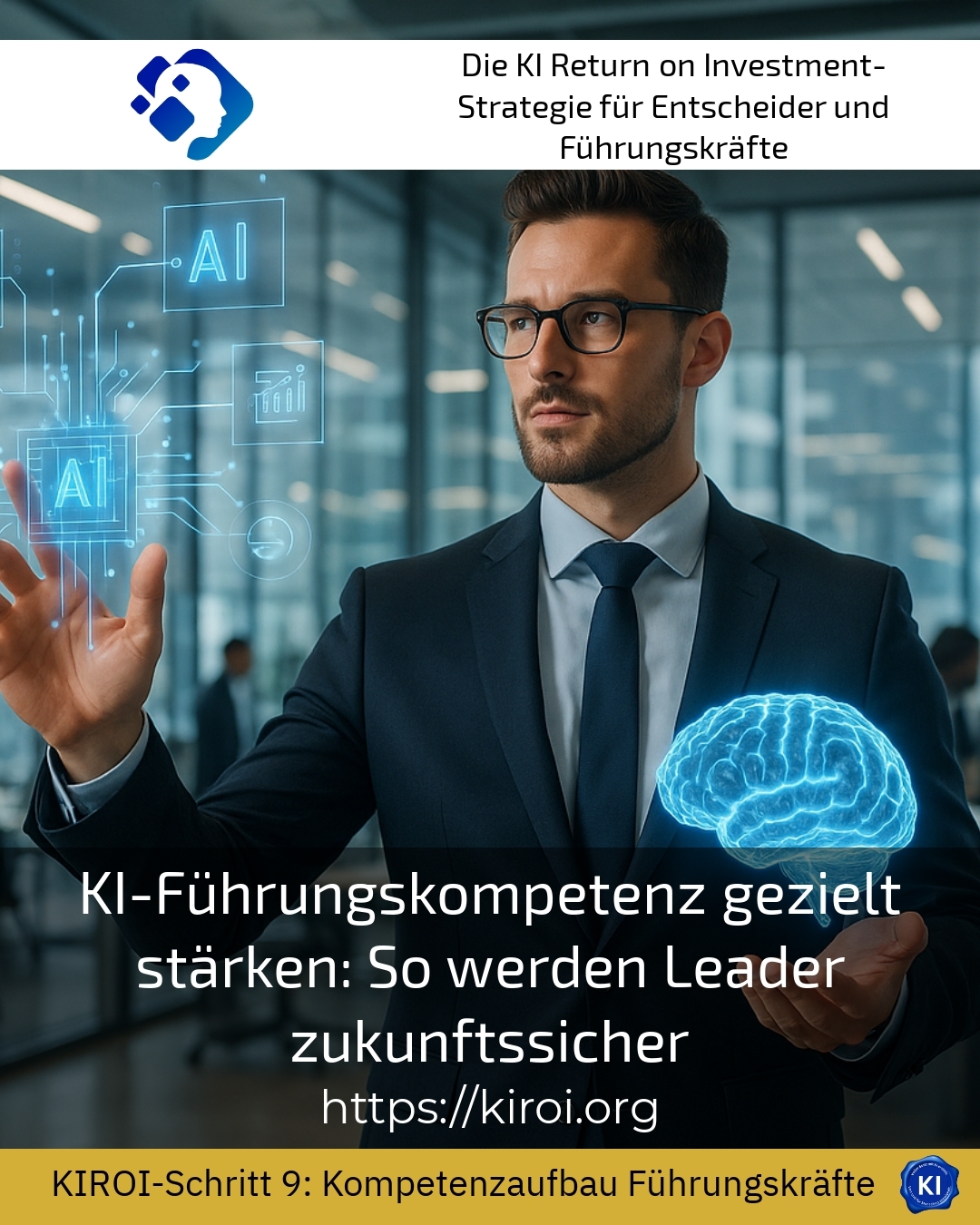
Targeted strengthening of AI leadership competence through strategic development.
Developing forward-thinking leadership qualities requires a systematic approach. Firstly, leaders should honestly assess their own digital competence. Many decision-makers overestimate their technical understanding, while others underestimate their abilities. A realistic self-perception forms the basis for targeted further development. This is particularly evident in the logistics industry when implementing route optimisation systems. Warehouse managers need to understand how algorithms make decisions to monitor them effectively. In the financial sector, team leaders face similar challenges with fraud detection. And in the energy industry, department heads must be able to interpret complex load forecasts [2].
transruptions-Coaching supports managers through precisely these development processes. The support begins where individual strengths and areas for development meet. This is not about technical training in the traditional sense. Rather, this approach helps to develop a holistic perspective on technology-enabled leadership.
The role of empathy in technology-enabled leadership
Paradoxically, human empathy becomes all the more important the more technology shapes everyday work life. Employees look to their managers for guidance. They want to understand the impact of changes on their work. And they need to feel involved in decision-making processes. In the automotive industry, shift managers experience firsthand daily how important this communication is. Production staff express concerns about robot-assisted workstations. In the insurance sector, claims adjusters report uncertainties regarding automated claim processing. And in the education sector, school principals struggle to enthuse teachers for adaptive learning systems [3].
Leaders who communicate empathetically build trust. They take fears seriously without amplifying them. They show perspectives and provide impetus for positive change. This ability can be developed and trained.
Best practice with a KIROI customer
A medium-sized manufacturing company faced the challenge of preparing its entire management level for digital transformation. Management recognised that technical training alone would not be enough to create the necessary willingness to change. Therefore, they opted for a holistic coaching approach that considered both technical and human aspects. As part of the KIROI Masterclass, the managers first analysed their individual strengths and areas for development. They reflected on their previous experiences with technological changes and identified personal blockages. Subsequently, they developed concrete strategies to guide their teams through the transformation process. The exchange among themselves proved particularly valuable, as the managers realised they had similar challenges to overcome. After six months, participants reported significantly increased confidence in handling data-based decision-making processes. Employee satisfaction measurably increased because communication had become more transparent. And the company was able to successfully implement several digitalisation projects that had previously failed due to internal resistance.
Strategic decision-making in complex environments
Modern leaders make decisions under uncertainty daily. In doing so, they must combine algorithmic recommendations with human intuition. Finding this balance presents considerable difficulties for many leaders. In the pharmaceutical sector, this challenge is particularly evident in drug development. Research leads must decide which predictive models they trust. In agriculture, farm managers face similar questions when optimising yields. And in the hotel industry, revenue managers must be able to critically question dynamic pricing recommendations [4].
The ability to critically reflect on technological proposals can be purposefully cultivated. Leaders learn to ask the right questions. They develop a feel for when algorithmic recommendations are sensible. And they recognise situations where human judgment remains indispensable. In this way, leaders can Strengthening AI leadership skills deliberately and make informed decisions.
Communication as a Key Competence for Future-Ready Leaders
Excellent communication skills distinguish average leaders from outstanding ones. In an era of technological disruption, this ability is becoming even more important. Leaders must be able to explain complex issues clearly. They need to convey visions and generate enthusiasm. In the telecommunications sector, project managers experience daily how crucial clear communication is for project success. In the construction industry, site managers struggle to introduce digital planning tools to their teams. And in the media industry, editorial managers must get their employees excited about data-driven content planning [5].
Effective leadership communication follows certain principles. It is formulated clearly and understandably. It addresses the needs of the listeners. And it creates space for questions and discussions. These skills can be developed and refined through targeted training.
How disruptive coaching supports leaders during transformation
The support offered by transruption coaching provides leaders with a structured framework for their personal development. The focus here is not on imparting specialist knowledge. Instead, it's about recognising and specifically fostering individual potential. Clients often report that it's only through reflection that they become aware of the strengths they already possess. In mechanical engineering, leaders often face questions about employee management in transformation projects. In the food industry, production managers seek support in implementing quality management systems. And in the transport sector, fleet managers need impetus for dealing with predictive maintenance [6].
The coaching approach takes into account the specific framework of each organisation. Industry-specific challenges are incorporated, as are individual leadership styles. This creates a tailored development path that enables sustainable change.
Best practice with a KIROI customer
A leader from the service sector entered coaching with significant doubts about their own competence. The individual felt overwhelmed by the pace of technological developments and questioned their own future viability. However, it quickly became apparent during the conversation that this self-assessment did not reflect reality. The leader possessed excellent analytical skills and a deep understanding of customer relationships. These strengths were consciously identified during the coaching process and used as a foundation for further development. Together, we developed a concrete plan to expand their technical understanding. The focus was not on superficial factual knowledge, but on a fundamental understanding of how data-based systems function. The leader learned to ask critical questions and assess the quality of algorithmic recommendations. After a few months, the individual reported significantly strengthened self-confidence. Communication with technical teams had noticeably improved, and for the first time, the leader was able to actively participate in strategic digitalisation decisions. This positive development also had a ripple effect on the entire team, which was now led by a confident leader.
Strengthening AI leadership competence through continuous learning
Future-proof leadership requires a lifelong learning mindset. Technological developments are advancing unstoppably. What appears innovative today can be obsolete tomorrow. Therefore, leaders must develop a willingness to continuously educate themselves. In the chemical industry, this is particularly evident with the introduction of laboratory automation. Research group leaders must be able to understand and evaluate new analytical methods. In retail, store managers face similar challenges with the implementation of inventory management systems. And in the entertainment industry, programme managers must learn to interpret data-driven audience preferences.
A learning attitude does not mean being able to do everything yourself. Rather, it's about asking the right questions and involving competent employees. Leaders with this attitude create a climate in which knowledge sharing is encouraged. They encourage their teams to try new things and learn from mistakes.
Ethical Responsibility in Technology-Supported Leadership
With increasing technological penetration, the ethical responsibility of leaders also grows. Decisions based on algorithmic recommendations can have far-reaching consequences. Leaders must understand these connections and act responsibly. In human resources, HR managers face the question of how far automated selection procedures may go. In the credit industry, department heads must ensure that scoring models do not discriminate. And in the healthcare sector, medical directors are responsible for the quality of diagnostic support systems [7].
Ethical leadership requires the ability to reflect and courage. Sometimes it means disagreeing with algorithmic recommendations. Sometimes it requires introducing additional control mechanisms. But it always demands a deep understanding of the human impact of technological decisions.
My KIROI Analysis
The development of future-proof leadership skills represents one of the key challenges of our time, and in my daily work with managers from a wide range of industries, I observe that those who are most successful at transforming are those willing to question old certainties and embrace new perspectives. The ability to, Strengthening AI leadership skills deliberately The ability to do so already distinguishes today between organisations that actively shape change and those that merely react to it. It repeatedly becomes clear that technical understanding alone is not enough; rather, the combination of analytical skills with emotional intelligence makes the crucial difference. Leaders who find this balance can navigate their teams through uncertain times while simultaneously driving innovation. They understand how to critically question algorithmic recommendations without fundamentally rejecting technological progress. And they manage to provide their employees with direction without knowing all the answers themselves. This type of leadership can be developed, and this is precisely where transruptive coaching comes in, by individually supporting leaders in their further development. The future belongs to those leaders who understand that technology is a tool that complements, but can never replace, human leadership. Whoever internalises this insight and builds the corresponding competencies will be able to lead successfully even in an increasingly complex working world.
Further links from the text above:
[1] McKinsey – Artificial Intelligence Insights
[2] Harvard Business Review – AI and Machine Learning
[3] World Economic Forum – Artificial Intelligence
[4] Gartner – Artificial Intelligence Research
[5] Forbes – AI Coverage
[6] MIT Sloan – Artificial Intelligence
[7] IBM – What is Artificial Intelligence
For more information and if you have any questions, please contact Contact us or read more blog posts on the topic Artificial intelligence here.











 Deutsch
  English (UK)