
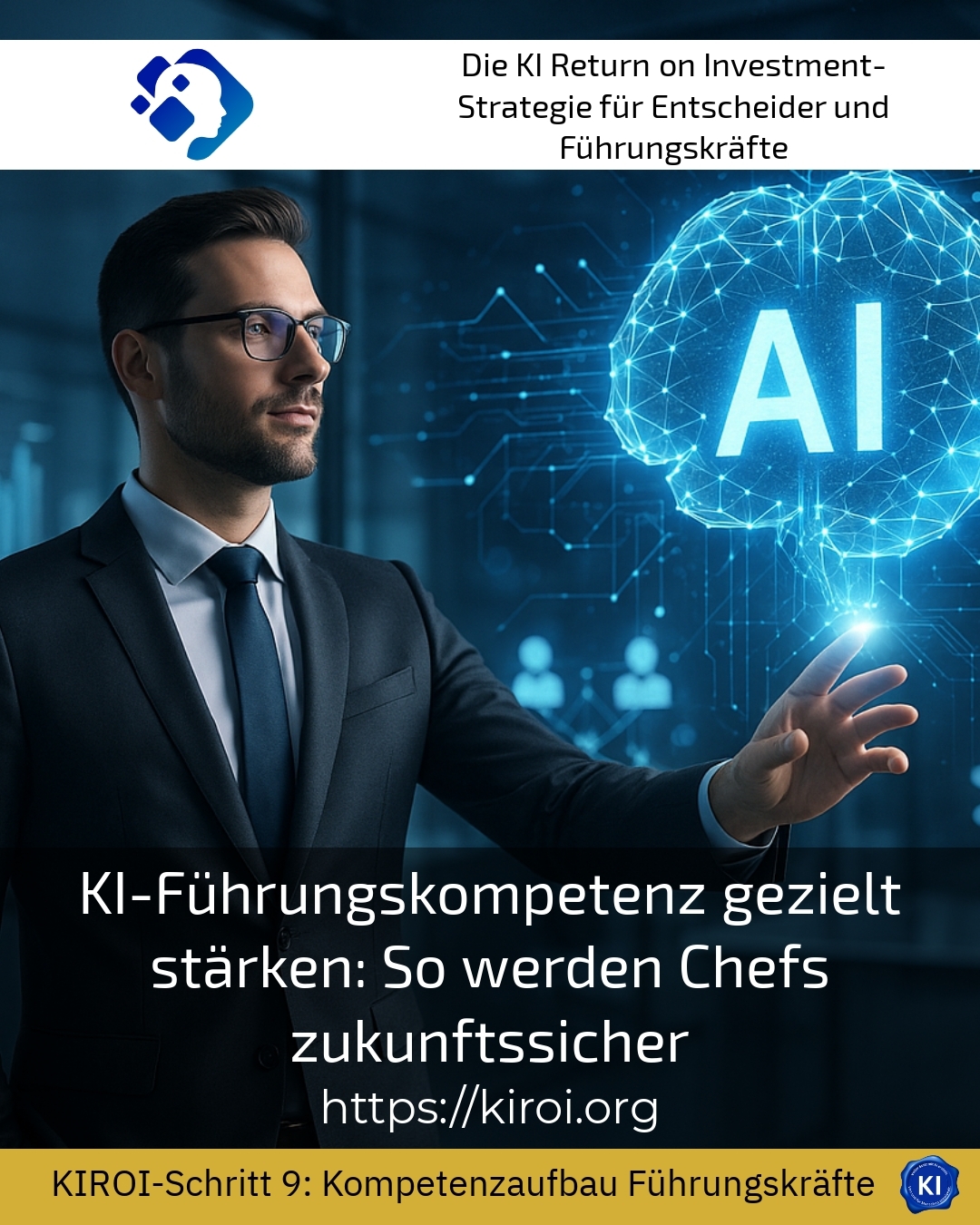
Digital transformation is fundamentally changing the demands placed on leaders. Anyone managing teams today has to develop completely new competencies. Strengthening AI leadership skills deliberately is at the heart of modern management development. Many leaders are already feeling the pressure of these changes. They come with questions such as: „How do I remain relevant?“ or „How do I lead teams that work with intelligent systems?“ This is precisely where professional guidance comes in. The good news is that these competencies can be systematically developed. This article shows you concrete ways and practical examples.
Why modern leadership skills are indispensable today
The world of work is undergoing profound change. Intelligent systems are taking over more and more routine tasks. At the same time, completely new fields of activity and areas of responsibility are emerging. Managers are faced with the challenge of actively shaping these changes. They need to understand how algorithmic decision-making works. They must know when human judgement remains irreplaceable. Finding this balance requires a completely new competency profile.
In many companies we experience similar situations. A sales manager reports on the introduction of a forecasting system. Suddenly, his team questions their own expertise. Motivation drops noticeably. This shows that technical implementation alone is not enough. Leaders must be able to guide their teams through these transitions. They must take fears seriously and outline perspectives. This is precisely where transruptions coaching provides professional support during such projects.
Another example comes from the HR sector. An HR director introduced an intelligent applicant management system [1]. The recruiters initially felt replaced and devalued. However, through targeted support, this perception completely changed. The team recognised the relief from routine tasks. At the same time, the strategic advisory function gained in importance. Such transformations only succeed with competent leadership.
Targeted strengthening of AI leadership skills through systematic development
The development of future-proof leadership skills follows clear principles. First, it is about a fundamental understanding of new technologies. Leaders do not need to become programmers. However, they must be able to assess the possibilities and limitations of intelligent systems. This is the only way they can make well-founded strategic decisions. Transruption coaching imparts this knowledge in a practical way.
The second area of development concerns ethical judgement. Algorithms make decisions on the basis of data and patterns. However, not every technically possible decision is also the right one. Leaders must be able to answer questions of value. They must set boundaries and take responsibility. A production manager reported on an optimisation system for shift rotas. The system maximised efficiency, but ignored social aspects. His task was to find the right balance.
The third area comprises communicative skills. Changes generate uncertainty in teams. Managers must be able to communicate transparently. They must be able to explain complex relationships comprehensibly. An example from the financial sector illustrates this: A head of department introduced an intelligent analysis system [2]. She invested a lot of time in explaining how it worked. She demonstrated concretely how the tool would make work easier. The result was an astonishingly high level of acceptance within the team.
Best practice with a AIROI customer
A medium-sized engineering company was facing a fundamental transformation. The management board wanted to introduce intelligent systems into quality control. Middle managers felt overwhelmed and insecure. They did not understand the technology well enough and feared for their positions. At the same time, they were expected to guide their teams through this change. The support provided by transruptions coaching targeted precisely this issue. In a series of workshops, the managers first developed a fundamental understanding of the technology. They learned to ask IT experts the right questions. At the same time, they developed communication strategies for their teams. A particular focus was placed on dealing with resistance. The managers practiced specific conversation scenarios in role plays. They developed individual responses to typical concerns raised by their staff. After six months, a clear shift was visible. The managers acted with confidence as drivers of change. Acceptance within the teams increased measurably. Quality control reached new levels of performance. Particularly noteworthy was the increased job satisfaction despite the profound changes.
The role of emotional intelligence in digital leadership
Technical knowledge alone does not make a good leader. Especially in times of technological upheaval, emotional intelligence is becoming increasingly important. Leaders need to be able to perceive moods within their teams. They need to understand what lies behind open or covert resistance. This ability can be purposefully developed and trained.
An example from customer service illustrates this aspect particularly well. A team leader introduced an intelligent chatbot system. The service agents initially reacted with rejection and defensiveness. The team leader took the time for one-to-one discussions with each team member. He learned of deep-seated fears of job loss. At the same time, he discovered unexpected potential for new areas of responsibility. Through empathetic communication, he transformed resistance into engagement.
Another example concerns a marketing department. The introduction of an intelligent content system caused uncertainty [3]. The creative staff questioned the value of their work. The manager recognised this existential dimension of the problem. She organised workshops to redefine creativity. The team developed a new self-image. Collaboration with the intelligent system was experienced as an enrichment.
Practical strategies for everyday leadership
Implementing new leadership skills requires concrete strategies. A proven method is regular technology briefings within the team. Managers inform about relevant developments and their impacts in the process. They thus create a shared level of knowledge and reduce uncertainties. These briefings should be designed to be interactive and offer space for questions.
Another strategy involves the inclusion of employees in decision-making processes. When new systems are introduced, those affected should be involved at an early stage. A logistics manager reported positive experiences with this approach. He let his team help choose a route optimisation system. The drivers contributed valuable practical experience. As a result, the chosen system was significantly better accepted.
The personal development of the leader is also among the important strategies. Regular reflection on one's own leadership behaviour is indispensable. Here, transruptions coaching can provide valuable impetus. A head of department from purchasing made intensive use of this support. He recognised his own resistance to technological changes. Through targeted work on these blocks, he became an authentic shaper.
Developing AI leadership skills in various business areas
Leadership requirements vary depending on the business area. In production, the integration of human and machine is often the primary focus. Here, leaders must pay particular attention to safety aspects. They need to identify skills gaps and initiate further training. A plant manager reported on the gradual introduction of collaborative robot systems. Close support for his shift supervisors was crucial to its success.
In sales, different priorities emerge. Here, it is often about the balance between data-driven management and customer relationships. A sales director introduced a forecasting and recommendation system [4]. Initially, the sales reps perceived this as control. The director clarified that the system was intended to support rather than replace. He emphasised the value of personal customer knowledge. This attitude rubbed off on the entire team.
In administrative areas, the focus is on process automation. Managers must redefine job profiles here. They need to show employees development prospects. A head of financial accounting guided her team through comprehensive automation. Routine tasks such as invoice verification were largely automated. In their place, new tasks emerged in the areas of analysis and controlling. The manager shaped this transition actively and communicatively.
Best practice with a AIROI customer
A healthcare service provider wanted to fundamentally modernise its administrative processes. The introduction of an intelligent document management system was imminent. The head of patient administration came to coaching with a great deal of uncertainty. She wondered how she should guide her team of twelve employees through this change. Some team members had been working with established processes for decades. The fear of being overwhelmed was clearly palpable. In the transruptions coaching, the manager first developed a clear vision for the future of her department. She realised that the new system would create leeway for better patient care. She used this insight as a basis for communication with her team. She held individual conversations with all employees, during which she learned about their personal concerns. One employee close to retirement age feared she would no longer be able to keep up. A young colleague, on the other hand, saw opportunities for her professional development. The manager developed an individual support plan for each employee. She organised training sessions in small groups at varying paces. Following the introduction of the system, a remarkable result became apparent. Patient satisfaction increased measurably because more time became available for personal care. The employees reported a reduced burden from routine tasks. The manager was perceived company-wide as a role model for successful transformation leadership.
The importance of continuous development for leaders
Leadership skills are not a static trait. They must be continuously developed. Technological progress is advancing rapidly. What is considered cutting-edge today may already be obsolete tomorrow. Leaders must therefore develop a learning mindset. They must be willing to regularly question their own assumptions.
An example illustrates this necessity. An IT director was regarded within his company as an expert on digital topics. A few years previously, he had led a successful system modernisation. Yet, the latest developments in the field of intelligent systems were increasingly overwhelming him. He recognised that his knowledge was outdated and sought support. Through targeted coaching, he updated his skills and regained his self-confidence.
Dialog with other leaders also contributes to continuous development. Experiences can be shared and reflected upon within peer groups. A network of like-minded individuals offers support in difficult situations. transruptions coaching also actively promotes this form of exchange. Leaders frequently report valuable insights gained from such encounters.
Barriers on the road to sustainable leadership
The path to new leadership skills is not free from obstacles. A frequent problem is the lack of time. Leaders are under enormous pressure. Developing new skills appears to be an additional burden. Here it helps to focus on the long-term benefits. Investments in one's own development pay off many times over.
Another obstacle is the fear of admitting to gaps in knowledge. Leaders are expected to appear competent and confident. To many, admitting uncertainty feels like weakness. In fact, the opposite is true. Authentic leaders who also show their own limitations gain trust. One managing director reported on his experience with this openness. He openly told his leadership team that he did not fully understand certain technical developments. He asked for joint learning. This attitude strengthened cohesion and the willingness to innovate within the company.
Organisational resistance can also make competence development more difficult. Some corporate cultures do not reward a willingness to change. Leaders who try new things encounter rejection. Perseverance is called for here. Small successes can gradually win people over. With professional guidance, such situations can also be mastered.
My AIROI Analysis
The transformation of leadership is one of the central challenges of our time. Intelligent systems are not only changing work processes, but also the very nature of leadership itself. Developing AI leadership skills in a targeted manner therefore means much more than acquiring technical understanding. It is about a fundamental realignment of how leadership is understood. Examples from various industries show that successful leaders combine technical competence with emotional intelligence. They understand the possibilities and limitations of intelligent systems while keeping people at the heart of their leadership.
Support through transruption coaching assists leaders on this demanding path. This is not about pre-made solutions, but rather about individual development paths. Every leader brings their own strengths and areas for development. Professional guidance helps to recognise these and develop them in a targeted manner. The best-practice examples presented illustrate the practical effectiveness of this approach. Leaders who engage in this development process report increased confidence and capability to act. They experience themselves as active shapers of digital transformation. This attitude rubs off on their teams and creates a positive dynamic of change throughout the entire company.
For more information and if you have any questions, please contact Contact us or read more blog posts on the topic Artificial intelligence here.
Further links from the text above:
[1] Personio: AI in recruiting – possibilities and limitations
[2] McKinsey: The State of AI in Business
[3] Haufe: AI in content marketing
[4] Salesforce: AI in sales – opportunities and applications







 Deutsch
  English (UK)