
The digital revolution is currently fundamentally changing all industries. Leaders are facing an enormous challenge. They have to navigate their teams through this change. It is not just about technical knowledge. It is about a completely new way of leading. Developing targeted AI leadership skills becomes the decisive success factor. Anyone who doesn't act now will fall behind. But how can this change be achieved in concrete terms? What skills do modern leaders really need? This article provides you with practical insights and shows proven ways forward.
Why modern leadership requires a paradigm shift
The world of work has changed dramatically over recent years. Automated systems are taking over more and more routine tasks. Algorithms make decisions in a split second. This development affects all economic sectors equally. Leaders must therefore fundamentally rethink their self-perception. The traditional role of the instructor no longer works. Instead, coaches and enablers are needed.
This change is particularly evident in the manufacturing industry. Today, production managers work alongside intelligent systems. They analyse data from networked machines and continuously optimise processes. In retail, store managers use forecasting models for workforce planning. They understand the software's recommendations and adapt them to the situation. Digital assistants also support diagnostics in the healthcare sector. Doctors and nursing staff must be able to use these tools competently.
Change requires more than technical understanding. Emotional intelligence is gaining in importance. Leaders must take their employees' fears seriously. They build trust in new technologies through transparent communication. At the same time, they foster a culture of continuous learning.
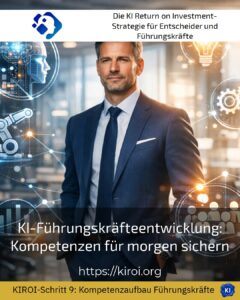
Developing AI leadership competence in a targeted manner through structured development
Building new competencies does not happen overnight. It takes a systematic approach with clear milestones. First, managers should honestly assess their own digital maturity. Where do strengths lie and where are there areas for development? This self-reflection forms the foundation for all further steps.
In the banking sector, companies are investing heavily in training programmes. Branch managers are learning how automated advisory systems work. They are understanding the logic behind credit decisions made by algorithms. This enables them to advise customers expertly and build trust. In the logistics industry, freight forwarders regularly train their dispatchers. The latter are learning how to use intelligent route planners. They use the time saved for strategic tasks and customer care.
The insurance industry is relying on intergenerational mentoring programmes. Experienced managers share their industry knowledge with younger colleagues. In return, the latter contribute digital expertise. This creates a productive exchange of knowledge on an equal footing.
Best practice with a AIROI customer
A medium-sized engineering company was facing major challenges with its digital transformation. Initially, the management team showed significant resistance to new technologies. Many team leaders felt threatened by automated systems. As part of transruption coaching, we intensively accompanied the company over several months. First, we developed an individual competency profile for each manager. In doing so, we identified specific areas for development and hidden strengths. We then designed bespoke learning paths for different initial levels. The managers received regular coaching sessions in small groups. They shared experiences and learned from one another. The practical exercises using real company data proved particularly valuable. The participants quickly recognised the tangible benefits of the new tools. After six months, over eighty percent reported a significantly increased level of confidence in handling digital systems. Management turnover decreased noticeably. The company was able to retain and further develop key knowledge holders.
Strategic areas of action for leaders
Modern leadership requires the integration of various areas of expertise. Data-driven decision-making is at the heart of this. Leaders must be able to interpret key performance indicators and translate them into actions. At the same time, human judgement and experience remain indispensable.
In the pharmaceutical industry, research directors use intelligent analysis systems for drug testing. They evaluate the results and make final decisions on further development steps. In the energy sector, engineers monitor complex grids using digital twins. They intervene when algorithms cannot handle unexpected situations. The advertising industry relies on automated campaign optimisation. Marketing managers steer the strategies and define creative guidelines.
Change management constitutes another core area of action. Managers actively and sensitively shape transformation processes. They bring employees along and provide orientation in turbulent times. In doing so, they communicate visions clearly and convincingly [1].
Successfully applying AI leadership skills in everyday work
Theoretical knowledge only unfolds its value in practice. The application of new competencies requires courage and perseverance. Managers should first dare to try small experiments. They test new ways of working within a manageable scope. They learn from mistakes and continuously adapt their approach.
The media industry demonstrates interesting application examples. Editorial directors use automated topic analyses for content planning. They identify relevant trends earlier than before. In tourism, hotel managers rely on intelligent pricing. They understand the system's recommendations and optimise their occupancy rates. The education sector is experimenting with personalised learning offers. Headteachers support their colleagues in integrating new methods.
Implementation is particularly successful in diverse teams. Different perspectives enrich the development process. Older employees contribute experience and composure. Younger colleagues add a technical affinity and curiosity. This diversity creates robust solutions for complex challenges.
Overcoming obstacles and growing sustainably
The path to competent leadership in the digital age is rarely straightforward. Setbacks are part of the learning process. What is important is how one deals constructively with difficulties. Leaders who speak openly about challenges create psychological safety within their teams.
In the automotive industry, project managers frequently report initial resistance. Experienced engineers doubted new development tools. Through patient guidance and concrete experiences of success, attitudes changed. The construction industry struggles with fragmented processes and data systems. Site managers have to consolidate and use different platforms. Retail faces rapid technological change. Procurement managers are continuously updating their skills [2].
Many clients come to us with specific questions. They are looking for guidance in confusing situations. Some feel overwhelmed by the speed of change. Others want to better prepare their teams for changes. Still others are looking for ways to remain relevant themselves.
Best practice with a AIROI customer
A retail chain with several hundred branches wanted to systematically develop its management team. The regional managers were to be enabled to make data-driven decisions independently. At the same time, there was a desire for greater personal responsibility at branch level. transruptions coaching accompanied this transformation project over eighteen months. We started with a comprehensive stocktake of existing competencies. This revealed a wide range of digital maturity. Some managers were already using advanced analytical tools. Others still felt unconfident with basic functions. We developed different learning formats for different target groups. Workshops alternated with one-to-one coaching sessions and peer groups. The practical projects in real business situations were particularly effective. The participants applied what they had learned immediately and received direct feedback. Following completion of the project, the regional managers reported a significantly higher level of confidence in their actions. The branch managers made better range decisions based on local data. Sales per square metre increased measurably.
The role of guidance and reflection in competence development
Self-study and personal initiative form important foundations for development. However, external guidance can significantly accelerate this process. Experienced coaches provide valuable impetus and new perspectives. They mirror blind spots and encourage profound reflection.
In the chemical industry, plant managers use regular supervision for their development. They discuss challenging leadership situations in a confidential setting. The telecommunications sector relies on structured feedback cycles. Leaders receive systematic feedback from employees and supervisors. In the consulting sector, partners cultivate peer-to-peer intervision. They support each other with complex mandates.
Transruptions-Coaching clearly positions itself as a guide for transformation projects. We support leaders in finding their unique role. In doing so, we start from existing strengths and build upon them. The process is individual and respects different learning paces [3].
Future prospects and continuous development
Technological development is progressing at an unabated pace. Leaders must therefore embed lifelong learning. The once acquired Developing targeted AI leadership skills is not permanently sufficient. Regular updating and expansion are necessary.
The aviation industry shows exemplary approaches to continuous qualification. Pilots and air traffic controllers complete regular simulator training. They thus stay up to date with the latest technology. In the legal sector, law firms are establishing knowledge management systems. Partners and associates share insights on new tools. The real estate industry is experimenting with virtual viewings and valuation models. Estate agents and property managers are developing new skills through practice.
Networking with other leaders creates additional learning opportunities. Cross-industry networks enable fruitful exchange. Best practices thus travel faster through the economy. Mistakes no longer have to be made multiple times.
My AIROI Analysis
The analysis of the current situation reveals clear needs for action at all management levels. Many companies still underestimate the scale of the necessary changes. They invest in technology while neglecting the human dimension. Yet it is precisely the quality of leadership that determines the success or failure of transformations.
We observe recurring patterns in our projects. Organisations that invest early in leadership development master change more easily. They build capabilities before acute pressure arises. This creates scope for action and reduces stress. In contrast, reactive companies often run out of time. They have to transform and learn at the same time. This overwhelms many participants and leads to friction losses.
Hybrid development formats appear particularly promising. The combination of digital learning modules and personal guidance shows a strong impact. Managers acquire basic knowledge through self-directed learning. In face-to-face or video sessions, they deepen what they have learned and clarify questions. This mix respects tight time budgets while still enabling deep learning. We recommend that companies adopt a phased approach with clear milestones. The building of AI leadership skills takes time and patience. Quick fixes rarely meet expectations.
Further links from the text above:
[1] McKinsey: Leading in the Age of AI
[2] Harvard Business Review: Leadership Topics
[3] World Economic Forum: Artificial Intelligence Insights
For more information and if you have any questions, please contact Contact us or read more blog posts on the topic Artificial intelligence here.








 Deutsch
 English (UK)