
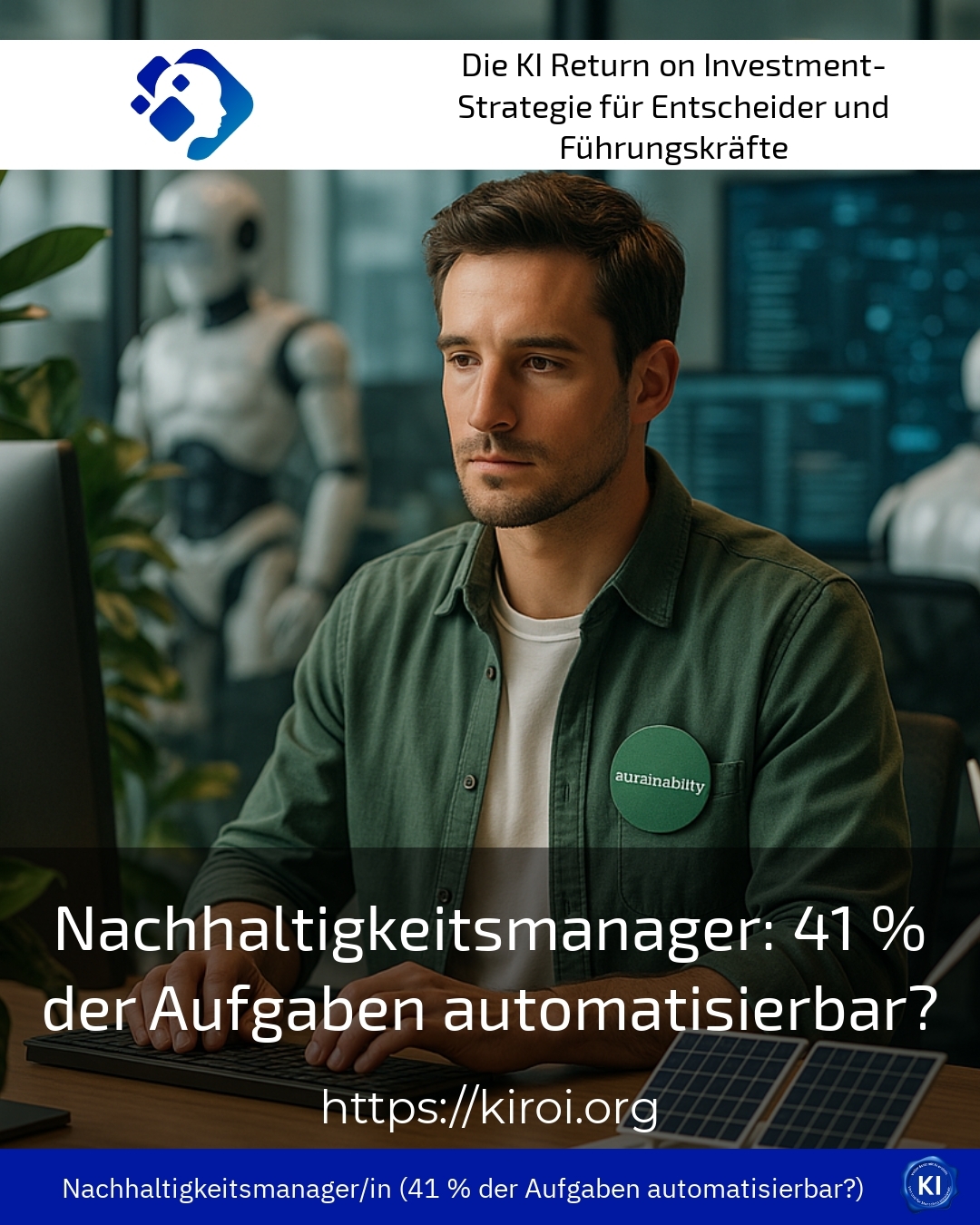
Will the profession of Sustainability manager's soon to be redundant, because intelligent systems can take over a significant portion of daily tasks?
This question is currently occupying many professionals working in the field of corporate environmental and social responsibility, because current analyses show that around 41 per cent of typical tasks in this professional field could be replaced by automated processes, which sounds alarming at first glance, but upon closer inspection harbours both risks and enormous opportunities. The Sustainability manager thus serving as an example for an entire professional group that finds itself in the midst of fundamental change and must develop new competencies in order to remain relevant in the future.
The insights mentioned here are based, among other things, on data from the Job Futuromat of the Institute for Employment Research [1]. Anyone working in this future-proof field who wants to prepare optimally for the coming changes will find valuable support in the AIROI seminars. The current dates for seminars, lectures and workshops are available under https://risawave.org/de/live-events-mit-sanjay-sauldie/ Ready. The AIROI strategy supports professionals in seeing technological developments not as a threat, but as a tool for professionalisation.
What does the 41 per cent quota mean specifically for the sustainability manager?
The statement that 41 per cent of tasks are automatable requires a nuanced view, because very different areas of activity are hidden behind this figure. Tasks that can be automated include, for example, the collection and processing of environmental data, the creation of standardised reports and the monitoring of consumption values in real time. Intelligent systems are already able today to calculate carbon footprints, analyse supply chains and identify deviations from sustainability targets without human intervention being necessary.
In practice, this means, for example, that a medium-sized manufacturing company can fully automatically record its energy consumption and have it compared with industry benchmarks. Another example can be found in the textile industry, where algorithmic systems check compliance with social standards at suppliers and report anomalies. In retail, too, companies are increasingly relying on automated solutions to document the origin of products seamlessly and present this transparently to consumers.
Nevertheless, essential core competencies remain that require human intelligence, empathy and strategic thinking. The development of sustainability strategies, communication with stakeholders and the embedding of ecological values in corporate culture cannot be delegated to machines. It is precisely these higher-value activities that are gaining in importance, while repetitive tasks disappear.
Best practice with a AIROI customer
An international chemical company faced the challenge of realigning its sustainability department after the initial introduction of automation tools. Employees initially feared that their positions might become redundant, as a significant portion of their previous work was now handled by software. As part of the AIROI support, we jointly developed a strategy that combined technological efficiency with human expertise. The specialists were empowered to use the time gained for strategic projects, such as developing innovative circular economy concepts and intensive collaboration with research institutions. After six months, those involved reported a significantly increased level of job satisfaction, because they could finally dedicate themselves to the demanding tasks for which they had originally been trained. Automation had not taken away their work, but had significantly improved the quality of their activities.
Which competencies are becoming essential for the sustainability manager?
The transformation of the occupational profile requires a conscious further development of one's own skills, because anyone who relies exclusively on traditional working methods risks losing touch in the medium term. First of all, the ability to work effectively with automated systems and critically evaluate their results is gaining in importance. An experienced professional in the field of corporate responsibility must understand how algorithms arrive at their conclusions in order to be able to identify and correct errors.
The food industry provides an example of how this collaboration can work. There, automated systems continuously monitor compliance with organic standards and fair-trade certifications, while human experts are responsible for the strategic direction of procurement policy. In the automotive sector, specialists use intelligent analysis tools to compare the environmental impacts of various drive technologies, yet they formulate the recommendations for management themselves. Similarly, in the financial sector, where ESG criteria are gaining increasing importance, algorithms take care of data analysis, while humans are responsible for interpretation and communication.
Furthermore, the importance of soft skills such as negotiation skills, intercultural competence and the ability to communicate complex relationships in an understandable way is growing. An Sustainability manager needs to be able to persuade a wide variety of stakeholders – from sceptical leaders and committed employees to critical NGOs – and win them over to shared goals.
The role of the AIROI strategy in skills development
The AIROI strategy provides a structured framework for actively shaping technological change rather than being passively subjected to it. In the seminars and workshops, participants learn how to use automated tools in a targeted way while simultaneously developing their unique human strengths. The approach helps professionals to redefine their professional identity and position themselves as indispensable drivers of change.
Clients working in the field of environmental management consultancy often report feeling initially unsettled by technological developments. They come to us with questions such as: Is my expertise still needed? How can I set myself apart from automated solutions? The AIROI support programme provides them with the impetus to transform these uncertainties into productive energy. In the energy sector, for example, participants have learnt to view automated audit systems as a support tool that frees them up to focus on strategic consultancy services. In the construction sector, following their participation, professionals are using intelligent simulation tools to develop sustainable building concepts that go far beyond standardised solutions.
Recognising the opportunities of automation for sustainability managers
The automation of 41 per cent of tasks harbours enormous opportunities for those who are willing to adapt their way of working. First, it enables a significant increase in quality, as automated systems work more precisely and consistently than humans when it comes to repetitive activities. Reports become more error-free, data analyses more comprehensive, and early warning systems react more quickly to deviations from defined standards.
In the logistics sector, forward-thinking companies are already using intelligent systems to calculate the most eco-friendly transport routes and simulate alternative supply chains. In healthcare, automated solutions help minimise the environmental footprint of hospitals by analysing consumption patterns and identifying potential for optimisation. In the tourism industry, too, the automated assessment of sustainability performance is gaining in importance, with human experts interpreting the results and translating them into concrete improvement measures.
Particularly exciting is the opportunity to open up completely new fields of activity through automation. When time-consuming routine tasks are eliminated, space is created for innovative projects such as the development of cross-industry cooperation models, supporting start-ups in sustainable business model development, or designing participatory processes to integrate all areas of the company into the sustainability strategy.
Best practice with a AIROI customer
A retail chain with several hundred branches faced the challenge of professionalising its sustainability reporting without having to hire additional staff. The existing department was so busy with manual data collection and preparation that there was hardly any time for strategic further development. Together with the AIROI team, we analysed the workflows and identified automatable processes. The implementation of an intelligent data collection system reduced the effort required for report generation by more than half, so that for the first time employees had the capacity to develop and roll out an innovative recycling programme. This programme was later awarded an industry prize and generated positive media resonance that sustainably increased the company's value. The specialists reported that they now find their work much more meaningful because they can bring about real change instead of maintaining spreadsheets.
Practical steps for integrating automated solutions
The successful use of automated tools requires a well-considered approach that takes both technical and human factors into account. First of all, it is advisable to carry out an honest stocktake of one's own activities and identify which tasks are suitable for automation and which are not. In doing so, professionals should not be afraid to critically question even cherished routines, because sometimes what looks like expertise is simply habit.
In the pharmaceutical sector, companies have had good experiences with rolling out automated compliance systems gradually and involving the affected staff from an early stage. In the fashion industry, the approach of starting with pilot projects and then transferring the insights to other areas has proven successful. In the public sector too, where sustainability officers are increasingly confronted with complex requirements, the value of a cautious yet consistent integration of technology is becoming apparent.
Transruption support helps professionals approach this transformation in a structured way and avoid typical pitfalls. Key focuses include selecting suitable tools, training team members, and communicating with sceptical stakeholders. The AIROI seminars teach field-tested methods that can be adapted to a wide variety of corporate contexts.
My AIROI Analysis
The prospect that 41 per cent of tasks in the field of corporate sustainability are automatable by no means marks the end of a significant profession, but rather the beginning of an exciting transformation. My analysis clearly shows that those professionals who are willing to evolve and to view technological tools as allies will emerge stronger from this change. The automatable tasks are predominantly repetitive and unfulfilling, whilst the remaining 59 per cent make up the true heart of the profession: strategic thinking, persuasion, creative problem-solving and the shaping of a future worth living.
Experiences from numerous AIROI support projects confirm that technological change frequently acts as a catalyst for personal and professional growth. Those who actively engage with the possibilities often discover entirely new perspectives for their own careers. At the same time, the social importance of experts who anchor ecological and social responsibility within companies is growing, because the challenges of our time require human wisdom and ethical judgement more than ever before. Automated systems can analyse data, but they cannot develop visions, negotiate compromises, or ignite enthusiasm for change. These deeply human skills remain indispensable – and their importance will continue to increase.
Further links from the text above:
[1] Job-Futuromat of the Institute for Employment Research
For more information and if you have any questions, please contact Contact us or read more blog posts on the topic Artificial intelligence here.








 Deutsch
  English (UK)