
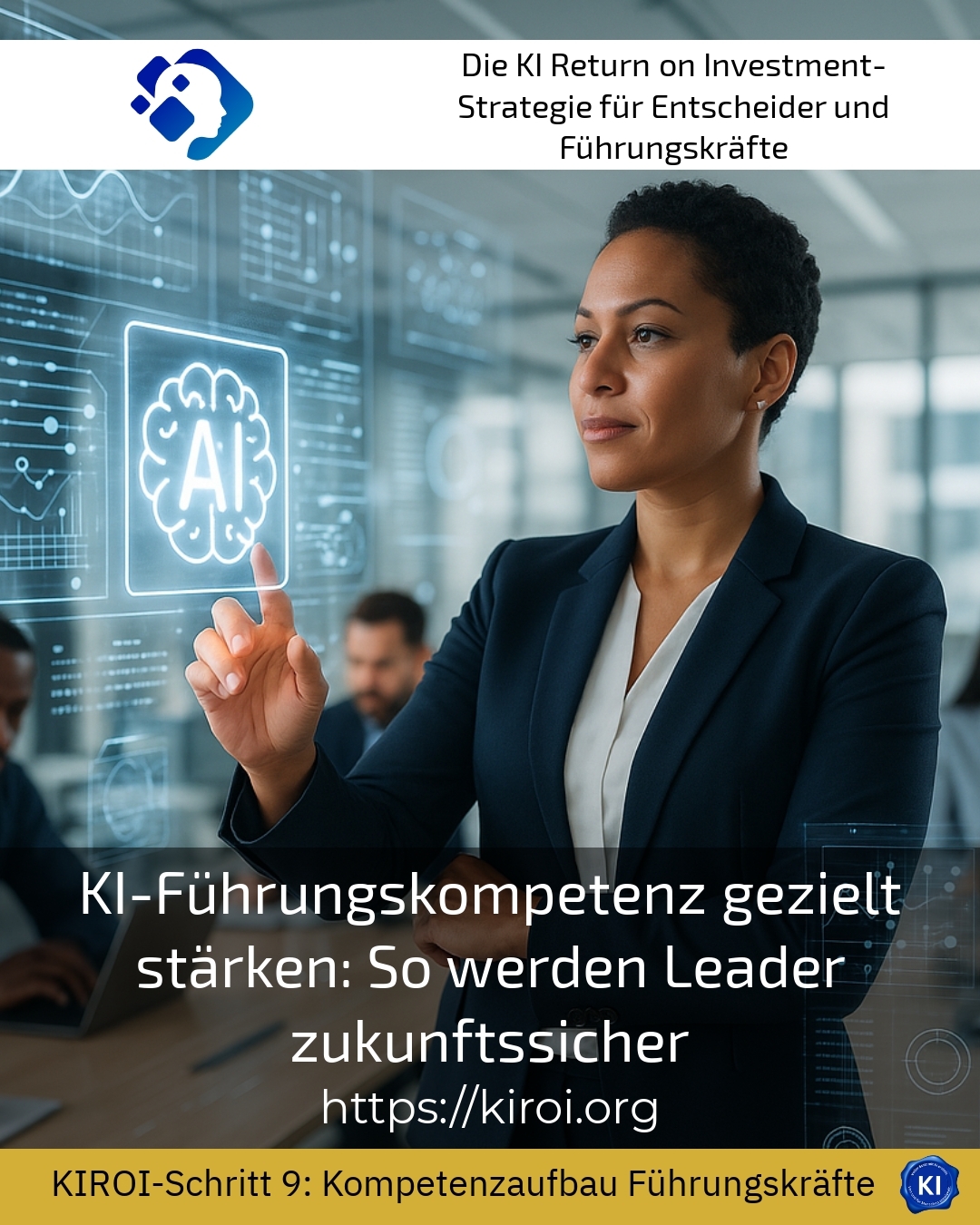
The world of technology is changing rapidly. Leaders today face entirely new challenges. They must make decisions in complex digital environments. At the same time, employees expect clear direction and human connection. Those who know their Strengthening AI leadership skills deliberately | German | English (UK) | |---|---| | möchte, betritt spannendes Neuland. Denn die Fähigkeit, intelligente Systeme strategisch einzusetzen, entscheidet über künftigen Unternehmenserfolg. Dabei geht es nicht nur um technisches Verständnis. Es geht um eine grundlegende Transformation des Führungsverständnisses selbst. | ventures into exciting new territory. This is because the ability to strategically deploy intelligent systems will determine future business success. This is not just about technical understanding. It is about a fundamental transformation of the understanding of leadership itself. |.
Why modern leaders should act now
The dynamics of change are constantly accelerating. Companies worldwide are integrating intelligent technologies into their processes. Leaders who ignore this development risk falling behind. Clients frequently report uncertainty when dealing with new tools. They come to coaching with questions about strategic direction and team leadership [1].
A medium-sized logistics company introduced automated route planning. Initially, management noticed resistance from the driver team. Through targeted communication and training, scepticism turned into acceptance. An insurance group uses intelligent systems for claims processing. This gave the claims handlers more time for complex customer concerns. A regional bank implemented chatbots for standard enquiries in the private customer sector. Since then, the advisors have been able to concentrate on personal consultations that offer higher added value.
These examples show clearly: technology alone does not create success. It needs people to shape and guide the change. This is precisely where Transruptions Coaching comes in as professional support for projects.
Targeted strengthening of the core elements of future-proof AI leadership competency
Successful leaders combine several areas of competence in their leadership work. They understand technological fundamentals and can communicate them clearly. At the same time, they maintain an awareness of human needs and fears. Achieving this balance requires continuous reflection and a willingness to learn.
A production company from the automotive sector trained its team leaders in new methods. The managers learned to combine data-based decisions with experiential knowledge. A retail group established regular technology updates for divisional management. This enables them to have informed discussions with IT departments. A healthcare provider trained its ward managers in the use of digital patient records. Acceptance among nursing staff increased noticeably through exemplary leadership behaviour.
Developing strategic thinking in complex technology environments
Today's leaders must combine long-term perspectives with short-term adaptability. They make decisions under uncertainty and with incomplete information. Intelligent analysis tools significantly support information processing in this regard. However, the final decision always rests with the individual [2].
An energy supplier uses predictive analytics for maintenance planning of its infrastructure. Operations managers interpret the predictions and prioritise measures based on experience. A telecommunications provider automatically analyses customer behaviour using intelligent systems. The sales management then develops personalised communication strategies for different target groups. A pharmaceutical company significantly accelerates research processes through machine-based literature analysis. This allows the science management to focus more strongly on creative hypothesis generation.
Best practice with a AIROI customer An internationally operating industrial group faced the challenge of fundamentally transforming its leadership culture. The previous hierarchical structure was no longer suited to the demands of a digitised working world. As part of transruption coaching, we supported the company in developing a new leadership vision. Initially, we jointly analysed the existing competency profiles of managers at all levels. We identified significant development needs in the area of fundamental technological competencies. Subsequently, we developed a tailor-made training programme with various learning formats. Managers went through face-to-face workshops, digital self-learning modules, and peer coaching sessions. The exchange between different business units and locations proved particularly valuable. After six months, employee surveys showed significantly higher satisfaction with leadership quality. Acceptance of technological innovations increased measurably and accelerated further projects. The company was able to noticeably strengthen and expand its market position through faster innovation cycles.
Targeted strengthening of human-centred leadership as a success factor for AI leadership competence
Technology serves people, not the other way around. Leaders sometimes forget this maxim in their enthusiasm for new possibilities. Employees often experience change as threatening and unsettling. Leaders must take these emotions seriously and address them proactively.
A media company introduced automated text generation for standard reports. The editorial management emphasised the relief function of these tools from the outset. A construction group implemented digital project management systems across all its building sites. Site managers were trained as technology ambassadors and are multiplying their knowledge. A tourism company uses intelligent booking systems combined with personal customer advice. The travel agency management trains its teams in value-added consulting beyond standard bookings.
Building trust through transparency and open communication
Leaders who openly discuss changes build trust with their employees. They explain the 'why' behind decisions in a clear and understandable manner. At the same time, they acknowledge their own uncertainties and signal a willingness to learn. This authenticity significantly strengthens the bond between leadership and the team [3].
A retail company communicated the introduction of automated warehousing early and comprehensively. The branch managers held regular information events with all employees. A software company actively involves development teams in technology decisions and benefits from this. Team leaders moderate discussions and constructively integrate different perspectives. A consultancy company effectively uses collaborative platforms for cross-project knowledge sharing. The partner level exemplifies the use of these tools.
Practical steps for competence development in everyday leadership
Skills are not acquired overnight. They require a systematic approach and continuous daily practice. Leaders should set realistic development goals and reflect regularly. External input through coaching can provide valuable guidance.
A mechanical engineering company successfully established monthly technology briefings for its management team. The content is prepared by internal experts in a practical and understandable manner. A food group regularly sends managers on secondments to start-ups. These changes in perspective sustainably foster innovative thinking and new approaches. A financial services provider organises intensive annual technology retreats for middle management. New developments are discussed there and strategic implications are jointly developed.
Best practice with a AIROI customer A long-established family business in the manufacturing sector approached us. The management recognised the need for a digital transformation of the entire company. At the same time, the company lacked the internal expertise for the successful implementation of this complex task. During transruption coaching, we initially developed a shared understanding of the current situation and objectives. The managers at all levels were involved in and listened to within a participatory strategy process. We identified quick wins and long-term development areas together with the entire team. The work on leadership culture and the self-understanding of the managers was particularly important. The previous control-oriented approach was gradually replaced by a culture of trust and empowerment. The managers learned to delegate decisions to teams and to understand mistakes as learning opportunities. After a year of intensive support, the company culture had noticeably changed and evolved. Employee turnover decreased significantly and the innovation rate increased measurably. The company won several industry awards for its successful transformation and digital development.
The ethical dimension of technology-supported leadership
New possibilities also bring new responsibilities for leaders. Intelligent systems can influence decisions and automate processes. Leaders must ensure that these technologies are used ethically. They bear responsibility for fair and transparent applications in their areas.
A personnel service provider regularly checks its automated pre-selection processes for discrimination. The management board established a mandatory ethics advisory board for critical technology issues. A credit institution makes its algorithmic credit decisions transparently comprehensible to customers. The divisional management comprehensively trained all advisors in the understandable explanation of the systems. A retailer uses facial recognition exclusively with explicit customer consent and transparency. The branch managers proactively communicate data protection aspects to all customers in a trust-building manner [4].
Strengthening AI leadership competence through continuous learning
Technological development never stands still and is even accelerating. What is considered innovation today can be standard tomorrow. Leaders must understand lifelong learning as a matter of course in their role. Only then will they remain relevant and be able to lead their teams successfully.
A chemical company explicitly and generously finances further training periods for executives. Department heads regularly document their learning progress in personal development plans. A fashion company systematically promotes exchange between leadership generations through mentoring programmes. Younger managers contribute technological perspectives and benefit from experience. A municipal utility company has successfully established an internal academy for digital leadership skills. Participation is mandatory for all managers and is refreshed annually.
My AIROI Analysis
The transformation of leadership through intelligent technologies is no fleeting fad. It is fundamentally changing how organisations operate and how people will collaborate. Leaders who actively shape this evolution will secure their own relevance and effectiveness. At the same time, they will create better working conditions for their teams and generate more value.
The numerous practical examples show: successful transformation is only achieved with consistent leadership. Technology alone does not solve problems and does not create sustainable improvements. It needs people who can provide direction, alleviate fears, and inspire enthusiasm. These skills develop over time through reflection, practice, and professional support.
Transruptions-Coaching effectively offers precisely this support for complex change projects. The guidance helps leaders to recognise and address their own development areas. It provides impetus for new approaches and encourages looking beyond one's own horizon. The exchange with other leaders in similar situations is particularly valuable.
Investing in leadership skills yields multiple returns and has a long-term impact. Companies with strong leadership are more innovative, attractive to talent, and resilient in crises. They can implement changes more quickly and seize opportunities better than their competitors. The time to act is now, as technological change does not wait.
Further links from the text above:
[1] Harvard Business Review – Leadership Insights
[2] McKinsey – People and Organisational Performance
[3] Gallup – Workplace Insights
[4] World Economic Forum – Artificial Intelligence
For more information and if you have any questions, please contact Contact us or read more blog posts on the topic Artificial intelligence here.









 Deutsch
  English (UK)