
Ask yourself why some organizations excel in digital transformation while others fail despite enormous investments? The answer often lies not in the technology itself, but in the ability to, Strengthening AI leadership skills deliberately and to be able to embed it sustainably throughout the entire company. In a time when algorithm-based systems increasingly influence strategic decisions, the development of appropriate leadership qualities becomes an existential necessity for any future-oriented organization. This is no longer just about technical understanding, but rather a profound transformation of the leadership culture that empowers people to master human-machine interactions while simultaneously assuming ethical responsibility.
The fundamental realignment of modern management principles
The challenges faced by leaders today are fundamentally different from those of previous decades. Traditional management approaches are reaching their limits because they were designed for a world where human intuition and experience formed the primary decision-making basis. Today, however, decision-makers must interpret the outputs of complex algorithmic systems, critically question them, and embed them in strategic contexts, which requires an entirely new competency matrix.
In counseling sessions, many executives report feeling overwhelmed. They experience that their tried-and-tested methods no longer work. At the same time, they feel the pressure to become quickly capable of action. The uncertainty about what skills they should develop often paralyzes initial steps. Some describe a kind of competence crisis. This starting situation is understandable and widespread.
Transruptions coaching is particularly well suited to addressing such challenges. It helps leaders gain clarity. Together, we develop individual development paths. The focus is on sustainable competence development. We respect each person’s individual starting point.
Why traditional forms of continuing education often aren't enough
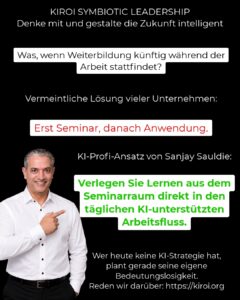
Many companies rely on standardized training programs to prepare their leadership levels for the future. These formats provide fundamental knowledge, but they often fail to bring about lasting behavioral changes. The transfer into the workplace remains absent. Leaders fall back into old patterns.
For example, a medium-sized manufacturing company invested substantial sums in external seminars. The participants initially showed great enthusiasm. However, after a few weeks, the effect was lost. The management wondered what had gone wrong. The answer lay in the lack of individual support.
A trading company experienced a similar situation when introducing new analytical tools. The management understood the technical fundamentals theoretically. In practice, however, they lacked confidence in their decisions. They delegated important tasks to technical specialists. The strategic management competence was lost.
A financial services provider, in turn, found that its department heads could evaluate reports, but they were unable to ask the right questions. The quality of the analyses remained superficial. Important connections were overlooked. The company lost its competitiveness.
Best practice with a AIROI customer
An internationally operating logistics company came to us with a specific question. The management had recognized that its middle management had difficulty moderating data-driven decision-making processes. The department managers felt overwhelmed by the wealth of information. They responded with avoidance behavior and delegated responsibility downward. In a six-month process, we jointly developed a multi-stage competency program that directly addressed the company’s real challenges. First, we analyzed the existing decision-making processes and identified critical interfaces. Subsequently, we developed individual learning goals for each manager. The coaching included regular reflection sessions where we discussed specific situations from the workplace. The leaders learned to critically question algorithmic recommendations and to place them in strategic contexts. They developed confidence in dealing with uncertainty. After completing the program, the participants reported a significantly increased sense of confidence in their actions. The management team observed improved decision-making quality. The turnover in middle management level decreased significantly.
Targetly strengthen AI leadership competencies through systemic approaches
The development of leadership qualities in the context of intelligent systems requires a holistic approach. It is not enough to train individual skills in isolation. Rather, mindsets, attitudes, and behaviors must be addressed simultaneously at multiple levels. Only in this way can sustainable change be achieved.
A systemic perspective reveals the diverse interactions between individual competencies and organizational frameworks. Leaders do not operate in a vacuum. Their development depends on corporate culture, team dynamics, and structural factors. These interconnectedness must be taken into account in every development process.
In the energy sector, we observe particularly complex requirements. Executives must keep abreast of technical, regulatory, and societal aspects simultaneously. The integration of intelligent grid systems challenges traditional hierarchies. New forms of collaboration are required.
Similar challenges are evident in healthcare. Clinic managers must decide how to integrate algorithmic diagnostic tools into treatment pathways. They are responsible for patients and staff. The ethical implications are enormous.
The pressure to transform is also growing in the education sector. School administrators and university leaders are faced with the question of how to implement adaptive learning systems. The balance between the use of technology and human interaction requires new skills. Proven pedagogical principles must be reinterpreted.
The importance of reflection ability for Strengthening AI leadership skills deliberately
One of the key skills that leaders need to develop is systematic self-reflection. In a world where algorithms increasingly provide decision suggestions, the ability to maintain a critical distance is indispensable. Leaders must recognize when they should follow algorithmic recommendations. But they must also know when human judgment is required [1].
Reflective ability encompasses several dimensions. First and foremost, it involves self-awareness. Leaders must be aware of their own patterns of thinking and biases. Only then can they avoid having these unconsciously influence decisions. Furthermore, they must learn to regulate their emotional reactions to technological changes.
An automotive supplier recognized this need when introducing predictive maintenance systems. The production managers had difficulty trusting the system recommendations. At the same time, they lacked the knowledge to critically question the recommendations. The reflection work in the coaching helped them develop an appropriate attitude.
An insurance company faced similar challenges. The claims officers needed to use algorithmic damage assessments. The team leaders had to learn how to support their employees in this process. The joint reflection on the advantages and disadvantages of the new tools created orientation.
In retail, we observed how store managers learned to handle automated ordering systems. Initially, they constantly corrected the system suggestions. Reflection helped them understand when interventions were useful. Their decision-making quality improved significantly.
Scaling leadership competencies in complex organizations
The development of individual leaders is important. However, for sustainable business success, competence development must be scaled up. This means that skills must be systematically built up on a broader level [2]. Multipliers play a central role in this process.
Scaling requires thoughtful structures and processes. Experienced leaders can serve as mentors for less experienced colleagues. Internal learning communities promote knowledge exchange. Regular reflection rounds create space for collaborative learning.
A telecommunications company developed a successful multiplier model. Selected executives were intensively supported. Subsequently, they passed on their knowledge to their teams. As a result, the reach of the competence development increased significantly.
A pharmaceutical company relied on cross-departmental learning circles. Executives from different departments met regularly. They exchanged experiences and learned from each other. The silo structures were broken down. New perspectives emerged.
In the public sector, a city administration tested innovative formats. The department heads developed together guidelines for dealing with data-driven systems. The participatory process strengthened commitment. Implementation was better than with previous initiatives.
Best practice with a AIROI customer
A medium-sized family business in the food industry sought support in scaling its leadership development in the context of digitalization. The company had already implemented individual pilot projects with intelligent production controls, but the experiences remained limited to a few individuals. The management wished that the entire leadership team could benefit from the insights. Together, we designed a tiered program that included both individual coaching and group formats. In the first phase, we identified five key individuals who were to serve as internal ambassadors. They received intensive coaching over several months. They not only learned new skills but also how to pass on their knowledge. In the second phase, they themselves moderated workshops for their colleagues. The external coaching supported them with supervision and methodological prompts. The third phase established solid structures for continuous learning. Regular exchange formats were introduced and strengthened. The company now has a self-sustaining system for competence development. The investment in external support has paid off in a lasting way.
Ethical dimensions in competence development
Working with intelligent systems raises fundamental ethical questions. Leaders must address issues such as data privacy, transparency, and fairness. They are responsible for ensuring that technology is used in accordance with human values [3].
In transruptions coaching, ethical reflections therefore play an important role. We discuss with leaders how they can make responsible decisions. This is not about simple answers. Instead, participants develop an awareness of the complexity of the questions at hand.
A human resources provider was grappling with the question of how to make algorithm-driven applicant selection fair. The executives realized that they could not simply rely on system recommendations. They developed testing mechanisms and escalation processes. The ethical sensitivity throughout the company increased.
A media company took on the challenge of automated content recommendations. The editorial team had to balance between reach optimization and journalistic quality. The reflection process helped define clear guidelines. Editorial integrity was preserved.
In the banking sector, the top management addressed the issue of algorithmic credit decisions. The decision-makers wanted to avoid discrimination. At the same time, the systems should operate efficiently. The balancing act required continuous reflection and adaptation.
Targeted strengthening of AI leadership competencies as a long-term process
Developing leadership skills in the digital age is not a one-time project. It requires continuous attention and investment. Technological development is advancing rapidly. What is considered relevant today may already be outdated tomorrow.
Therefore, it is important to cultivate a mindset of lifelong learning. Leaders should view curiosity as a resource. They should be willing to question established beliefs. Flexibility and adaptability become key competencies.
Transruptions coaching accompanies leaders on this journey. We offer impulses and spaces for reflection. We support the development of individual learning strategies. In doing so, we respect the respective pace and the needs of each person.
My AIROI Analysis
The systematic development of leadership competencies in the context of intelligent technologies represents one of the greatest challenges of our time. Organizations that underestimate this task risk losing their edge over competitors. At the same time, the deliberate exploration of this topic offers enormous opportunities for sustainable growth and innovation.
My experience from numerous mentoring processes shows that success depends on several factors. First, there must be genuine commitment from the top management level. Without this, initiatives quickly fail. Second, a realistic assessment of the initial level is essential. Overly ambitious expectations lead to frustration. Third, competence development must be integrated into the workday. Isolated training rarely yields lasting results.
I find the balance between technical understanding and human qualities particularly important. Leaders do not have to become programmers. However, they should understand the basic principles of intelligent systems. At the same time, classic leadership skills such as empathy, communication skills, and ethical judgment are becoming increasingly important. The art lies in combining both dimensions.
Finally, I would like to emphasize that the path to Strengthening AI leadership skills deliberately It is not a sprint, but a marathon. Patience and endurance are required. Setbacks are part of the learning process. Those who embark on this journey are rewarded with increasing sovereignty and ability to act. The investment in their own development pays off multiple times.
Further links from the text above:
[1] Harvard Business Review – Artificial Intelligence
[2] McKinsey – QuantumBlack AI Insights
[3] World Economic Forum – Artificial Intelligence and Robotics
For more information and if you have any questions, please contact Contact us or read more blog posts on the topic Artificial intelligence here.






 Deutsch
 English (UK)