
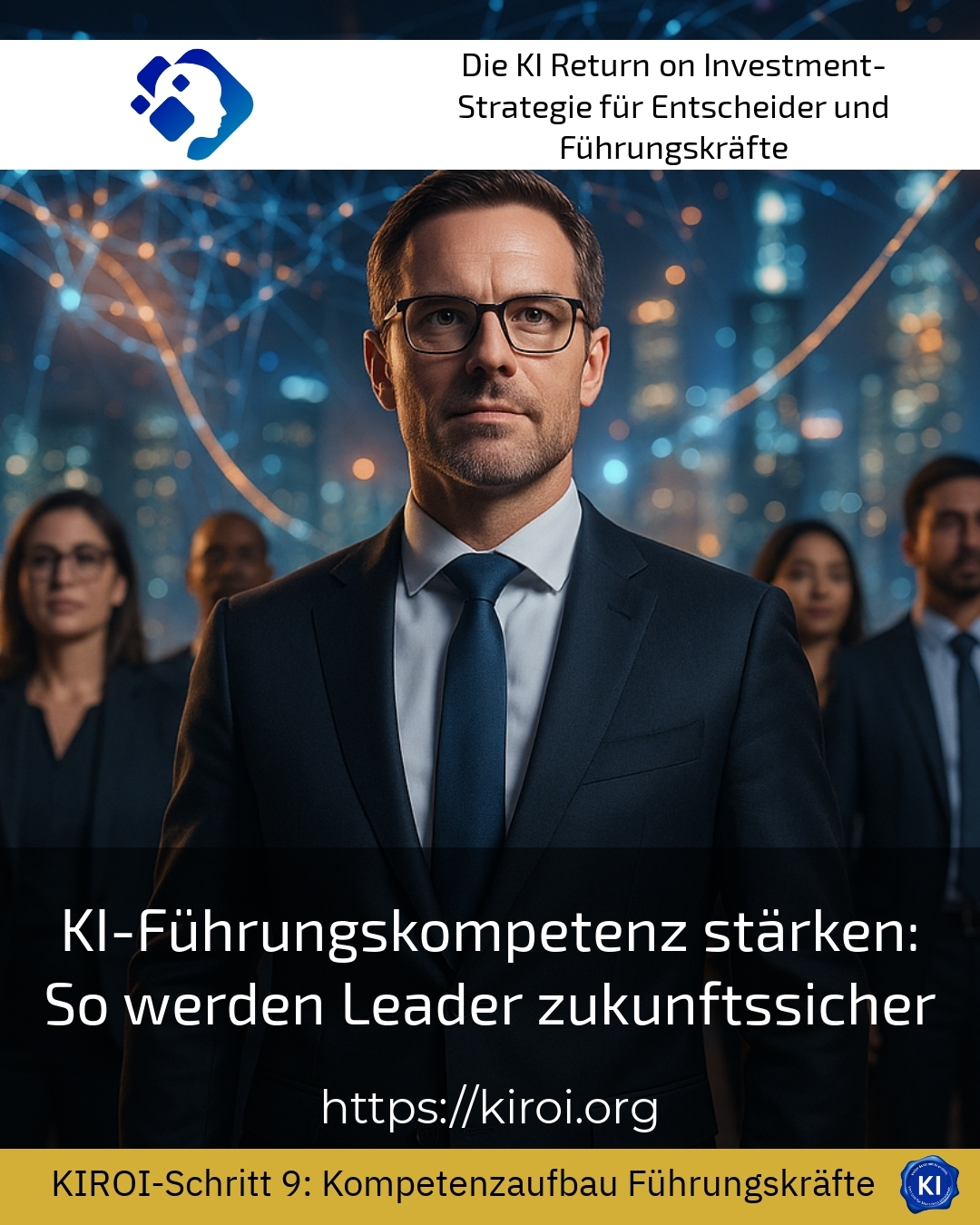
The world of work is changing at a breath-taking pace, and many leaders are faced with the question of how to navigate their teams through this transformation. Strengthening AI leadership skills today means far more than developing a technical understanding. Rather, it is about cultivating a new way of thinking and acting that connects people and intelligent systems in a meaningful way. Clients frequently report that they feel overwhelmed by the speed of change and are looking for guidance. In this article, you will discover the concrete steps decision-makers can take to make their organisations resilient and adaptable.
Why traditional leadership models are reaching their limits
The classical hierarchies and decision-making pathways that provided stability over decades are increasingly proving to be an obstacle to agile responses to market changes. For example, a manufacturing company takes weeks to push a process adjustment through all approval levels. In the same time, competitors have already brought new product variants to market. A financial services provider loses valuable customer contacts because decision-making powers are too heavily centralised and advisors are not permitted to respond independently to individual needs.
Another example can be found in healthcare, where hospital management frequently struggles with rigid structures. The introduction of new digital diagnostic tools fails not because of the technology itself, but due to a lack of willingness to delegate responsibility to specialist levels. These observations show that change is not primarily of a technical nature, but a cultural one. Leaders must learn to relinquish control while simultaneously providing guidance, which represents a challenging tension.
Strengthening AI leadership skills through conscious self-reflection
The first step towards becoming a future-proof leader begins with honest self-reflection and the willingness to question one's own thought patterns. Many decision-makers carry unconscious beliefs that stem from a time when knowledge meant power and having an information advantage secured careers. These mental models collide with a reality in which information is available in fractions of a second and expert knowledge can be aggregated algorithmically.
A managing director of a medium-sized logistics company realised through transruption coaching that his reluctance towards data-driven decision-making tools was actually a fear of losing relevance. In retail, store managers struggle to accept recommendations from forecasting systems because they feel their experiential knowledge is being devalued. A head of HR in the chemical industry resisted the introduction of analysis tools for application processes for months until she understood that her expertise lay in interpretation and contextualisation, not in sorting through CVs.
Best practice with a AIROI customer
An international engineering firm faced the challenge of preparing its regional management team for the integration of smart manufacturing systems. The divisional managers had decades of experience and were highly regarded within their teams, but showed clear reservations about the planned changes. As part of a six-month ‘transruptions’ coaching programme, AIROI provided individual support to the managers as they addressed their concerns and underlying resistance. It became clear that the main obstacle was not a lack of technical understanding, but rather the fear of appearing ignorant in front of their own staff. Through targeted guidance and safe spaces for reflection, the participants developed a new self-image in which not knowing was seen not as a weakness, but as a starting point for collaborative learning. As a result, the company was able to accelerate implementation by several months and recorded significantly higher acceptance at shop-floor level.
The role of emotional intelligence in digital transformation
Paradoxically, the human capacity for empathy and relationship-building is gaining massive importance precisely in times of increasing automation. Employees seek guidance and security when job profiles change and familiar routines disappear. Leaders who can recognise and address these emotional needs create the prerequisite for successful change processes. In an insurance company, the introduction of automated claims processing initially led to massive uncertainty within the claims processing team [1]. The team leader took time for one-to-one discussions and created a space for the articulation of fears.
A pharmaceutical company established regular dialogue formats in which laboratory managers could talk openly about their experiences with new analysis systems. An energy supplier specifically trained its department heads in active listening and appreciative communication. This investment in interpersonal skills paid off through lower staff turnover and higher engagement. The examples illustrate that technological transformation is doomed to fail without emotional support.
Strategies for Sustainable Development of AI Leadership Competence
Strengthening leadership skills for the algorithmic age requires a systematic approach that integrates various levels of learning and is designed for the long term. One-off training sessions are not enough to sustainably change deeply rooted patterns of thought and behaviour. Instead, what is needed are continuous learning loops that combine reflection, experimentation and feedback. A telecommunications company established so-called learning partnerships between experienced managers and digitally affine junior talent [2]. Both sides benefit from this exchange in different ways.
In the construction industry, a main contractor is experimenting with project-based rotations in which site managers are temporarily integrated into digital pilot projects. A hotel chain regularly sends managers to the reception desk to experience firsthand how technology-supported services change guest interaction. These experience-based learning formats generate deeper insights than theoretical seminars. Managers who have experienced for themselves how new tools transform work processes can guide their teams through change more authentically.
Creating spaces for experimentation and cultivating a tolerance for error
An essential prerequisite for the development of future-proof leadership skills lies in the creation of protected experimental spaces where mistakes are not punished, but understood as learning opportunities. While many organisations advocate a positive culture of error, they do not consistently live it. Leaders who are sanctioned for poor decisions will not take risks and therefore will not be able to enable innovation.
An automotive supplier set up an internal innovation fund from which teams can finance small experiments without lengthy approval processes. A media organisation introduced the practice of explicitly asking for and documenting the most valuable mistakes upon completion of projects. An accountancy firm established regular retrospectives in which leadership teams openly reflect on failed initiatives [3]. These practices signal that learning is more important than perfection and encourage bold decisions.
Best practice with a AIROI customer
A long-established family-run business in the food industry approached AIROI because the senior management had realised that middle management had become the bottleneck in the digitalisation process. The production managers and quality managers possessed excellent technical expertise but showed little willingness to try out new ways of working. As part of a ‘transruption’ coaching programme, a safe experimental space was first created in which managers could work with new tools without the pressure of being assessed. In parallel, regular reflection sessions were held, during which participants could process their experiences and emotions. A particularly valuable insight was the realisation that much of the resistance stemmed from past negative experiences with poorly implemented IT projects. By addressing these historical issues and establishing new, positive reference experiences, the managers’ underlying attitude changed permanently. The company reports a significant increase in the pace of innovation and improved cross-departmental collaboration.
Strengthening AI leadership competence in everyday practice
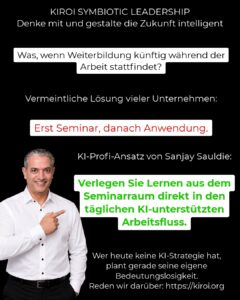
The theoretical engagement with new leadership concepts forms an important foundation, but must be translated into everyday leadership practice in order to have an impact. This is where many well-intentioned initiatives fall flat, because the bridge between the seminar room and day-to-day business is not built. Transruption coaching supports managers in integrating new behaviours directly into their working practice and continuously developing them.
An example from the banking sector illustrates this approach very clearly: a branch manager wanted to involve her team more in decisions, but under time pressure repeatedly fell back into directive patterns. Through weekly short reflection sessions with a coach, she was able to identify her triggers and practise alternative response patterns. A production manager in the textile industry used the guidance to improve his communication during shift handovers and share information more transparently. A sales director in the software sector worked on granting her team more autonomy in customer service without compromising quality standards [4].
Networks and collegial support as a success factor
Leaders who embark on a path of transformation benefit enormously from exchanging views with like-minded individuals who are navigating similar challenges. The isolation of a leadership position intensifies in times of change because established networks often fail to provide answers to novel questions. Building new peer groups and participating in cross-industry formats can provide valuable impetus here.
An association of human resources directors from various industrial companies meets regularly for a confidential exchange of experience on digital transformation projects. In the healthcare sector, hospital managers have formed a learning circle to share best practices on integrating new diagnostic systems. A network of managing directors in the trades organises reciprocal company visits to learn from each other and gain inspiration. These informal structures complement formal training and development opportunities in a valuable way and promote sustainable learning.
The ethical dimension of modern leadership responsibility
With the increasing integration of intelligent systems into decision-making processes, the ethical demands placed on leaders are also growing. These leaders are responsible for these systems and must consider their impact on people. It is no longer enough to optimise efficiency metrics and serve shareholder interests. Modern leaders must be able to reflect upon the societal implications of their decisions and communicate them transparently.
A recruitment agency is faced with the question of how far the algorithmic pre-selection of applications may go without compromising equal opportunities. A mail-order company has to weigh up which customer data should be used for personalisation and where limits are to be drawn [5]. A mobility provider is wrestling with the decision of how much monitoring of drivers is acceptable for quality assurance. These dilemmas require ethical judgement that cannot be replaced by algorithms and which forms the core of human leadership responsibility.
My AIROI Analysis
The systematic accompaniment of managers through transruptions coaching has proven in numerous projects to be an effective lever for developing future-proof organisations. Experience shows that technological transformation without the parallel development of leadership culture regularly falls short of expectations and wastes valuable resources. Investing in the human side of change, on the other hand, pays off several times over because it reduces resistance, promotes engagement and enables sustainable change.
Strengthening AI leadership competence is not a one-off project, but an ongoing process of personal and organisational development that requires continuous attention and care. Leaders who are prepared to embark on this journey and question their own patterns will become valuable companions for their teams and organisations. The ability to guide people through uncertainty, provide direction while cultivating openness to the unknown, is becoming the decisive differentiating factor in a world where technological solutions are increasingly available and interchangeable. The combination of self-reflection, continuous learning, emotional intelligence and ethical judgement forms the foundation of a leadership practice that will be equal to the demands of the coming decades.
Further links from the text above:
[1] McKinsey – The importance of employee experience in times of change
[2] Harvard Business Review – Leadership Development
[3] Forbes – Leadership Insights
[4] MIT Sloan Management Review – Leading Change
[5] World Economic Forum – Artificial Intelligence and Ethics
For more information and if you have any questions, please contact Contact us or read more blog posts on the topic Artificial intelligence here.






 Deutsch
  English (UK)