
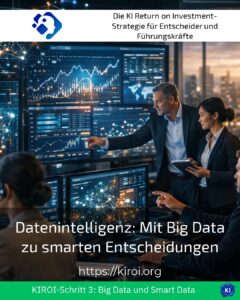
Imagine you are standing in front of a vast sea of data, the currents and depths of which have hitherto remained hidden from you, whilst your competitors are already hoisting the most valuable treasures with precise navigation equipment. The SmartDataRevolution for Decision Makers fundamentally alters how leaders understand and use information. This is precisely where a fundamental shift begins, which is not only technological in nature. It affects the entire mindset of modern corporate management. Anyone making strategic decisions today needs more than intuition and experience. Data-driven insights are becoming the decisive competitive advantage.
Understanding the new era of information processing
Modern businesses generate unimaginable amounts of information daily from a wide variety of sources. Customer interactions, production processes and market movements continuously produce valuable data points. Taming this flood and using it meaningfully presents many leaders with considerable challenges. At the same time, this opens up completely new opportunities for well-founded business decisions [1].
In retail, leading companies analyse their customers' purchasing behaviour in real time. They identify trends before they manifest themselves on the market. A fashion retailer dynamically adjusts its product range to regional preferences, using weather forecasts, social media and sales data simultaneously.
Financial service providers use advanced analytical methods to identify attempted fraud at an early stage. They search millions of transactions for anomalies in fractions of a second. In doing so, the systems continuously learn from new patterns and steadily improve their accuracy.
Logistics companies optimise their supply chains through precise predictive models. They anticipate bottlenecks and delays before they become critical. In this way, they reduce costs while significantly increasing customer satisfaction.
Why the SmartData Revolution is becoming indispensable for decision-makers
The speed at which markets are changing requires rapid and well-founded responses. Traditional decision-making processes based on monthly reports are no longer sufficient. Leaders require access to up-to-date insights in an understandable format. Only in this way can they act proactively rather than reactively [2].
A pharmaceutical company uses real-time analytics to accelerate clinical trials. It identifies promising active ingredients faster than with traditional methods. The time to market for new drugs is thereby shortened by valuable months.
Insurance companies personalise their tariffs through individual risk assessments. They take hundreds of factors into account simultaneously. Customers receive fairer prices, while the company optimises its risk portfolio.
Energy suppliers forecast consumption peaks with impressive accuracy. They control their production capacities accordingly and avoid expensive overcapacities. At the same time, they contribute to grid stability and reduce emissions.
Best practice with a AIROI customer
A medium-sized mechanical engineering company faced the challenge of making its maintenance cycles more efficient and minimising unplanned downtimes. The management recognised that the existing sensor data from the delivered machines had previously been underutilised. Together with transruptions coaching, the leadership team developed a clear strategy for data utilisation. The process began with a comprehensive inventory of all available information sources. Subsequently, the decision-makers defined concrete business goals that were to be achieved through better analytics. The company gradually implemented a predictive maintenance system based on machine learning. Within eighteen months, unplanned stoppages fell by more than forty per cent. Customer satisfaction rose noticeably because service interventions took place preventatively rather than reactively. Particularly valuable was the continuous support provided by the coaching team, which combined technical expertise with strategic advice. The managers developed a deeper understanding of data-driven decision-making processes and are now independently cascading this knowledge throughout their organisation.
Build strategic competence and anchor it sustainably
Technological change requires new skills at all levels of management. Decision-makers do not need to become data experts themselves. Nevertheless, they require a fundamental understanding of the possibilities and limitations of modern analytical methods. Only in this way can they ask the right questions and critically evaluate results.
Car manufacturers systematically train their managers in the use of analytics tools. They empower them to interpret market trends independently and make production decisions. The combination of human experience and machine analysis leads to better results.
Telecommunications providers use customer analytics to identify churn risks at an early stage. They develop personalised retention measures for vulnerable customer groups. The return on investment of such programmes frequently exceeds traditional marketing measures significantly [3].
Retailers optimise their pricing using dynamic algorithms. They take competitor prices, stock levels and demand forecasts into account simultaneously. Profit margins increase while competitiveness is maintained.
Mastering challenges in the transformation process
Many decision-makers report uncertainty when introducing data-driven processes. They wonder where to begin and which investments are worthwhile. There is often a lack of internal expertise to implement projects successfully. This is where professional support from experienced partners helps.
Hospitals use patient data to improve treatment protocols. They identify risk factors for complications and act preventatively. At the same time, they must meet strict data protection requirements and respect ethical boundaries.
Construction companies analyse project data to predict cost overruns. They identify critical phases early and take timely countermeasures. Budget adherence improves, and client relationships are strengthened.
Media companies personalise their content recommendations through user analytics. They increase dwell time and reduce subscription churn rates. The algorithm learns continuously and adapts to changing preferences.
Practical implementation of the Smart Data Revolution for decision-makers
The journey towards a data-driven organisation begins with an honest stocktake. What information is already available, and how is it currently being used? Where do data silos exist that are blocking valuable insights? These questions form the basis for a targeted strategy.
Food manufacturers monitor their production chains thoroughly. They guarantee quality standards and react immediately to deviations. Product recalls are becoming less frequent and less extensive because problems are identified early.
Airlines optimise their pricing strategies through continuous market monitoring. They maximise the load factor of their flights whilst maintaining attractive prices. The algorithm simultaneously takes seasonality, events and competitor behaviour into account.
Hotel chains personalise the guest experience through comprehensive preference analyses. Regular guests are welcomed with their favourite drinks. The emotional bond with the brand strengthens, and repeat bookings increase [4].
Best practice with a AIROI customer
An insurance company wanted to fundamentally modernise its claims management, aiming both to reduce costs and increase customer satisfaction. The previous processes were largely manual and required a significant amount of time for each individual case. The management team decided on a comprehensive transformation accompanied by transruptions-Coaching as a strategic partner. Together, they first analysed the existing workflows and identified bottlenecks and inefficiencies. Subsequently, they developed a concept for the automated initial assessment of claims. The system now uses historical data to process standard cases autonomously and focus employees on complex cases. The average processing time fell by more than sixty per cent while maintaining consistent quality. Customers receive feedback more quickly and rate the service significantly more positively than before. The employees now work on more demanding tasks and report higher job satisfaction. The coaching team accompanied the entire change process and provided impetus for the sustainable embedding of the new working methods within the company.
Shaping cultural change and empowering teams
Technology alone does not create added value if people are not prepared to use it. Cultural change is often the biggest challenge in transformation projects. Leaders must set an example and actively demonstrate a readiness for change. Transparent communication regarding goals and benefits fosters acceptance within the team.
Industrial enterprises are establishing competence centres for advanced analytics. They pool expertise and make it available to the entire organisation. Functional departments can request support there for their specific issues.
Banks promote data-driven thinking through internal academy programmes. They train employees at all levels in fundamental analytical skills. The threshold of inhibition regarding new technologies falls, and innovative ideas emerge decentrally.
Retailers experiment with small pilot projects before scaling widely. They test new approaches in selected stores and learn from the results. This iterative approach reduces risks and accelerates organisational learning.
recognising the Smart Data Revolution as an opportunity for decision-makers
The ability to gain insights from information is becoming the central competitive factor. Companies that invest today are securing their position for the future. Technology is developing rapidly and constantly opening up new opportunities. Decision-makers who actively shape this development will benefit the most.
Energy companies integrate data from renewable sources with traditional power plants. They balance supply and demand more precisely than ever before. Intelligent control is precisely what makes the energy transition economically viable [5].
Logistics service providers use real-time information to optimise deliveries. They reduce empty runs, thereby cutting costs and emissions simultaneously. Customers benefit from more precise delivery time windows and higher reliability.
Technology companies analyse usage behaviour to continuously improve their products. They identify problems before customers complain. This proactive approach sustainably strengthens customer loyalty.
My AIROI Analysis
Following intensive engagement with the challenges and opportunities of data-driven corporate management, a clear picture emerges. Successful transformations are always based on a combination of technological expertise and strategic foresight. Pure technology implementation without cultural change rarely leads to sustainable results. Decision-makers who address both dimensions simultaneously achieve the best outcomes. Guidance from experienced partners such as transruptions-Coaching can provide valuable impetus in this regard and help to avoid typical pitfalls.
The step-by-step approach with clearly defined intermediate goals seems particularly important to me. Large transformation projects frequently fail due to unrealistic expectations and a lack of patience. Small successes build trust and motivate for the next steps. Continuous reflection on what has been achieved and the adaptation of the strategy are part of the process.
Leaders should not shy away from bringing in external expertise and learning from the experiences of other companies. The complexity of the subject matter requires humility and a willingness to learn at all levels. Those who adopt this mindset will not be overtaken by the data-driven future, but will actively help shape it.
Further links from the text above:
[1] McKinsey Analytics Insights on data utilisation
[2] Gartner Data Analytics Research
[3] Harvard Business Review Data Topics
[4] Forbes Big Data column by Bernard Marr
[5] International Energy Agency Digitalisation
For more information and if you have any questions, please contact Contact us or read more blog posts on the topic Artificial intelligence here.









 Deutsch
 English (UK)