
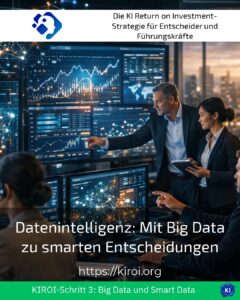
Imagine you are sitting on a massive treasure without knowing it. Every day, companies collect millions of data points, yet only a few know how to transform this valuable information into real value creation. SmartDataPower describes precisely this process of intelligent data utilisation that transforms raw columns of figures into profitable business decisions. The digital transformation began long ago, and anyone who fails to act now will lose touch with the competition. In this article, you will learn how to proceed systematically in order to deploy your data assets profitably.
Understanding the basics of intelligent data usage
Before we turn to the practical applications, we must first look at the theoretical foundations. Information is the new oil of our time. Unlike fossil fuels, however, data multiplies exponentially. Around 2.5 trillion bytes of new information are created worldwide every day. Processing this volume requires sophisticated strategies and modern technologies.
In retail, point-of-sale systems continuously collect sales data. At the same time, loyalty cards record shopping habits. Online shops track every click of their visitors. Together, these three sources form a powerful information network. However, this data often remains unused, sitting in separate silos.
The manufacturing industry shows similar patterns. Sensors on production machines measure temperature, pressure and vibration. Quality control checks generate extensive inspection reports. Logistics systems track every movement of goods in the warehouse. Yet the connection between these information flows is frequently missing.
Financial service providers also possess enormous amounts of data. Transaction histories show customer behaviour over many years. Loan applications contain detailed personal information. Market data flows through the systems in real time. The challenge lies in putting these puzzle pieces together in a meaningful way.
SmartDataPower in practical application
Implementing a data-driven strategy begins with an honest inventory. What information are you already collecting today? Where is it stored? Who has access to it? These questions form the foundation of any successful data strategy. Only when you know your current situation can you plan improvements.
For example, a medium-sized engineering company recognised untapped potential in its maintenance logs. For years, the technicians had meticulously documented every service call. However, nobody evaluated these records systematically. Following the introduction of an analytics platform, a clear pattern emerged regarding certain components. Predictive maintenance significantly reduced unplanned downtime.
A supermarket chain used its till data for a revolutionary range optimisation. The analysis showed which products were frequently bought together. As a result, the company rearranged the shelves. In addition, it adjusted order quantities dynamically based on the weather. When the sun shone, orders for barbecue charcoal increased automatically.
Best practice with a AIROI customer
An internationally active logistics service provider was faced with a complex challenge in the field of route optimisation. The company operated a fleet of several hundred vehicles and delivered to thousands of customers across Europe every day. Previous planning was largely based on the experience of the dispatchers. Through support within the framework of transruptions coaching, the company developed a data-driven solution. First, we integrated all existing data sources into a central platform. Traffic data, weather forecasts, historical delivery times and customer preferences were brought together. The algorithms calculated optimal routes taking into account all relevant factors. Within six months, the company reduced its fuel costs by a significant proportion. Customer satisfaction increased because deliveries were made more punctually. The dispatchers gained valuable time back for strategic tasks. This example impressively demonstrates how SmartDataPower can generate tangible economic benefits. The key lay in the systematic combination of previously isolated information sources.
Explore industry-specific application areas
Every industry has specific applications for intelligent data analysis. In healthcare, algorithms assist with diagnosis in complex clinical pictures [1]. Insurance companies use claims data for fraud detection and risk assessment. Energy suppliers optimise their grid utilisation through precise consumption forecasts.
The construction industry benefits from the analysis of historical project data. Cost overruns can be identified early and avoided. Material orders are placed more precisely, reducing waste. Quality defects are identified and rectified more quickly. These improvements add up to considerable savings.
Hotels and catering businesses are relying on dynamic pricing. The occupancy rates of historical periods are factored into the calculation. Events and public holidays are taken into account automatically. Weather data influences roster planning in service. In this way, businesses optimise their revenues while maintaining consistent quality.
The automotive sector demonstrates the possibilities particularly impressively. Vehicles continuously transmit telemetry data to the manufacturers. This information significantly improves future models. At the same time, it enables personalised services for customers. The garage already knows which part needs to be replaced before the appointment.
Challenges in implementing SmartDataPower
The path to becoming a data-driven organisation rarely runs in a straight line. Clients frequently report resistance among the workforce. Employees fear being replaced by algorithms. These concerns must be taken seriously. Transparent communication forms the foundation of successful transformations.
Technical hurdles also represent a significant challenge. Legacy systems often do not communicate with each other. Data formats vary considerably between departments. The quality of the available information rarely meets the requirements of modern analytics. Here, a structured approach supports step-by-step development.
Data protection and compliance require special attention. Personally identifiable information is subject to strict legal regulations [2]. The GDPR defines clear limits for data processing. Companies must take these requirements into account from the very beginning. Otherwise, severe penalties and reputational damage are imminent.
A textile retailer initially underestimated the effort required for data cleansing. The master article data contained numerous inconsistencies and duplicates. Different spellings for identical products made analysis difficult. Only after months of cleanup work did the evaluations yield reliable results. However, this investment paid off in the long run.
Cultural transformation as the key to success
Technology alone does not guarantee success in data utilisation. The corporate culture must evolve in parallel. Decisions should in future be based on facts rather than gut feeling. This change takes time and consistent leadership. Managers must lead by example.
A pharmaceutical company established regular data drop-in sessions for all employees. Analysts explained the latest insights there in an easy-to-understand way. Questions were explicitly encouraged and answered patiently. Gradually, interest in data-driven decisions grew. Today, department heads proactively request new analyses.
A city administration used citizen data to improve public services. Complaint patterns highlighted vulnerabilities in the infrastructure. Traffic counts noticeably optimised traffic light phasing. Rubbin bins reported their fill levels for more efficient collection routes. The satisfaction of the residents increased measurably.
Best practice with a AIROI customer
A medium-sized family-owned business in the food production sector approached us with a specific problem. The management team had for some time observed fluctuating production qualities without any recognisable pattern. Despite state-of-the-art machinery and experienced employees, scrap rates repeatedly exceeded the industry average. As part of our support through transruptions coaching, we initially analysed all available production data. Surprisingly, a correlation emerged between humidity and quality issues. Although the existing air conditioning systems regulated the temperature reliably, they neglected the humidity. Following the installation of additional sensors and adjustment of the control system, the situation improved significantly. The scrap rate fell to an industry-leading level within a few months. The investment in the sensor technology paid for itself in the very first quarter after implementation. This example illustrates how SmartDataPower can uncover hidden connections. Sometimes the solutions are closer than one first assumes.
Technological foundations for sustainable data strategies
The choice of the right technologies is a decisive factor in determining success. Cloud solutions offer flexibility and scalability for growing volumes of data. On-premise systems guarantee maximum control over sensitive information. Hybrid approaches skilfully combine the advantages of both worlds.
Machine learning significantly expands analytical capabilities [3]. Algorithms recognise patterns that remain hidden from human analysts. Forecasting models become more precise with every new piece of information. The automation of repetitive evaluations creates space for creative work.
An electronics retailer implemented a machine learning-based recommendation system. The system continuously analysed the clickstream data of all website visitors. Personalised product suggestions appeared in real time on the homepage. As a result, the conversion rate improved noticeably. At the same time, the return rate decreased due to more relevant recommendations.
The telecommunications industry uses network data for capacity planning. Peak loads can be precisely predicted and prepared for. Faults are often detected before customers notice them. Technicians can intervene proactively rather than just reacting. This predictive maintenance significantly reduces downtime.
Take data security and ethical aspects into account
With great power comes great responsibility. This wisdom applies particularly to the handling of data. Companies must communicate transparently which information they collect. The intended uses should be clearly defined and adhered to. Trust forms the foundation of every long-term customer relationship.
A bank developed ethical guidelines for its credit decision algorithms. The systems were regularly checked for discriminatory patterns. Affected individuals received understandable explanations in the event of rejections. This transparent approach sustainably strengthened customer trust.
Particularly sensitive applications are created in human resources. Applicant management systems must not filter according to inadmissible criteria. Employee analyses require the involvement of the works council. Employee privacy deserves special protection. Here, legal and ethical standards must be strictly adhered to.
A sportswear manufacturer analyses movement data from its connected shoes. The users explicitly consent to the anonymised use of this data. In return, they receive personalised training recommendations. This win-win situation creates added value for all involved. The company continuously improves its products based on real usage data.
My AIROI Analysis
The systematic use of corporate data is developing into a decisive competitive factor. Organisations that mine their information assets gain sustainable advantages. SmartDataPower enables more precise decisions at all company levels. The technology for this is available and affordable today.
At the same time, experience from numerous projects shows that technology alone is not enough. The human factor remains crucial to success. Employees must be empowered and brought along on the journey. Corporate culture must encourage and reward data-driven decisions.
Transruptions coaching supports companies through this demanding transformation. We provide impetus for strategic direction. We assist with the selection of suitable technologies. We guide cultural change using proven methods. Clients frequently report surprising insights even in the early stages of projects.
The industry examples in this post illustrate the diversity of application possibilities. From retail to manufacturing to public administration, all sectors benefit. Investment in data infrastructure and analytical competence consistently pays off. The balance between innovation and responsibility always remains important.
Finally, I would like to emphasise that the journey towards a data-driven organisation is a marathon. Quick wins are possible, but sustainable transformation requires perseverance. Begin with the first step today. Critically analyse your existing data sources. Identify quick wins for initial successes. Then systematically build further capabilities.
Further links from the text above:
[1] Federal Ministry for Economy – Digitalisation in Healthcare
[2] Information on the GDPR and data protection law
[3] Plattform Lernende Systeme – Maschinelles Lernen in der Praxis
For more information and if you have any questions, please contact Contact us or read more blog posts on the topic Artificial intelligence here.









 Deutsch
 English (UK)