
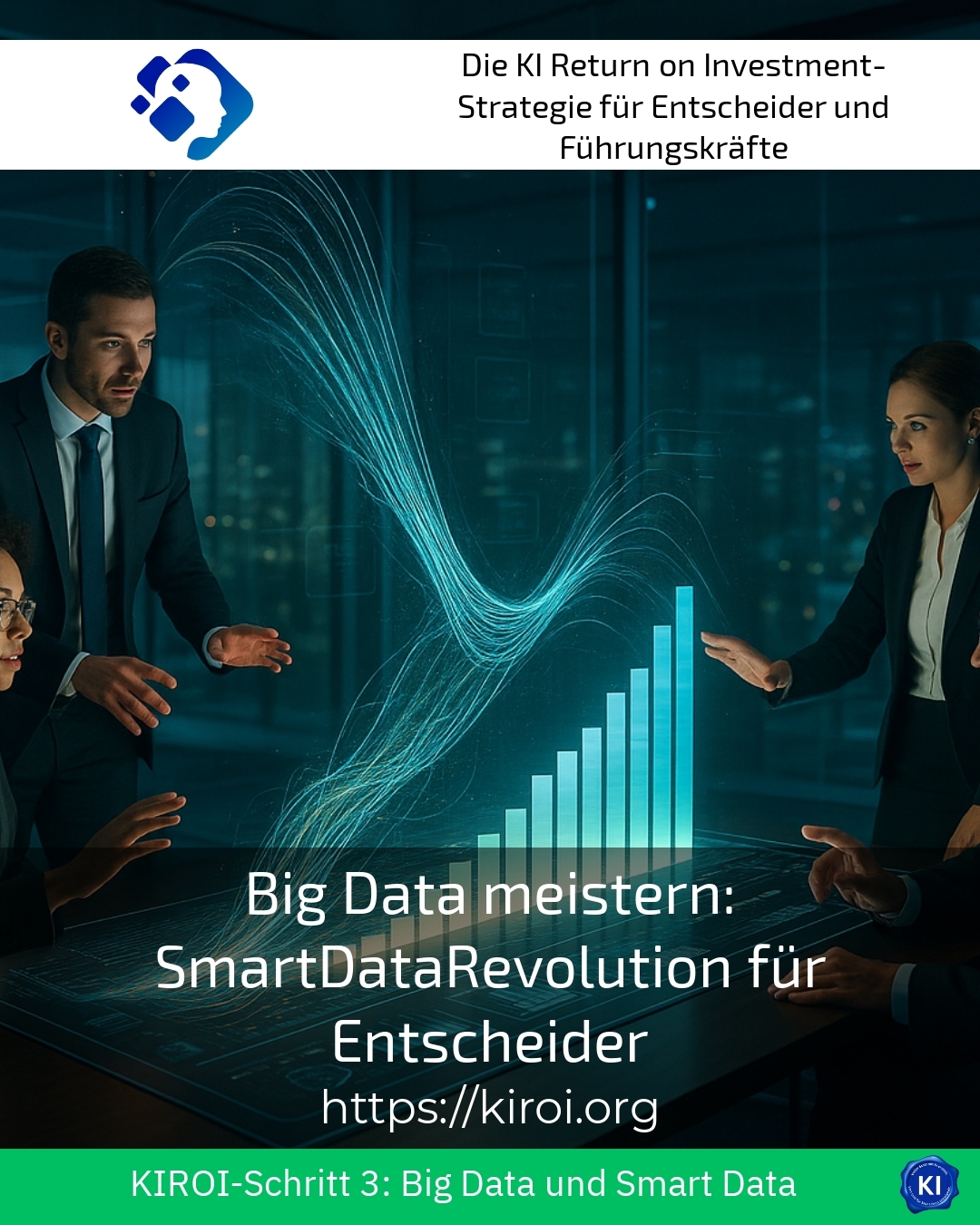
The flood of information that batters managers every day has long since overwhelmed traditional analysis methods, and that is precisely where the SmartDataRevolution for Decision Makers , because it enables valuable insights to be gained from seemingly chaotic amounts of data. Companies face the challenge of taming huge streams of information. They have to transform these into strategic advantages. Anyone who relies on outdated structures in the process will fall behind. As is well known, the competition never sleeps. In this article, you will discover how modern data strategies work. You will get to know practical approaches. These approaches help to make well-founded decisions.
Why the Smart Data Revolution has become indispensable for decision-makers
The business world has changed fundamentally. Information is generated today at a breathtaking pace. Sensors in production facilities continuously deliver measured values. Customer interactions leave digital traces. Supply chains generate real-time data. This development presents managers with new challenges.
In the manufacturing industry, networked machines collect thousands of data points per minute. A medium-sized automotive supplier can thus identify quality deviations at an early stage. Logistics companies optimise their routes through real-time analytics. Energy suppliers forecast peak loads with astonishing precision. These examples demonstrate the practical relevance of modern data strategies.
The challenge does not lie in gathering information. The problem lies in interpreting it meaningfully. Many businesses are practically drowning in data. At the same time, they suffer from a lack of actionable insights. This is where professional guidance comes in. It helps with the establishment of suitable structures.
Best practice with a AIROI customer
A leading manufacturer of industrial pumps was facing a typical problem familiar to many companies in the manufacturing sector: the fragmentation of information across different departments, which led to inefficiencies and missed optimisation opportunities. Production data was in one system, while quality information was managed separately. Customer feedback existed in a third database. As part of a transruption coaching programme, we supported the company in integrating these data sources. First, we jointly analysed the existing structures. Then we developed a roadmap for bringing them together. The project team learned to recognise patterns in the data. After six months, the company was able to carry out cross-departmental analyses for the first time. The results surprised even the most experienced employees. Downtime fell by a considerable percentage. Customer satisfaction increased measurably. This example shows how systematic support enables sustainable change.
The cornerstones of a successful SmartData Revolution for decision-makers
Successful data strategies are based on several pillars. First of all, companies need a clear vision. They must know which questions they want to answer. Without this clarity, every analysis remains superficial.
In mechanical engineering, forward-looking companies use data for predictive maintenance. Chemical corporations optimise reaction processes through continuous monitoring [1]. Retail companies personalise customer communications based on behavioural patterns. These applications require different technical foundations.
The technical infrastructure forms the foundation of every data strategy. Cloud solutions offer flexibility and scalability. On-premise systems guarantee maximum control. Hybrid approaches combine the advantages of both worlds. The choice depends on individual requirements.
Cultural transformation as the key to the smart data revolution
Technology alone is not enough. People must be willing to make data-driven decisions. This requires a cultural shift. Many leaders report resistance within their organisations.
A traditional family-run business in the field of metal processing experienced precisely this situation. Experienced master craftsmen trusted their gut feeling. Young engineers demanded data-based decisions. The conflict paralysed important projects. Mediation was only achieved through structured guidance. Both perspectives have their justification.
Training programmes help to reduce initial reservations. Pilot projects demonstrate the benefits in practice. Success stories also motivate sceptical employees. In this way, a data-savvy corporate culture is created step by step.
Best practice with a AIROI customer
A medium-sized food manufacturer approached us because the introduction of new analytical tools met with massive resistance, as long-standing employees feared being replaced by automated systems, which led to a noticeable sense of uncertainty throughout the workforce. As part of our transruption coaching, we initially accompanied intensive discussions with all those involved. We listened and took their concerns seriously. Together, we developed a communication concept. This concept put people at the centre. The new tools were positioned as support. They were intended to make routine tasks easier, not to replace them. Experienced employees contributed their knowledge. They defined relevant analytical parameters. This created a sense of co-creation. After the project, participants reported increased self-confidence. Acceptance of the new systems increased significantly. This example illustrates just how important the human component is in transformation projects.
Strategic action areas for modern corporate management
Decision-makers should keep various fields of action in mind. First of all, it is important to ensure data quality. Incorrect entries lead to false conclusions. The principle of „garbage in, garbage out“ remains relevant [2].
Pharmaceutical companies are subject to strict documentation requirements. Here, data quality has the highest priority. Financial service providers need reliable information for risk analyses. Telecommunications providers process billions of transactions daily. In all industries, quality determines success.
Another area for action concerns data security. Cyberattacks are steadily increasing. Sensitive information must be protected. At the same time, regulations such as the GDPR demand transparent processing. Companies must master this balancing act.
Understanding and using technological enablers
Modern technologies open up new possibilities. Machine learning recognises patterns in complex data sets. Algorithms make predictions with a high degree of accuracy. These tools support human decisions.
An insurance company uses such technologies for loss forecasting. A retailer uses it to optimise its inventory. An energy supplier balances supply and demand in real time [3]. The potential applications are diverse.
Nevertheless, decision-makers should be aware of technological limitations. Algorithms can identify correlations. They frequently do not understand causal relationships. Human expertise remains indispensable here. Combining both strengths promises the greatest benefit.
Practical implementation of the Smart Data Revolution for decision-makers
The path to a data-driven organisation is rarely linear. Setbacks are part of the process. Realistic planning is important. Unrealistic expectations lead to frustration.
Successful projects often start small. A limited use case serves as a pilot project. The experience gained feeds into larger initiatives. Competence is thus built up step by step. We regularly recommend this approach.
In the healthcare sector, a hospital group began analysing patient flows. The insights noticeably improved rostering. Later, the approach was expanded to medication management. Today, the system optimises the entire logistics. Such developments take time and patience.
Best practice with a AIROI customer
An international construction group sought support in optimising its project control, as delays and cost overruns had repeatedly caused problems, despite extensive data from past projects being available, which had never been systematically analysed, however. Our transruptions coaching accompanied the company over several months. Initially, we jointly identified relevant success factors of past projects. Then we developed a dashboard for project managers. This dashboard displayed early warning indicators in real time. The project managers received training on how to interpret the data. We placed special emphasis on practical exercises. Following the introduction, many participants reported improved decision-making bases. Problems were recognised and addressed earlier. Collaboration between construction sites and headquarters improved significantly. This example illustrates how structured guidance can support complex transformations.
Performance measurement and continuous optimisation
Every data strategy requires clear success criteria. Without measurable goals, the benefit remains unclear. Key performance indicators should be defined realistically. They must align with the corporate strategy.
A textile manufacturer measures success through reduced returns. A logistics service provider focuses on delivery reliability. A financial institution evaluates the accuracy of risk models. Every company defines its own benchmarks.
Regular review of the results enables adjustments. Strategies must remain flexible. Markets change rapidly. What worked yesterday may be outdated tomorrow. Continuous learning becomes mandatory.
My AIROI Analysis
The systematic use of data resources has evolved from an optional advantage to a strategic necessity, and companies that ignore this trend risk their long-term competitiveness in increasingly digitised markets. From my consulting practice, I know that the greatest success factor is not the technology, but the people who are supposed to use it. Clients frequently report technically perfect systems gathering dust unused due to a lack of acceptance. Therefore, I always emphasise the importance of change management. The SmartDataRevolution for Decision Makers is only possible with a holistic approach.
My experience also shows that perfectionism is detrimental. Many projects fail because those responsible wait for the ideal solution. It is better to start pragmatically. Learning experiences are incorporated into improvements. In this way, competence develops step by step. This iterative approach has proven its worth in numerous projects. It reduces risks and creates early successes.
Finally, I would like to emphasise that data-driven decision-making is not an end in itself, but a means to achieve corporate goals, which is why the strategic focus should never be lost sight of. External input can help to identify blind spots. Professional guidance supports navigation through complex transformation processes. Investing in corresponding skills development pays off in the long term.
Further links from the text above:
[1] McKinsey Digital – The Data-Driven Enterprise
[2] Harvard Business Review – Data Management Insights
[3] Gartner – Data and Analytics Research
For more information and if you have any questions, please contact Contact us or read more blog posts on the topic Artificial intelligence here.









 Deutsch
  English (UK)