
How can you ensure that automated systems in your company do not become a risk to reputation, while competitive pressure increases constantly and regulatory requirements become increasingly complex?
This question concerns decision-makers in almost all economic sectors. The AI Compliance Ethics This is at the heart of a transformation. Leaders face the challenge of responsibly using algorithmic systems. At the same time, they must secure competitive advantages. The balance between innovation and responsibility requires new competencies. transruptions coaching supports companies in this complex task. The following sections show concrete ways forward.
The new framework of responsibility for decision-makers
The digital transformation has fundamentally changed business models. Automated decision-making systems now permeate almost every business area. In the financial sector, algorithms assess the creditworthiness of applicants. Insurance companies use similar systems for risk assessments. Human resources decision-makers use applicant filters to optimize the recruitment process. However, each of these applications carries significant risks.
A large European insurer had to acknowledge that its automated pricing system systematically discriminated against certain postal codes [1]. The resulting public debate significantly damaged the company’s image. Another example comes from the banking sector. There, a credit scoring algorithm led to unintentional discrimination against certain professional groups. Regulatory authorities imposed severe sanctions. In healthcare, a diagnostic support system caused a stir. It systematically weighted symptoms differently for certain patient groups.
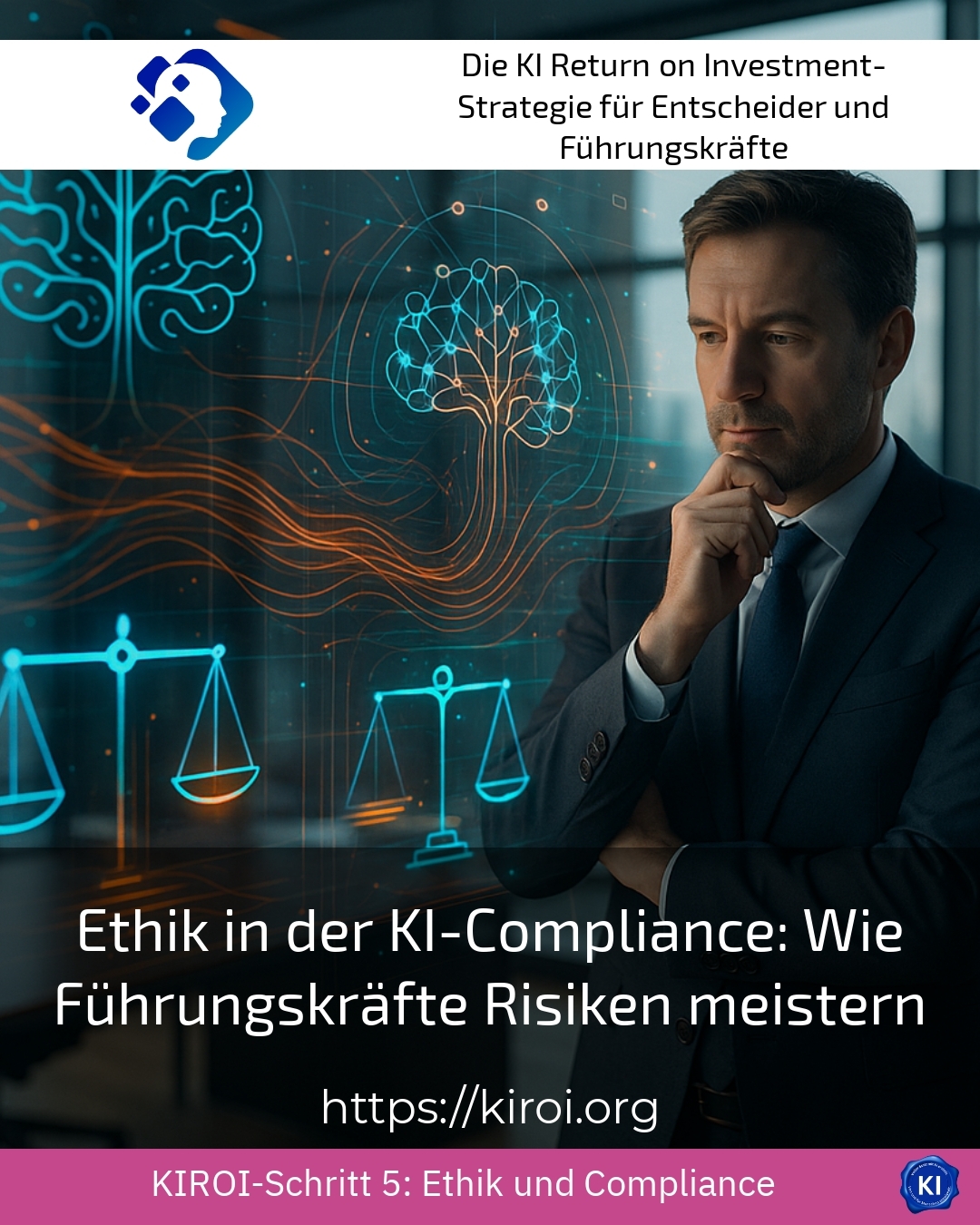
These examples illustrate a central insight. Technical excellence alone is not enough. AI Compliance Ethics it requires a holistic approach. Leaders must understand the social impact their systems can have. They are responsible for transparency and fairness.
Understanding ethics in AI compliance as a leadership task
Responsible corporate governance today means more than maximizing profits. Integrating ethical principles into automated processes has become business-critical. A telecommunications company recognized this in a timely manner. It established an ethics board for algorithmic decision-making. Every new application now undergoes a structured review process. An automotive supplier took a similar approach. It trained its entire senior management on ethical issues. A retail conglomerate, in turn, integrated external advisors into its governance process.
Best practice with a AIROI customer
A medium-sized manufacturing company faced a complex challenge in implementing an automated quality control system that was intended to identify production errors and evaluate employee performance. The workforce expressed significant concerns regarding the monitoring and fairness of the algorithmic evaluations. Transruptions coaching accompanied the management over several months in developing a transparent governance framework that considered both the technical requirements and the legitimate employee interests. Together, communication strategies were developed that strengthened the workforce’s trust. The leadership learned to take ethical concerns seriously and address them constructively. The company established a participatory process for algorithmic decisions. Employee representatives were given insight into the functioning of the system. Regular audits were implemented to detect distortions early on. The results convinced all involved stakeholders. The production quality improved measurably. At the same time, employee satisfaction significantly increased. The company positioned itself as a responsible employer in its region.
Strategic risk minimization through proactive action
Proactive leaders do not wait for regulatory requirements. They develop their own standards that go beyond minimum requirements. This approach pays off in the long run. A logistics company implemented transparency guidelines for its route optimization systems early on. When new regulations came into effect, the company was already compliant. An energy provider established similar structures for its consumption forecasts. The investment quickly paid off through avoided adjustment costs.
In retail, the importance of proactive action is particularly evident. Personalized pricing carries significant conflict potential. A leading online retailer decided to implement full price transparency. Customers can understand which factors influence pricing. The company gained customer trust as a result. In contrast, a competitor suffered massive reputational damage. Its opaque dynamic pricing was publicly criticized [2].
Practical implementation of ethics in AI compliance
The practical implementation of ethical principles requires concrete measures. Executives often report uncertainties regarding implementation. transruptions coaching provides impulses for structured approaches. The first step consists of a comprehensive inventory. Which algorithmic systems are in use? What decisions do these systems make? Who is affected by these decisions?
A pharmaceutical company went through this process systematically. It identified over thirty different algorithmic applications. During the analysis, significant action was needed. Some systems no longer met current ethical standards. The company developed a plan of action with clear priorities. A mechanical engineering company adopted a similar approach for its predictive maintenance systems. Maintenance planning now also takes employee workloads into account. In the food production sector, a company optimized its quality control. Originally problematic evaluation criteria were revised.
Best practice with a AIROI customer
An internationally operating service company has been using a system for evaluating the performance of its field sales representatives for several years, which was based on various indicators and had an impact on remuneration and career development. Internal complaints about alleged unfairness increased, and the senior management became increasingly concerned. As part of the transruptions coaching, a detailed analysis of the system logic was first conducted, which revealed systematic disadvantages for certain sales regions. Together with the management, new evaluation criteria were developed. These now take regional specificities appropriately into account. The managers learned to critically question algorithmic decisions. They developed competencies for identifying potential biases. The revised system was communicated transparently. Employees now understand the evaluation basis. Trust in the company’s management increased measurably. Turnover in the field sales team decreased by more than twenty percent. Today the company is considered a pioneer for fair performance evaluation in its industry.
Cultural change as the foundation for sustainable transformation
Technical solutions alone do not create an ethical corporate culture. The necessary cultural change begins with the leadership. They must integrate ethical considerations into their daily decisions. A construction company made this experience when introducing project management algorithms. The technical implementation was successful without any problems. However, acceptance among project managers remained initially low. It was only when management itself began to address ethical aspects that the attitude changed.
In the media sector, a similar situation is evident. Editorial recommendation systems influence which content users see. A publishing house established ethical guidelines for these systems. Journalists and technicians are now working closely together. The corporate culture has changed significantly. In the education sector, institutions are experimenting with adaptive learning systems. An educational institution integrated ethical reflection into its product development team. Every new feature is evaluated for potential negative effects.
Developing leadership skills for the algorithmic future
Developing leadership skills for algorithmic challenges takes time. Many executives report feeling overwhelmed by the technical complexity. transruptions coaching supports this development process. It is not about becoming technical experts. Rather, leaders need to be able to ask the right questions.
A tourism company systematically trained its senior management. Managers now understand basic algorithmic concepts. They can formulate critical inquiries to technical teams. The quality of strategic decisions improved as a result. In the field of corporate consulting, several companies established internal training programs. Consultants learn to address ethical aspects with clients. A tax consulting firm integrated similar modules into its partner development [3].
The AI Compliance Ethics It is increasingly becoming a differentiating factor. Companies that build up expertise in this area gain trust. Customers, employees, and business partners honor responsible behavior. The competitive advantage is reflected in more stable business relationships in the long term.
My AIROI Analysis
Accompanying numerous companies in ethical matters reveals recurring patterns and success factors that are relevant to executives in all industries and often make the difference between successful transformation and costly missteps. First, it is important to note that technical solutions can never be viewed in isolation; they must always be understood within their organizational and societal context, with the leadership level playing a crucial role in creating appropriate frameworks.
The most successful companies are characterized by proactive action. They do not wait for regulatory requirements. Instead, they develop their own standards. This attitude requires courage and foresight. However, the investment regularly pays off. Companies avoid reputational damage and regulatory sanctions.
The integration of different perspectives appears particularly important. Technical teams alone cannot fully assess ethical issues. The involvement of specialist departments, employee representatives, and external experts significantly improves decision-making quality. transruptions coaching supports the moderation of these complex processes.
The AIROI-methodology offers a structured framework for these challenges. It combines strategic considerations with practical implementation. Leaders develop competencies for critical reflection. They learn to ask the right questions. This makes it easier to sustainably embed ethical principles in the corporate culture.
Further links from the text above:
[1] European Approach to Artificial Intelligence
[2] AlgorithmWatch – Research on algorithmic systems
[3] World Economic Forum – AI and Machine Learning
For more information and if you have any questions, please contact Contact us or read more blog posts on the topic Artificial intelligence here.








 Deutsch
 English (UK)