
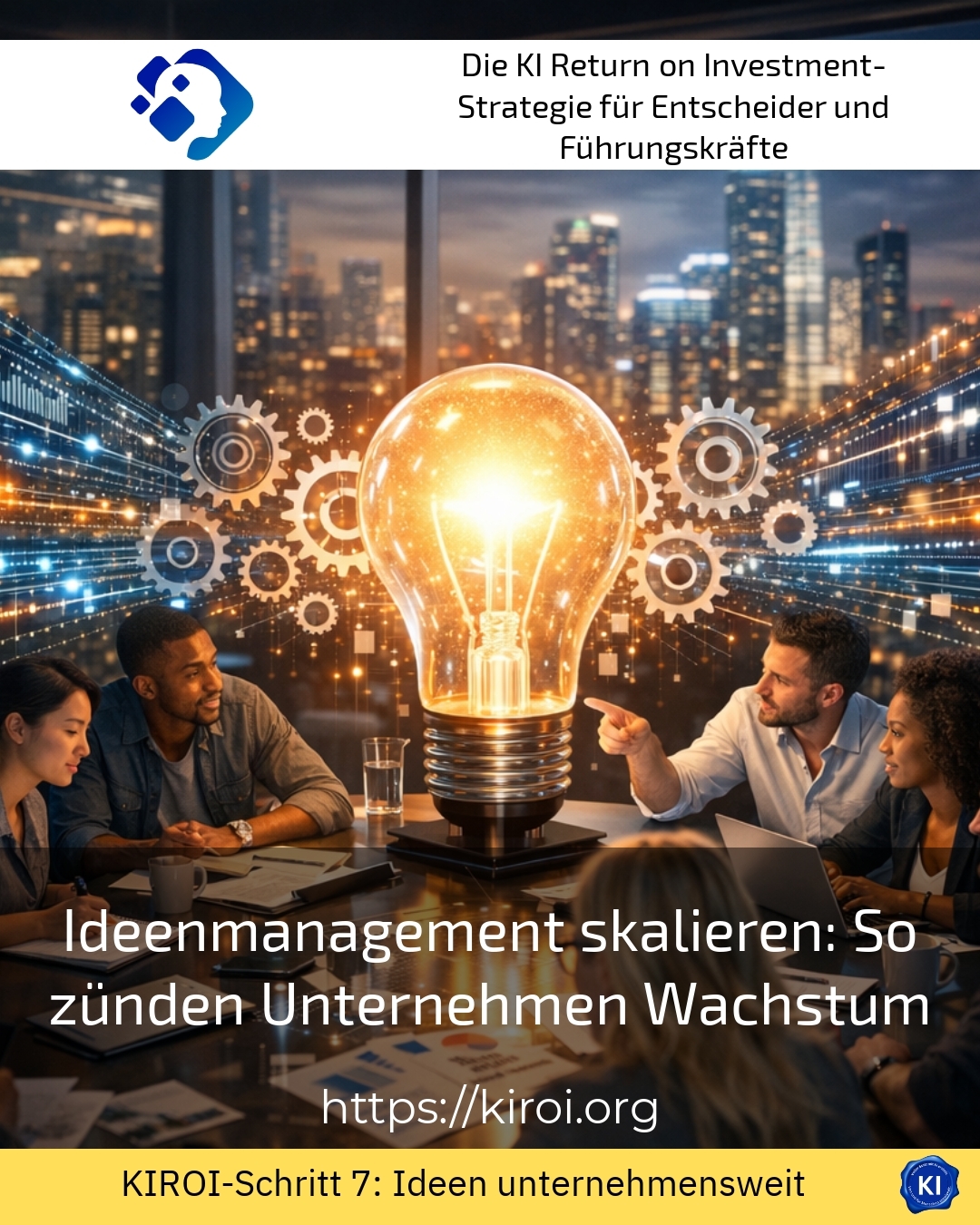
Why do so many companies fail to unleash the full potential of their employees, despite having hundreds of creative minds?
The answer often lies in the lack of ability to, Scaling ideas management to be able to generate systematic growth through the accumulation of ideas. Many organizations do collect ideas from their employees diligently, but these ideas disappear into digital filing systems or get lost in endless rounds of coordination, so valuable impulses never see the light of implementation. Transruptive coaching AIROI helps companies overcome these barriers and establish structured processes that transform creativity into measurable business success. In this article, you will learn about the mechanisms used by successful organizations to turn individual bursts of inspiration into a continuous engine of innovation.
The strategic dimension: Scaling idea management as a competitive advantage
Companies today face the challenge of combining innovation speed with quality. At the same time, they must actively involve their workforce. A structured approach can provide crucial impetus here. In the automotive industry, leading manufacturers have recognized that the best improvement suggestions often come from production workers who are on the line every day and experience inefficiencies firsthand. A southern German supplier was able to significantly reduce its defect rate by systematically capturing and evaluating optimization suggestions. The pharmaceutical industry, in turn, uses internal innovation platforms to connect researchers from different locations and identify synergies between different projects. In mechanical engineering, clients often report surprising breakthroughs when service technicians can bring their field experience into the development process in a structured manner.
The real art lies in establishing a process that works both low-key and results-oriented. Many companies make the mistake of either requiring overly complex submission forms or simply passing on any vague idea unfiltered. Both extremes lead to frustration. Transruptions coaching helps find the right balance. In retail, store managers have gained valuable insights into customer behavior through simplified feedback systems. In the logistics industry, warehouse workers were able to document process improvements through mobile input tools without interrupting their workflow.
Best practice with a AIROI customer
A medium-sized company in the precision engineering sector approached AIROI us because, despite a dedicated workforce, hardly any actionable innovation impulses were generated. The management was frustrated because they knew that enormous knowledge lay dormant in the minds of the employees, but it was never systematically captured. During the transruptive coaching, we first analyzed the existing communication channels and identified several gaps where ideas were lost. Together, we developed a three-stage evaluation system that enables quick initial assessment by direct supervisors, followed by a technical in-depth review and finally a strategic evaluation by an interdisciplinary panel. The results exceeded expectations significantly, as within six months, thirty actionable improvement proposals were identified, eight of which directly contributed to product development, and two even represented patentable innovations. The cultural transformation that accompanied this process was particularly valuable, as employees now actively sought opportunities for optimization.
Scaling the technological foundations for successful idea management
Without the right digital tools, any scaling attempt remains piecemeal. Modern platforms enable the automatic categorization of submissions and their assignment to relevant subject areas. In the chemical industry, companies use AI-powered systems to match submitted concepts with existing patent databases, thus detecting collisions or synergies early on [1]. The telecommunications industry relies on gamification elements to increase participation in internal innovation competitions. Energy providers have had positive experiences with anonymous submission options, as employees can thus also express critical improvement suggestions without fear of consequences.
Integration with existing enterprise systems plays a crucial role in acceptance. When employees have to open a separate application, the likelihood of usage drops drastically. Successful implementations are characterized by the ability to submit ideas directly from familiar work environments, whether from the email program, the project management software, or the internal communication tool. In the banking sector, institutions have seamlessly embedded their innovation platforms into existing intranet structures [2]. The insurance industry uses chatbots as a low-threshold entry point for suggestions.
Cultural prerequisites for sustainable success
Technology alone is not enough. The best systems fail if the corporate culture does not provide psychological security. Employees must be able to trust that their suggestions will be valued, even if they prove to be impractical. In the aviation industry, leading airlines have recognized that seemingly absurd ideas can sometimes lead to groundbreaking innovations. The medical technology industry explicitly encourages lateral thinking by deliberately challenging interdisciplinary teams with unconventional perspectives. Food manufacturers regularly hold innovation days where employees from all levels of the organization work together to develop new product concepts.
Transruptive coaching helps leaders establish a culture of constructive openness. Clients often report that they themselves unconsciously exhibit behaviors that prevent employees from contributing ideas. A interrupted contribution to a meeting, a skeptical expression when an unusual proposal is made – such micro-signals have a strong impact on innovation readiness. In the retail sector, companies were able to double the submission rate through targeted training for their leadership team. The construction industry is experimenting with hierarchical-free innovation circles, where construction managers and assistants discuss optimization potentials on an equal footing.
Best practice with a AIROI customer
An international consumer goods company faced the challenge of pooling and evaluating innovation impulses from twenty countries without ignoring local peculiarities or stifling the process through excessive centralization. The transruptions coaching accompanied the company in developing a federated model where regional innovation hubs initially collect and pre-evaluate ideas independently before promising concepts are brought to the global platform. We worked intensively with the local teams to make cultural-specific adjustments, as what is considered encouraging feedback in Scandinavia can be completely interpreted differently in Asia. Particularly challenging was the development of an evaluation system that takes cultural differences into account while still delivering comparable results. After eighteen months, the number of proposals submitted and implemented had quadrupled, with particularly gratifying news that regions that were previously considered to be lacking in innovation are now actively contributing.
Scalability in the measurement of ideas and continuous optimization in idea management
What cannot be measured cannot be improved. Therefore, companies need clear metrics that go beyond mere submission numbers. The implementation rate shows how many ideas are actually put into practice. The time-to-implementation measures the speed from the initial idea to its realization. In the steel industry, producers have found that quick feedback to the submitters is crucial for long-term motivation [3]. The textile industry uses Net Promotor Scores to gauge the satisfaction of idea submitters with the process. Software companies measure the economic impact of implemented proposals and communicate these successes transparently.
Regular retrospectives allow the process itself to be continuously improved. Where are bottlenecks emerging? Which categories are submitted particularly frequently or rarely? Through such analyses, the furniture industry has recognized that production proposals were overrepresented, while sales ideas hardly materialized. Through targeted measures, this imbalance could be offset. In the hospitality industry, hotel chains use the analysis of regional differences to transfer best practices from successful locations to others.
Reward systems and appreciation
The question of the right incentive system is of concern to many companies. Monetary rewards can increase submission rates in the short term, but they often lead to a decline in the quality of submitted proposals. Combinations of different recognition methods are usually more successful. In the electronics industry, manufacturers have had good experiences with so-called “Innovator of the Month” programs, in which particularly dedicated employees are publicly recognized. The cosmetics industry relies on exclusive invitations to strategy workshops as a way of valuing particularly valuable contributions. Automotive suppliers offer successful ideas with the opportunity to actively participate in the implementation process.
Transruptions coaching helps companies develop a balanced recognition system that fits their corporate culture. In some organizations, public awards have a motivating effect, while in others a more discreet form of appreciation is preferred. The gaming industry uses virtual badges and rankings to promote competitive play. Traditional manufacturing companies, on the other hand, rely on personal conversations with the management as the highest form of recognition.
My AIROI Analysis
The support of numerous projects in the field of Scaling ideas management It has shown me that success depends on three core factors. First, organizations need a clear strategic anchor for the innovation process at the management level. Second, technological solutions must be seamlessly integrated into existing workflows. Third, a cultural transformation is required that makes psychological safety and constructive feedback the norm. These three pillars are closely intertwined and can only collectively achieve their full effect.
What I find particularly remarkable is that many companies systematically underestimate the potential of their employees. In almost every project I have overseen, untapped treasure troves of improvement ideas lurked in the minds of the workforce. The problem was never a lack of creativity, but always a lack of structures that could channel that creativity. The industries that scale most successfully with innovation initiatives are characterized by a culture of appreciation that goes far beyond financial incentives. They understand that every employee is a potential innovator and that the task of leadership is to create the conditions under which that potential can flourish. Transruptive coaching provides the impetus for exactly this transformation and accompanies companies on their individual journey towards a vibrant innovation culture.
Further links from the text above:
[1] WIPO – World Intellectual Property Organization Patent Resources
[2] McKinsey Insights on Innovation Strategy
[3] Harvard Business Review – Innovation Topic Collection
For more information and if you have any questions, please contact Contact us or read more blog posts on the topic Artificial intelligence here.









 Deutsch
 English (UK)