
What actually happens when your best sales representatives suddenly conduct fewer customer meetings – and sales figures still rise?
This question sounds like a contradiction at first, but it describes a phenomenon that more and more companies are discovering for themselves and that is revolutionising the way we think about sales efficiency have to think. In a world where quantity was long considered the benchmark for success, we are currently experiencing a fundamental paradigm shift in which the AIROI strategy plays a central role in helping companies to finally deploy their most valuable resource – their employees' time – where it makes the biggest difference. Because while many organisations still believe that more calls, more emails and more contact attempts will automatically lead to more closed deals, reality paints a completely different picture that forces a rethink.
The Paradox of Overactivity in Modern Sales
Imagine a typical day in a sales department. Employees work through lists and call hundreds of contacts. They send out standardised emails and hope for a response. In doing so, they often spend more than sixty percent of their working time on tasks that do not generate direct revenue because they have to maintain data, coordinate appointments or follow up on unqualified leads that will never become customers [1].
A medium-sized engineering company had recognised precisely this problem and discovered that its field sales staff spent an average of only twenty per cent of their time on actual sales pitches. The rest was taken up by administrative tasks, travel time and processing enquiries that later turned out to be unsuitable. A pharmaceutical company reported similar experiences, as its sales representatives needed an average of seven contact attempts before they could even conduct a qualified discussion. A financial services provider analysed its processes and discovered that eighty per cent of all initial discussions ended with prospects who had neither a budget nor decision-making authority.
How average companies tackle the problem with the AIROI strategy
The obvious reaction of many organisations is to rely on technology and let AI automatically generate as many customer contacts as possible. Chatbots answer queries round the clock. Automated email sequences bombard potential customers with messages. Predictive dialers dial new numbers every second, leaving not a moment unused.
This strategy follows a simple logic. If ten percent of all contacts lead to closed deals, you simply need more contacts. A telecommunications provider invested millions in such a system and increased its contact rate by three hundred percent. An e-commerce company automated its entire initial contact and suddenly reached five times as many potential customers as before. An insurance group implemented AI-supported cold calling and was able to triple the number of daily calls per employee.
However, the results frequently fell short of expectations. After all, more contacts do not automatically mean better contacts, and conversion rates actually dropped in some cases because the quality of interactions suffered and customers felt repelled by the impersonal approach [2].
The hidden costs of mass automation
What looks like an increase in efficiency on paper often turns out in practice to be a Pyrrhic victory. Customers feel annoyed by standardised messages. Sales staff suffer from the monotony of their work. Brand perception suffers because the company is perceived as intrusive.
A software vendor had to learn this the hard way when their automated campaigns led to a forty per cent increase in unsubscribes. An industrial supplier lost key existing customers because they no longer felt valued due to the impersonal communication. A consultancy firm discovered that its AI-generated initial pitches achieved a response rate of under one per cent, whereas personally written messages were ten times more successful.
The AIROI strategy as an intelligent alternative to mass automation
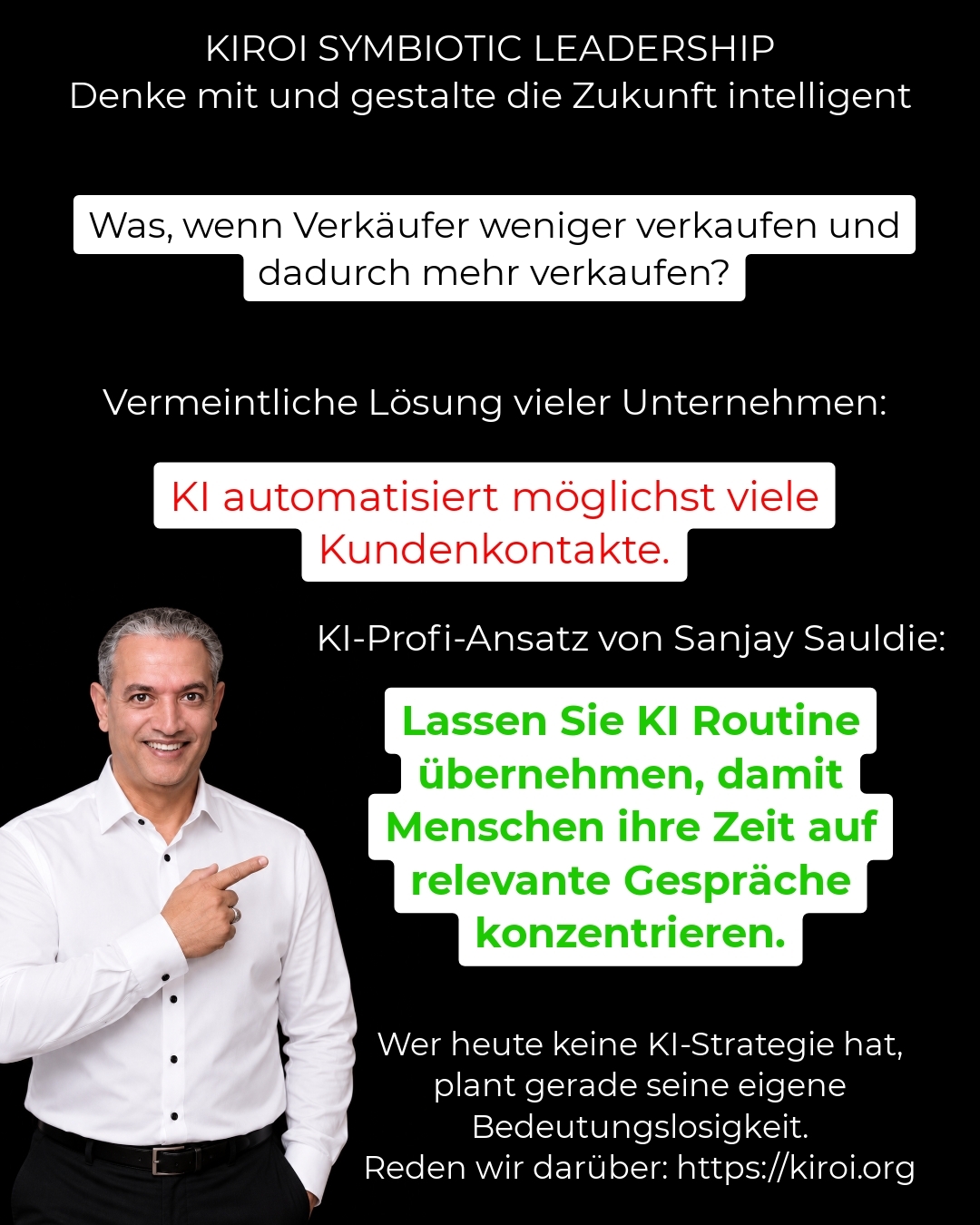
The AIROI solution takes a fundamentally different approach. Instead of using AI to generate more leads, it uses intelligent systems to identify the right contacts and handle all routine tasks so that people can focus their time on meaningful conversations.
The principle is simple, yet effective. AI analyses data, identifies patterns and filters out the most promising leads. It takes care of scheduling appointments, data maintenance and preparing for conversations. Instead of a long list of unqualified contacts, sales representatives receive a short selection of prospective clients who are actually signalling a readiness to buy and with whom a conversation makes sense.
A logistics company implemented this approach and reduced the number of customer contacts per employee by fifty per cent. An equipment manufacturer used the AIROI strategy to relieve pressure on its sales team and give them more time for advisory discussions. A medical technology manufacturer relied on intelligent prioritisation, enabling its field sales staff to focus on the twenty per cent of customers that accounted for eighty per cent of revenue.
Best practice with a AIROI customer
A medium-sized company in the technical wholesale sector faced the challenge that its twenty sales representatives had to process hundreds of enquiries daily and hardly had any time left for strategic customer management. The management had initially considered hiring additional staff or increasing automation, but then decided to collaborate within the framework of transruption coaching to find a more sustainable path. Following a thorough analysis of existing processes, the team implemented an AI-powered system that automatically categorised and prioritised incoming enquiries, enabling sales staff to immediately identify which contacts offered the greatest potential. At the same time, the AI took over the creation of quotes for standard products and the answering of frequently asked questions, saving employees an average of three hours of administrative work per day. The result exceeded all expectations, because although the number of personal customer meetings fell by thirty per cent, revenue per employee rose by twenty-five per cent, as the meetings that did take place were significantly more focused and result-oriented. Customer satisfaction also improved significantly because prospective buyers felt better advised and no longer had the feeling of just being a number in a long list.
How the AIROI strategy separates routine from relevance
The key lies in the intelligent division of tasks. AI takes over all activities that do not require human contact. Humans concentrate on what only humans can do.
A chemical company currently uses AI to pre-sort technical enquiries and enrich them with relevant product information before a specialist advisor takes over. A construction company has automated systems analyse project requirements and compile suitable references so that sales enters every meeting thoroughly prepared. An automotive supplier has semi-automated its quotation process, giving its employees the opportunity to invest more time in cultivating relationships with decision-makers.
The human dimension in AI-driven sales
What happens to sales representatives when AI takes over their routine tasks? Experience shows that they do not become redundant. On the contrary, they evolve into true consultants and strategic partners for their clients [3].
An energy supplier reports that, since the introduction of the AIROI strategy, its customer advisors once again have time for on-site visits and can thus identify projects that would never have come up during telephone contact. An IT service provider notes that its sales staff are selling more complex solutions because they finally have the capacity to delve deeply into their customers' requirements. A packaging manufacturer sees that long-term partnerships are emerging because the sales team is no longer rushing from appointment to appointment, but can instead focus on sustainable relationships.
Quality over quantity as a new paradigm for success
The numbers speak for themselves. Companies that consistently implement the AIROI strategy frequently report significant improvements in their key figures without having to increase the size of their sales team.
A tool manufacturer reduced its cold calls by seventy percent while simultaneously doubling its closing rate. A textile company halved the number of customer visits per week and still recorded a fifteen percent increase in sales. An electronics retailer focused its sales on top customers and generated more contribution margin with less effort than ever before.
Practical implementation in companies
The introduction of the AIROI strategy requires more than just installing new software. It is about a cultural shift that affects the entire company and must be actively supported by management.
A steel merchant began with a pilot phase in which only one team tested the new way of working before it was rolled out to the entire organisation. A food producer invested heavily in training its employees so that they understood how to use AI-generated insights for their conversations. A furniture manufacturer set up a feedback system through which sales representatives could continuously contribute suggestions for improving the AI algorithms.
Best practice with a AIROI customer
An internationally active component manufacturer approached us with the challenge that its sales team was suffering from chronic overload and, despite constant overtime, customer satisfaction scores were falling. The employees were frustrated because they felt they were merely firefighting rather than proactively developing business, and staff turnover in the department had reached worrying levels. As part of transruptions coaching, we jointly analysed the workflows and identified numerous processes suitable for intelligent automation without jeopardising the personal character of customer relationships. The team implemented a system that automatically sorted customer enquiries by urgency and potential, prepared standard responses and converted meeting notes into structured data sets accessible to all team members. Within six months, the workload normalised, overtime dropped by sixty percent and, at the same time, customer satisfaction scores rose to record levels because employees once again had the time and energy to truly engage with their conversational partners. Management also reported a significant drop in staff turnover and a noticeably improved mood throughout the team.
My AIROI Analysis
Insights from numerous projects clearly show that the traditional sales approach – more contacts equal more revenue – has reached its limits in many industries and must be replaced by smarter methods. The AIROI strategy offers a promising path here that both increases efficiency, raises employee job satisfaction and improves the quality of customer relationships.
Particularly noteworthy is the observation that companies which use AI not as a replacement for human interaction, but as a tool to free employees from routine tasks, consistently achieve better results than those that rely purely on automation. The key lies in the conscious decision to use technology where it has strengths and to foster people where their unique skills – empathy, creativity, relationship-building – are required.
For managers, this means rethinking and no longer measuring the success of their sales by the number of contacts, but by the quality of conversations and the sustainability of customer relationships. The AIROI strategy supports this shift by providing concrete tools and methods to shape the transformation successfully. Companies that take this path not only position themselves better economically, but also become more attractive employers for talented sales professionals who want to be more than just cold callers with targets. The future belongs to those who understand that less can indeed sometimes be more – provided that the right priorities are set.
Further links from the text above:
[1] Harvard Business Review – Sales & Marketing Insights
[2] McKinsey – Sales and Channel Management
[3] Gartner – Sales Leadership Research
[4] Forrester – B2B Sales Research
Are you a leader and would you like to learn how you can genuinely introduce AI into your company in a valuable and sustainable way, away from the hype? Take part Contact us or read more blog posts on the topic Artificial intelligence here.








 Deutsch
 English (UK)