
Why do so many brilliant ideas fail along the path from the initial sketch to a marketable innovation, even though companies invest millions in research and development?
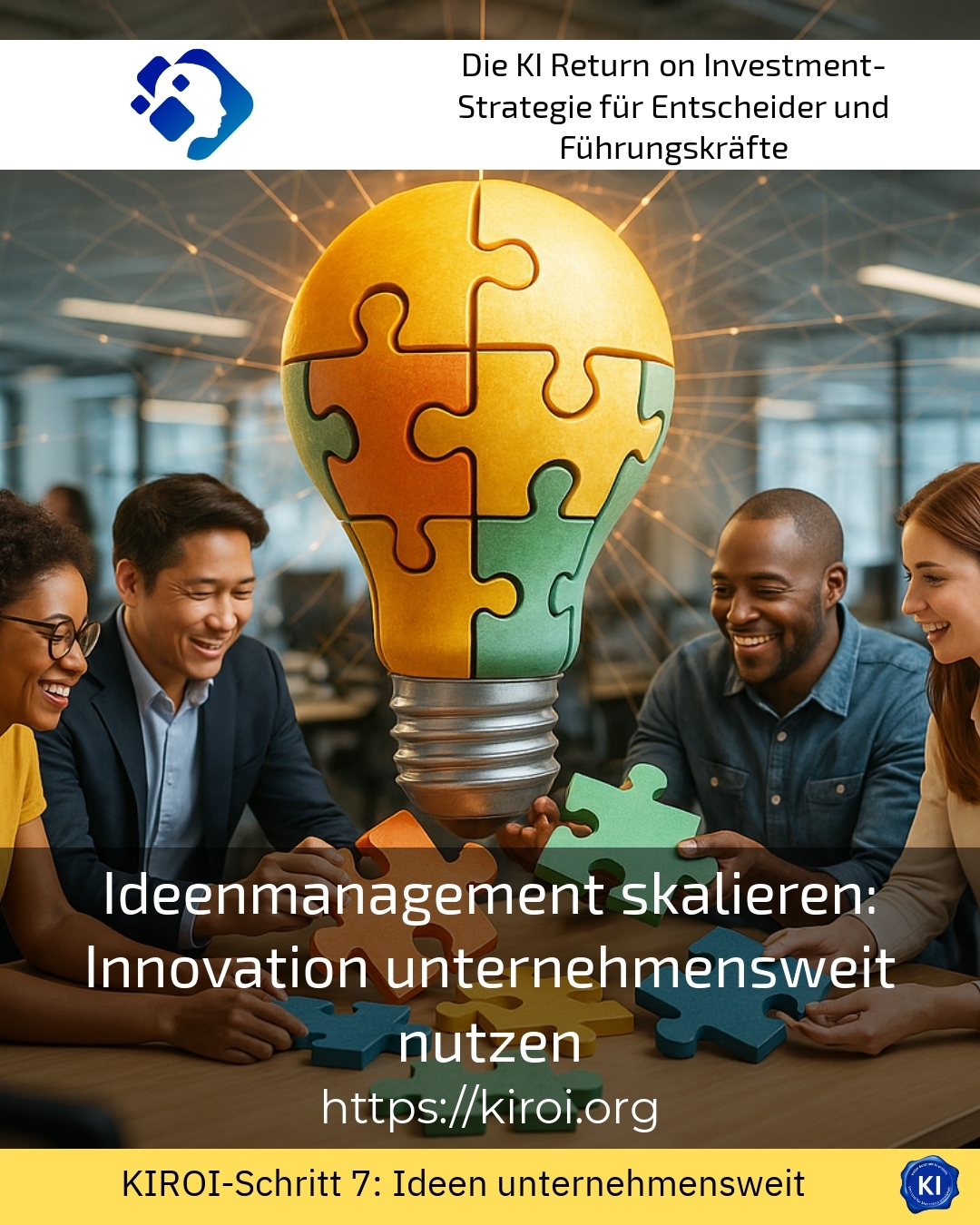
This question concerns both managers and innovation managers. The answer often lies in a fundamental structural problem: the Scaling ideas management Only a few organizations achieve this successfully. Yet there is enormous creative potential lurking within every company. Employees from different departments develop improvement proposals every day. They identify optimization opportunities in processes and discover new market opportunities. But without systematic structures, these valuable impulses are lost in day-to-day operations. The challenge lies in harnessing innovation across the company while leaving no one behind.
The foundations of a scalable innovation culture
A sustainable innovation culture does not emerge overnight. It requires strategic planning and consistent implementation. Many organizations begin with isolated pilot projects in individual departments. However, this approach quickly shows its limitations. The most valuable innovations often arise at the intersections between different functional areas. A sales representative recognizes customer needs that the product team does not have on its radar. A logistics expert identifies efficiency potential across the entire supply chain. An IT specialist sees automation opportunities in administrative processes. These diverse perspectives form the raw material for real breakthroughs.
The introduction of digital platforms significantly supports the networking of these diverse sources of knowledge. Modern software solutions enable transparent documentation of all submitted proposals. They promote cross-departmental exchange and make evaluation processes comprehensible. At the same time, they create incentive structures through gamification elements and reward systems. Employees can comment on ideas, develop them further, and evaluate them. This creates collective intelligence that goes far beyond the sum of individual contributions.
Best practice with a AIROI customer
A medium-sized company in the manufacturing sector faced the challenge of systematically capturing and evaluating innovative ideas from all business areas. The previous practice was based on traditional corporate proposal systems, which recorded few submissions and were perceived by employees as outdated. As part of a transruptive coaching project, we supported the company in completely reorienting its innovation processes. First, we analyzed the existing structures and identified key barriers that prevented creative employees from submitting their proposals. Fear of criticism played a role, as did unclear responsibilities and a lack of feedback on submitted concepts. Together, we developed a multi-stage system that combined low-threshold submission options with structured evaluation processes. The results exceeded all expectations: Within six months, the number of submissions increased by more than three hundred percent, and several proposals resulted in concrete product improvements that enabled measurable cost savings.
Scaling idea management: structures for sustainable growth
Scaling innovation processes requires clear responsibilities and defined processes. Without these foundations, friction and frustration arise. In practice, many clients report failed attempts to establish innovation across the board. The reasons for this are diverse and range from a lack of leadership support to insufficient resources. A common problem is the lack of integration of innovation activities into regular business processes. When idea development is understood as an additional task alongside day-to-day operations, it inevitably falls by the wayside.
Successful organizations prioritize innovation as a strategic priority at the board level. They appoint dedicated innovation managers or create cross-functional teams with clear mandates. These teams have their own budgets and decision-making authority. This allows them to quickly respond to promising proposals and develop prototypes. Engaging external partners and startups further expands the innovation ecosystem. Collaborations with universities and research institutions bring fresh knowledge into the organization.
Another critical success factor lies in the design of incentive systems. Monetary rewards alone often are not enough to generate sustained motivation. Many employees value recognition and visibility as well as financial compensation. Regular innovation awards and public recognition of successful projects create positive role models. They signal to the entire workforce that creative contributions are valued. At the same time, they lower the psychological barrier for submitting their own contributions.
Cultural Transformation as a Foundation
Technical solutions and organizational structures are only part of the overall picture. The real challenge lies in cultural transformation. Many companies unconsciously cultivate a culture of error that punishes experimentation. Employees learn early on that failure has negative consequences. These experiences permanently shape their behavior and inhibit their willingness to take risks. A true innovation culture, by contrast, requires psychological safety and trust. Leaders must demonstrate that mistakes are welcomed as learning opportunities.
The implementation of agile work methods supports this cultural change. Scrum, Design Thinking, and Lean Startup offer proven frameworks for iterative development. They encourage rapid experimentation with minimal resources. Regular retrospectives lead to continuous improvement processes. Teams learn from their experiences and adapt their methods. These learning loops significantly accelerate the speed of innovation.
Best practice with a AIROI customer
A service company with several thousand employees in various locations struggled with silo-like structures that significantly hindered cross-departmental knowledge exchange. Although individual departments developed innovative solutions, these insights often remained isolated and did not find widespread adoption within the overall organization. As part of our transruptive coaching support, we developed a comprehensive concept to promote cross-organizational knowledge transfer. Central elements were regular innovation workshops where employees from different departments came together to work on concrete challenges. These formats not only created new solutions but also fostered personal networks across departmental boundaries. Additionally, we introduced a digital knowledge platform where best practices were documented and made accessible to everyone. The combination of personal interactions and digital tools proved particularly effective because it took into account different communication preferences and offered different entry points for engagement.
Use technological enablers for innovation across the company
Modern technologies open completely new possibilities for systematic Scaling ideas management. Artificial intelligence can automatically categorize submitted suggestions and identify similar concepts. This prevents duplication and makes synergies visible. Predictive Analytics helps assess the potential for success of ideas early on. Natural Language Processing enables the analysis of unstructured text data from customer feedback or employee surveys. These insights provide valuable insights for innovation initiatives.
Collaboration platforms connect employees across geographical and organizational boundaries. Video conferencing, virtual whiteboards, and shared document editing create digital workspaces. These tools enable asynchronous collaboration across different time zones. Remote teams can effectively work on shared projects. The spatial distance loses its importance for creative processes.
Cloud-based solutions offer additional advantages through high scalability and flexibility. Companies can adapt their innovation infrastructure to meet their needs. As user numbers increase, capacity automatically grows. At the same time, the entry barriers for smaller organizations significantly decrease. Modern software-as-a-service models enable professional innovation management without high initial investments.
Measurability and continuous optimisation
Sustainable innovation programs require clear metrics and regular performance measurement. Without quantifiable goals, the foundation for strategic management is lacking. Typical key performance indicators include the number of ideas submitted per employee and per unit of time. The implementation rate shows what proportion of the proposals are actually implemented. The time from submission to implementation provides insight into the efficiency of the processes.
Qualitative measurement variables complement these quantitative indicators in a meaningful way. Employee surveys capture satisfaction with the innovation program. They identify improvement potential from a user perspective. Regular stakeholder interviews provide deeper insights into perceptions and expectations. These feedback inputs are integrated into continuous optimization processes.
Best practice with a AIROI customer
An international company wanted to expand its existing innovation program to include additional country-based entities, while appropriately taking cultural differences into account. The challenge was to create a uniform framework that allowed for local adaptations at the same time. Our transruptive coaching approach focused on developing a modular system that bound core elements in a binding manner while leaving room for regional specificities. We worked closely with local management to understand their specific needs and constraints. It was revealed that the appreciation for formal versus informal communication channels varied significantly across cultures. In some cultures, employees preferred personal conversations, while others favored digital channels. The resulting hybrid model combined standardized processes with flexible implementation options and was positively received by all participating locations because it ensured both global consistency and local relevance.
Scaling idea management as a strategic competitive advantage
In dynamic markets, innovation capabilities determine long-term business success. Organizations that systematically harness creative potential gain sustainable competitive advantages. They react faster to changes and anticipate trends early. The involvement of all employees multiplies the available perspectives and competencies. This creates solutions that purely centralized research departments could not develop.
The democratization of innovation simultaneously strengthens employee engagement and employer attractiveness. People want to make a contribution and experience their work as meaningful. When companies enable their employees to actively shape the future, their engagement increases significantly. This intrinsic motivation far exceeds the impact of external incentives.
My AIROI Analysis
Systematic unlocking of corporate-wide innovation potential represents one of the most important strategic tasks for forward-thinking organizations. My experience from numerous consulting projects shows that successful implementations always rely on three pillars: well-thought-out structures, supportive technologies, and a supportive culture. None of these components can replace the others, and it is only their interplay that generates lasting impact. Particularly often I observe that companies overvalue technical solutions and neglect cultural aspects. The most modern software platform remains ineffective when employees are afraid of negative consequences or their contributions are not valued. At the same time, good will alone is not enough when clear processes and responsibilities are lacking. Transruptional coaching supports organizations in addressing all three dimensions simultaneously and developing individually tailored solutions. This is not about adopting standardized best practices, but about developing customized concepts that fit the specific corporate culture and strategic direction. The time and energy invested pay off many times over in terms of increased innovation and improved competitiveness. Companies that consistently take this path regularly report surprising breakthroughs and a noticeable change in the collaborative culture.
Further links from the text above:
[1] Harvard Business Review – Innovation Insights
[2] McKinsey – The Eight Essentials of Innovation
[3] IdeaScale – Innovation Management Resources
For more information and if you have any questions, please contact Contact us or read more blog posts on the topic Artificial intelligence here.







 Deutsch
 English (UK)