
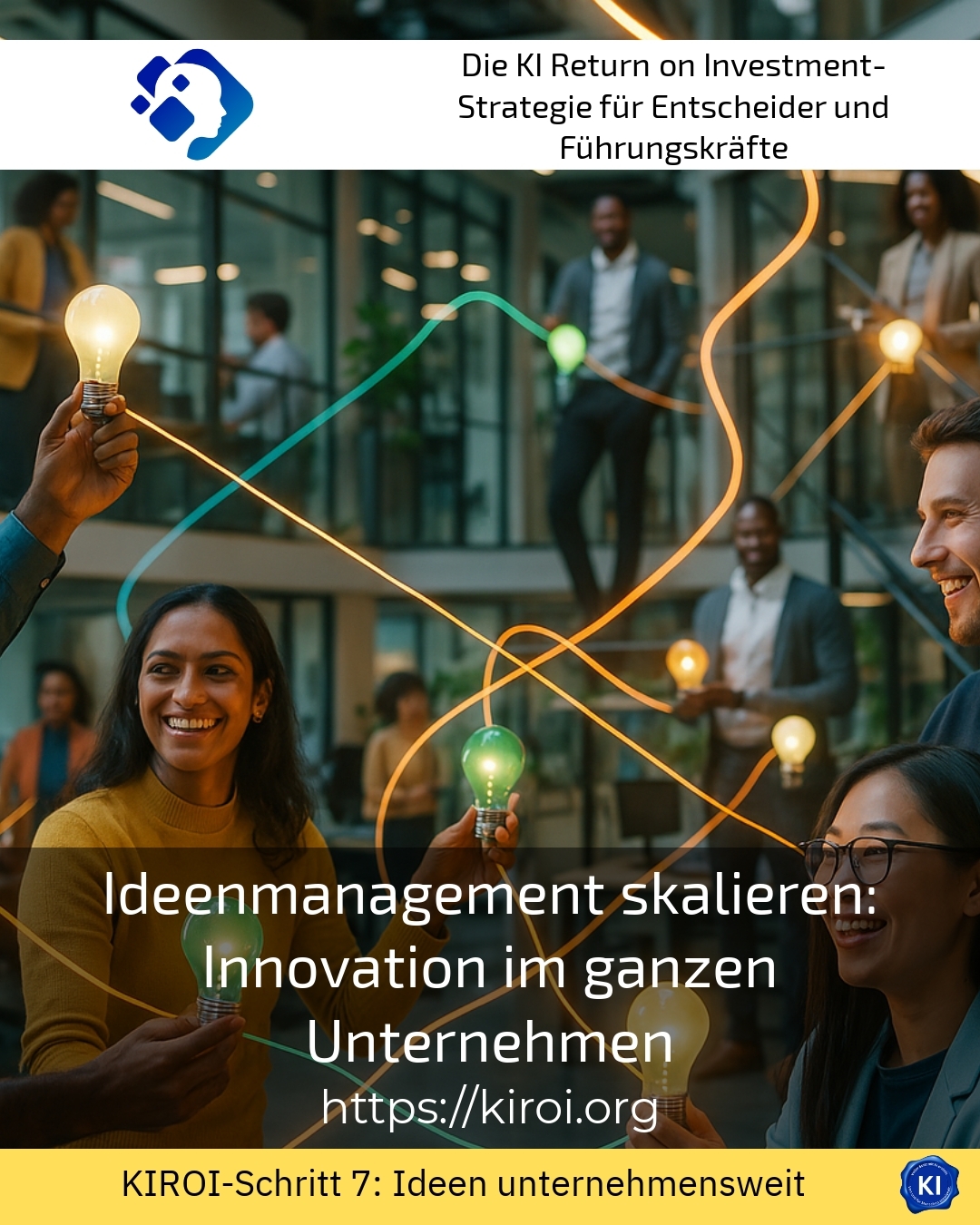
In a world where competitive advantages are disappearing faster than ever before, a crucial question arises: How can companies systematically tap into the creative potential of all employees? The Scaling ideas management and embedding innovation throughout the entire company is today one of the most important strategic tasks of all. For individual brilliant minds are long no longer enough to survive on the market. Instead, structures are needed that foster creativity in every corner of the organisation and harness it.
Why scaling systematic idea management is indispensable today
The challenges of modern markets demand continuous renewal. Companies that rely solely on the development department are squandering enormous potential. In fact, many of the most valuable suggestions for improvement arise directly at the grass roots. Employees in production, service or administration know everyday processes better than any manager. They notice inefficiencies sooner and often develop workable solutions from their own experience.
An engineering company from Southern Germany recognised this opportunity and established cross-location innovation circles. The results far exceeded all expectations. A logistics company introduced digital suggestion platforms and recorded hundreds of submissions within a few months. A medium-sized automotive supplier also benefited from the systematic involvement of its skilled workforce. These examples clearly show that structured approaches can produce measurable successes.
The cultural dimension of innovation
However, technical systems alone are not enough to initiate sustainable change. Rather, what is needed is a culture that rewards a willingness to experiment and views mistakes as learning opportunities. Managers play a key role here as both role models and enablers. They must create spaces where employees can express their thoughts without fear of criticism.
A pharmaceutical manufacturer established regular innovation breakfasts where hierarchies were deliberately removed. An energy supplier introduced so-called failure celebrations to analyse failed projects and learn from them. Particularly noteworthy is the example of an insurance group that organises internal hackathons. These formats promote cross-departmental exchange and often produce surprising synergies.
Best practice with a AIROI customer
An internationally active manufacturing group faced the challenge of better connecting its more than twenty locations worldwide and making more effective use of existing knowledge. Although previous approaches to gathering ideas worked at a local level, cross-site knowledge transfer practically did not take place. As part of transruptions support, we jointly developed a multi-stage strategy that encompassed both digital tools and cultural change processes. First, we implemented a cloud-based platform where employees could submit their proposals in their respective native language. An AI-supported translation system enabled cross-site exchange in real time. In addition, we established regional innovation ambassadors who acted as multipliers and local points of contact. These ambassadors received special training to promote creative processes and constructive evaluation of submissions. After about a year, those responsible reported a threefold increase in high-quality proposals and a significant improvement in cross-departmental collaboration.
Scaling structures and processes for idea management
The successful expansion of creative processes requires well-thought-out structures and clear responsibilities. Without defined procedures, good approaches often get lost in day-to-day business. Therefore, it is advisable to first create a framework that combines commitment and flexibility.
A telecommunications provider set up a central innovation unit that acts as a hub for all locations. A retail group established decentralised innovation teams that work closely with head office. A financial services provider, which introduced what are known as sponsorships between experienced managers and young talent, was also particularly successful. These tandems promote the intergenerational exchange of knowledge and bring together fresh perspectives.
Digital tools as accelerators
Modern technologies open up entirely new possibilities for company-wide collaboration. Platforms for collaborative ideation enable employees to submit and further develop proposals. Artificial intelligence can assist in merging similar submissions and identifying patterns.
A chemical company uses machine learning to automatically prioritise promising proposals. A media group relies on gamification elements to increase workforce engagement. A construction company also benefits from digital tools by virtually connecting project teams and thus enabling the exchange of experience between building sites. These examples illustrate that technology can act as a catalyst for innovation throughout the entire company.
Overcoming resistance and building acceptance
Every change is met with scepticism at first, and that is completely normal. Many employees wonder whether their ideas will really be heard or simply fade away into nothingness. Leaders, on the other hand, sometimes fear a loss of control or additional effort. It is important to take these concerns seriously and address them through transparent communication.
An engineering company publishes a monthly newsletter providing updates on the status of submitted proposals. A food manufacturer regularly invites people to public presentations of implemented improvements. The establishment of an innovation budget, which teams can manage autonomously, proved particularly effective at a textile company. Such measures build trust and demonstrate the seriousness of the initiative.
Best practice with a AIROI customer
A medium-sized healthcare company approached us because previous attempts to establish a suggestion scheme had failed and the workforce was becoming increasingly frustrated. The analysis as part of our transruption coaching revealed that the lack of prompt feedback in particular was responsible for the failure, as employees felt their submissions were being ignored. Together, we developed a three-stage feedback system that guarantees an initial confirmation of receipt within 72 hours and provides an initial substantive evaluation within two weeks. We also introduced quarterly innovation forums where selected suggestions are publicly discussed and rewarded. The executive management personally moderated these events to emphasise their strategic importance. After six months, the participation rate rose from under five per cent to over thirty per cent of the workforce, and several improvements led to measurable cost savings and quality increases.
Designing incentive schemes smartly
The question of the right motivation concerns many organisations when scaling their innovation efforts. Monetary incentives can be effective in the short term, but also carry the risks of misdirection. Therefore, an increasing number of companies are relying on a combination of material and non-material recognition.
A software company offers successful idea generators the opportunity to present their projects in person to the executive board. An industrial corporation awards an internally highly regarded innovation prize annually with corresponding visibility. A retail company also does well with its approach of involving idea generators in the implementation teams. This participation in success provides sustainable motivation and strengthens the sense of responsibility of everyone involved.
Scaling ideas management: embedding innovation across the entire company
The decisive step from isolated successes to a comprehensive culture of innovation requires long-term commitment. It is not enough to launch one-off initiatives and then wait for results. Rather, it requires continuous nurturing and regular adaptation of established structures to changing conditions.
A mobility provider reviews its innovation processes every six months and adapts them as necessary. A consumer goods manufacturer conducts regular surveys to measure satisfaction with existing participation opportunities. A technology corporation is operating with particular success, having integrated innovation metrics firmly into its balanced scorecard. This anchoring in management tools signals a lasting commitment and secures resources for the long term.
My AIROI Analysis
Based on my experience from numerous accompaniment projects, a clear pattern consistently emerges that distinguishes successful companies from less successful ones. The systematic expansion of creative processes works best when three factors come together: firstly, genuine support from the management level; secondly, appropriate technical infrastructure; and thirdly, a culture that rewards openness and a willingness to experiment.
Frequently, clients report that the biggest lever does not lie in technology, but in the changed attitude of managers. As soon as employees experience that their suggestions are taken seriously and valued, participation often increases by leaps and bounds. This cultural shift takes time and patient support, which is why transruptions coaching can provide valuable momentum here [1].
At the same time, the structural prerequisites must not be neglected. Clear processes for submitting, evaluating and implementing proposals create commitment and trust. Digital tools can support and accelerate these workflows, but should always complement and not replace human exchange [2].
Finally, I would like to emphasise that there is no one-size-fits-all solution that works equally well for all organisations. Every company must find its own path that suits its culture, industry and strategic goals. The examples and approaches presented here can serve as orientation and inspiration to sustainably strengthen one's own innovative capacity and unlock the full potential of all employees.
Further links from the text above:
[1] Transruptions Coaching for sustainable change processes
[2] Strategically shaping digital transformation
For more information and if you have any questions, please contact Contact us or read more blog posts on the topic Artificial intelligence here.











 Deutsch
 English (UK)