
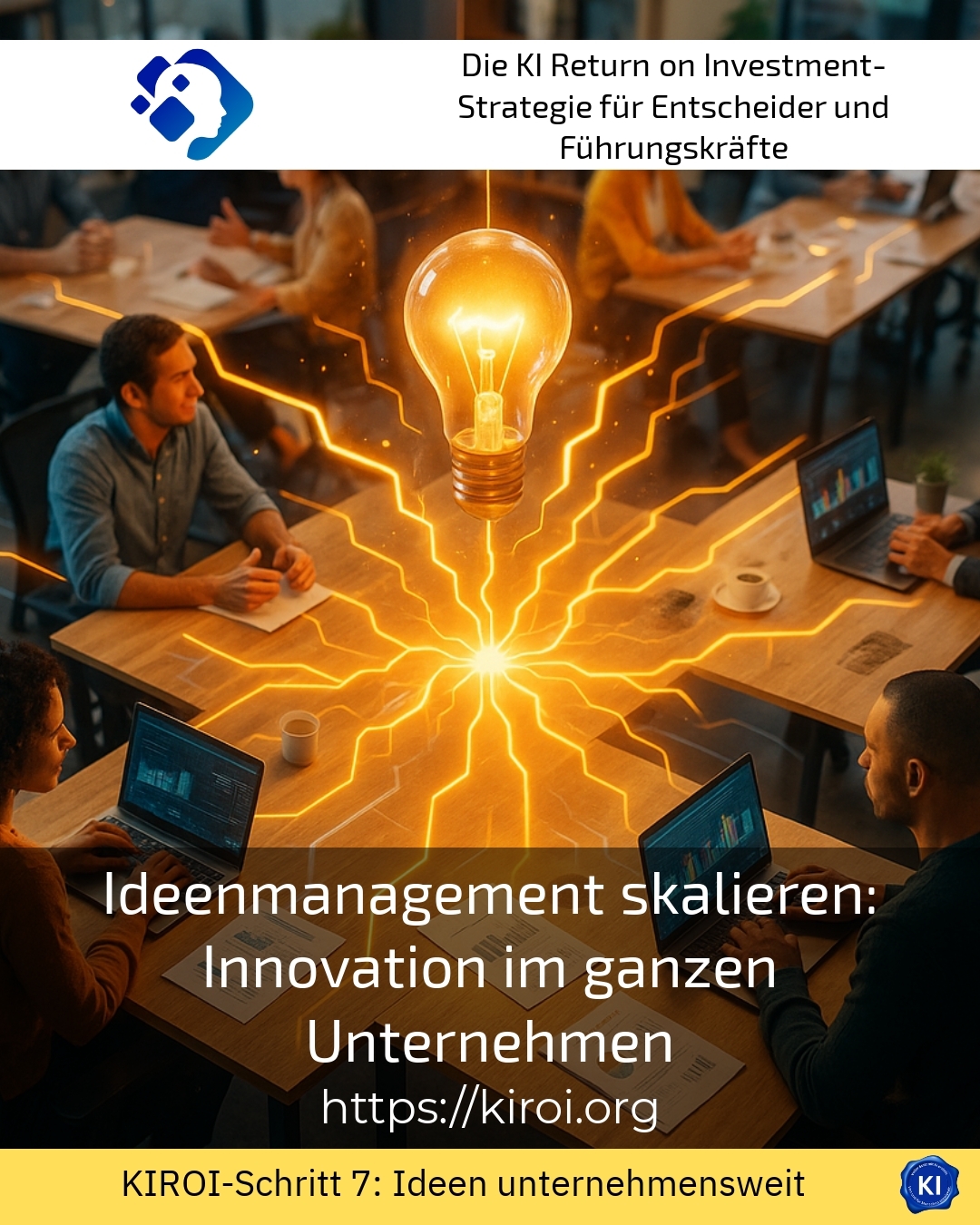
Imagine thousands of brilliant ideas lie dormant within your company, never seeing the light of day. Employees at all levels develop innovative thoughts daily, but these get lost in the depths of hierarchical structures. The potential remains untapped while competitors surge ahead. This is precisely where the concept of Scaling ideas management an, embedding innovation throughout the entire company. But how can creative processes be designed so that they don't just function in individual departments, but permeate the entire company? The answer lies in systematic approaches that foster creativity while delivering measurable results.
Why traditional innovation approaches are reaching their limits
Many organisations still rely on traditional suggestion schemes that date back to the last century. These systems often work according to the letterbox principle: employees submit their ideas and then wait for feedback. The waiting times are often months, and many submissions disappear without a trace. Motivation quickly wanes when people do not feel valued for their creative contributions. One medium-sized production company, for example, reported that less than ten per cent of suggestions submitted each year were ever processed. The frustration of the workforce meant that after a few years, hardly anyone was sharing ideas. Another example shows a logistics service provider that digitised its suggestion scheme but did not adapt the underlying processes. The beautiful new interface could not hide the fact that decision-making processes remained slow and non-transparent. In addition, a retail company found that innovative ideas were only welcome in the research department. Employees from sales and logistics felt excluded, even though they had daily customer contact and valuable insights.
Scaling Idea Management: The Cornerstones of a Company-Wide Innovation Culture
A genuine culture of innovation is not created through individual measures, but through the interplay of various factors. Firstly, there needs to be a clear attitude at management level that communicates and exemplifies innovation as a strategic priority. Managers themselves must be prepared to break new ground and take uncomfortable suggestions seriously. Employees also need psychological security to express ideas that may seem unusual or risky. One technology company introduced regular innovation forums in which hierarchies were deliberately dissolved. Apprentices presented their ideas there on an equal footing with managers, which led to surprising impulses. A mechanical engineering company established so-called innovation mentors who accompanied idea providers through the entire process. This personal support significantly increased the likelihood of suggestions actually being implemented. In addition, an energy supplier experimented with decentralised innovation budgets that individual teams could use independently. This significantly increased the speed of decision-making and employees experienced the direct impact of their ideas.
Best practice with a AIROI customer
An internationally active industrial company was faced with the challenge of coordinating innovation across different locations. The individual plants worked largely in isolation from each other and hardly exchanged any experience. As part of a transruption coaching programme, the company developed a digital platform that enabled cross-location collaboration. Employees could now post ideas, comment on them and develop them further together, regardless of where they were physically working. The transruptions coaching helped to bridge cultural differences between the locations and create a common understanding of innovation. Within eighteen months, the number of proposals submitted increased by more than three hundred per cent. Even more significant, however, was that the quality of the ideas increased because people from different perspectives worked together. One suggestion for optimising production processes, which originally came from the Asian plant, was further developed with input from European colleagues so that it could be rolled out across the Group. The savings amounted to a seven-figure sum and the employees involved were genuinely recognised for their contribution.
Digital tools as catalysts for innovation
Technology alone does not create innovation, but it can significantly accelerate and democratise innovation processes. Modern platforms make it possible to collect, evaluate and prioritise ideas without creating piles of paper. Artificial intelligence can help to cluster similar proposals and identify synergies [1]. One pharmaceutical company, for example, uses machine learning to automatically assign submitted ideas to the right experts. This reduced the time to initial evaluation from weeks to just a few days. An automotive supplier implemented gamification elements in its innovation system, which significantly increased the participation of younger employees. Points, badges and ranking lists appealed to playful motives and increased motivation to participate. In addition, a financial services provider experimented with virtual realities in which teams could work together on prototypes. This immersive experience encouraged creative thinking and made abstract concepts tangible.
Creating structures without stifling creativity
The Scaling ideas management requires a balancing act between structure and freedom. Too many rules stifle creativity, while too few guidelines lead to chaos. Successful companies establish clear processes for evaluating and implementing ideas, but leave room for experimentation. One consumer goods manufacturer, for example, defined various innovation categories with different requirements. Small suggestions for improvement went through a quick process, while disruptive ideas received intensive scrutiny and resources. A telecommunications company set up innovation labs in which selected teams could work on promising concepts for several weeks. These temporary structures enabled deep focussing without disrupting regular operations. One media company also introduced so-called innovation sprints, in which cross-functional teams developed prototypes within a week. The time limit created productive pressure and prevented endless analysis loops.
The role of leaders in scaling idea management
Managers shape the culture of innovation more than any formal system. If managers ignore or devalue their employees' suggestions, the creative flow quickly dries up. Conversely, open-minded leaders can create spaces for innovation even in structurally difficult environments. One construction company systematically trained its managers to give constructive feedback and to treat critical ideas with respect. The investment in management development paid off by increasing the teams' willingness to innovate. A chemical company introduced regular innovation dialogues between managers and their teams. These structured dialogues ensured that creative impulses did not get lost in day-to-day business. In addition, transruptions coaching supported several management teams in reflecting on and overcoming their own resistance to change. Only if managers themselves are prepared to question habits can they credibly encourage their teams to innovate.
Best practice with a AIROI customer
A family business from the manufacturing industry wanted to strengthen its innovative capacity, but encountered resistance from middle management. Many managers perceived their employees' suggestions as criticism of their own work and unconsciously blocked them. As part of transruption coaching, the managers worked on their own beliefs and behavioural patterns. They recognised that innovation is not a threat, but an opportunity to improve together. The coaching provided impetus on how managers can develop and exemplify a supportive attitude. After a few months, employees reported that they felt their suggestions for improvement were being taken seriously for the first time. The implementation rate increased considerably and the mood in the company improved noticeably. A peer coaching format in which managers supported each other in difficult situations was particularly effective. This peer learning reinforced the effect of the external support and created lasting change.
Measurability and continuous improvement
Innovation cannot be fully captured in key figures, but certain metrics help to recognise progress. The number of ideas submitted is an initial indicator, but says little about quality and impact. More relevant are key figures such as the implementation rate, the time from submission to realisation and the measurable benefit of implemented proposals [2]. One insurance company introduced an innovation dashboard that made these metrics transparent. The visibility of successes motivated other employees to participate and created positive competition. A food manufacturer regularly surveyed its employees on their perceived innovation culture. This qualitative data supplemented the quantitative key figures and revealed potential for improvement. In addition, an electronics company systematically analysed which factors differentiated successful from failed innovation projects. The insights gained were channelled into improved processes and training.
Scaling idea management through networking and collaboration
Isolated innovation efforts rarely reach their full potential. The true power unfolds when people from different backgrounds work together and combine their perspectives. Cross-functional teams bring together expertise from different areas to create unexpected solutions. One furniture manufacturer regularly brought together designers, production staff and customer advisors. This diversity led to product innovations that were both aesthetically pleasing and practically realisable and in demand on the market. One healthcare provider established community formats in which employees could network on specific topics. These informal networks complemented the formal innovation processes and promoted the spontaneous exchange of ideas. In addition, one software company opened up its innovation process to external partners, customers and even competitors. This open innovation strategy significantly expanded the pool of ideas and accelerated development cycles.
My AIROI Analysis
The systematic scaling of innovation processes presents companies with a variety of challenges that go far beyond technical solutions. In my observation, many initiatives fail not because of a lack of tools, but because of cultural barriers and a lack of stamina. Organisations often expect quick results, although real cultural change takes time and setbacks are inevitable. The most successful organisations combine clear strategic direction with patience and a willingness to learn from mistakes. Technology can support innovation processes, but it is no substitute for human relationships and trust. Leaders play a crucial role and must be willing to step out of their comfort zone. Transruption coaching can help to uncover blind spots and develop new perspectives that would be lost in day-to-day business. External support is particularly valuable when integrating various initiatives into a coherent overall picture. Many companies launch parallel programmes that hinder rather than reinforce each other. A systematic approach connects these strands and creates synergies. Investing in a culture of innovation does not pay off immediately, but it ensures long-term competitiveness in a world that is changing ever faster. Companies that invest in their ability to innovate today will be the winners tomorrow, while others will struggle to keep up.
Further links from the text above:
[1] Harvard Business Review: Innovation Management Resources
[2] McKinsey: Insights on Innovation Performance
For more information and if you have any questions, please contact Contact us or read more blog posts on the topic Artificial intelligence here.










 Deutsch
  English (UK)