
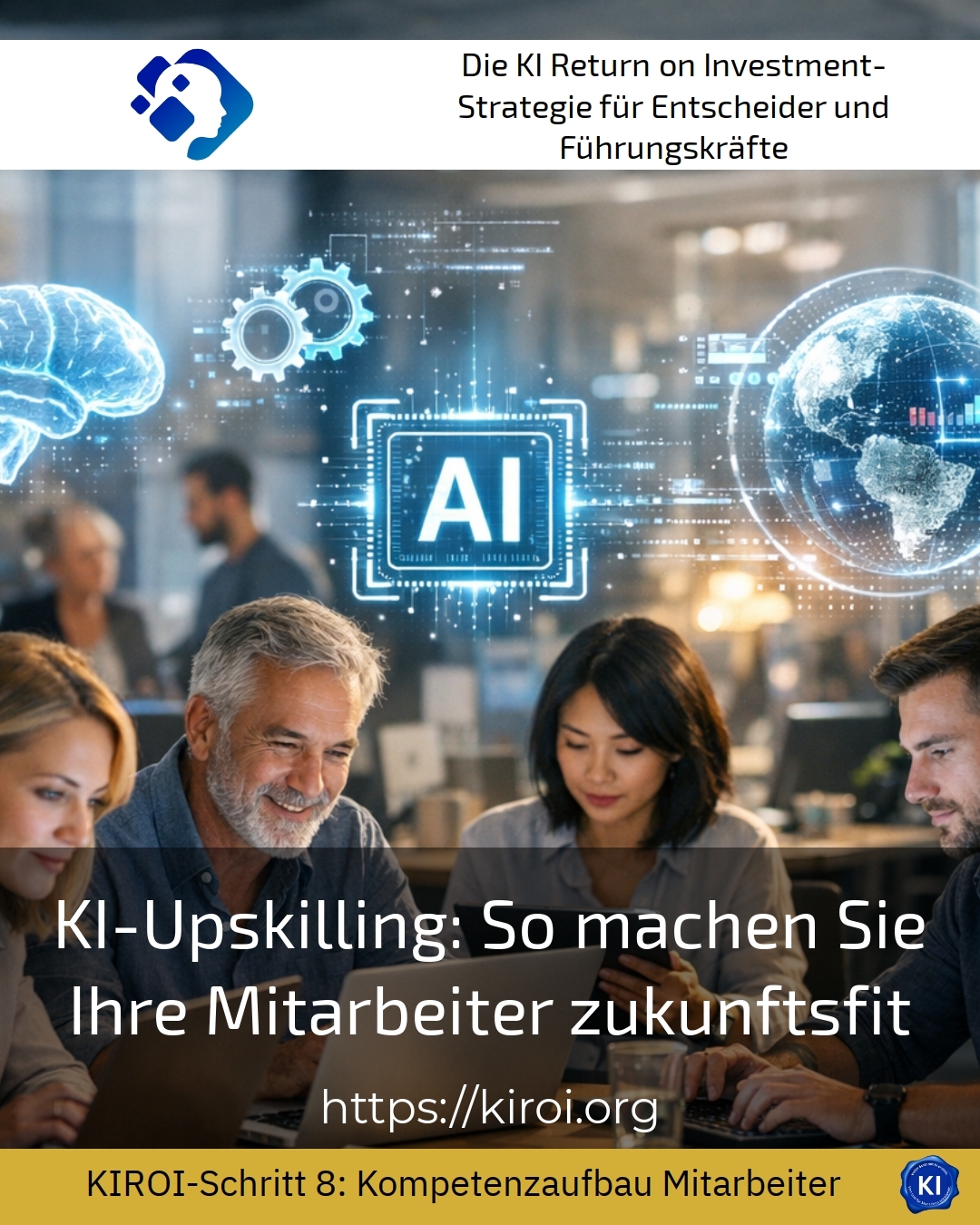
Why do companies lose their best talent to competitors who have previously invested in training? This question concerns executives and human resources managers alike. AI Upskilling It is becoming the decisive competitive factor. Those who do not act today risk falling behind tomorrow. Digital transformation is not waiting. Employees expect active support from their employers in developing their skills. This involves more than just technical knowledge. Instead, holistic development concepts are at the heart of the issue. Companies that systematically train their teams report higher levels of employee satisfaction. At the same time, innovation power increases significantly. Investing in people pays off in the long run.
Why AI Upskilling is Becoming a Strategic Priority
The working world is changing fundamentally and inexorably. Automation and intelligent systems are taking over repetitive tasks. At the same time, completely new fields of activity and job descriptions are emerging. Employees therefore continuously need to acquire new skills. A manufacturing company recently trained its machine operators in the handling of predictive maintenance. The results convinced even skeptical executives in a lasting way. Another example comes from customer service. There, employees learn to effectively use intelligent assistance systems. In the financial sector, account managers are now analyzing complex data patterns using algorithmic tools. This development affects virtually all industries and company sizes.
The challenge lies not only in the technology itself. Rather, it involves cultural changes within the organization. Employees must develop trust in new working methods. Leaders should lead by example and learn themselves. Change can only be achieved together and with clear communication. Fears of job loss must be taken seriously. Transparent information creates the necessary foundation for trust in change.
Best practice with a AIROI customer
A medium-sized company in the mechanical engineering sector faced a particular challenge. The average tenure of employees was over fifteen years. Many employees had concerns about new digital tools. As part of a transruptive coaching program, we developed a customized qualification program. First, we conducted extensive discussions with all departments. It became apparent that the concern about overwork was greater than the fear of job loss. We designed learning modules in small, digestible units. Experienced employees were trained to become internal mentors. They accompanied their colleagues in learning new skills. After six months, eighty percent of the participants reported increased job satisfaction. Productivity in quality control increased measurably. Particularly pleasing was the positive change in the workplace climate. Younger and older employees now worked more closely together. The project impressively demonstrated how mentoring can be successful in transformation processes.
Developing the right strategy for AI upskilling
Successful qualification programs begin with a thorough assessment of the existing skills and competencies. Which skills already exist? Where are gaps and development potential? A trading company recently analyzed the skills of all employees in the purchasing department. It turned out that many of them already worked intuitively with data. However, they lacked an understanding of systematic analysis methods. A logistics company, on the other hand, recognized a need in interpreting route optimization. In healthcare, the focus was primarily on the handling of diagnostic support systems. Each organization has individual starting points and goals.
The strategy development should take into account different learning formats. Not all people learn in the same way effectively. Some prefer classic training with personal guidance. Others appreciate digital self-learning modules with flexible scheduling. Peer-learning in small groups works particularly well for many. One insurance company successfully combined different formats. External impulses were linked to internal knowledge exchange. A telecommunications provider relied on playful learning elements. An energy provider integrated qualification directly into the work routine.
Designing individual learning paths
Standardized programs rarely reach all target groups equally. The individual design of learning paths significantly increases success. Employees in accounting require different focus areas than sales representatives. Executives, in turn, need a strategic understanding of decision-making processes. A pharmaceutical company therefore developed differentiated qualification tracks. Researchers learned how to use data analysis in clinical trials. The marketing team focused on personalized customer communication. The production department dealt with quality assurance through pattern recognition. This differentiation significantly increased the relevance for all involved parties.
The timeframe also plays a crucial role. Intensive workshops are suitable for concentrated knowledge dissemination. Long-term programs enable sustainable behavioral changes. Many organizations use both in a meaningful way. An automotive supplier started with a two-day basic workshop. Subsequently, monthly in-depth sessions followed over the course of a year. A media company integrated weekly short learning sessions into team meetings.
Leaders as drivers of change
The success of qualification initiatives depends largely on the leadership level. Leaders shape the learning culture of the organization through their behavior. When they themselves actively learn, their employees follow suit. A construction company experienced this dynamic impressively. The CEO personally participated in all training sessions. This visibility clearly signaled the importance of the initiative. A retail conglomerate initially intensively trained the middle management. These leaders were then transformed into multipliers within the company. A consulting firm involved partners and senior consultants from the outset.
Executives need specific skills for this role. They should be able to assess which tasks are suitable for automation. At the same time, they must be able to guide teams through change processes. Empathy and clear communication are becoming increasingly important. A chemical company developed a special leadership program. Executives learned how to identify development potential. They practiced how to lead difficult conversations about change. This preparation supported the entire transformation process in a sustainable way.
Best practice with a AIROI customer
An international financial services provider approached us with a specific question. The middle management team members were skeptical about new technologies. This attitude noticeably slowed down the transformation of the entire company. As part of the transruptive coaching, we initially supported individual pilot teams. Together, we identified concrete use cases from day-to-day operations. The management team members experienced immediate benefits for their work as a result. A team leader in the credit department significantly reduced his time spent on routine checks. A department manager in customer service improved response times measurably. These positive experiences spread organically throughout the organization. After three months, more management team members volunteered for the program. The initial skepticism turned into active curiosity and commitment. The project illustrated how important personal experiences are for behavioral change. Theoretical knowledge alone rarely convinces when there are deep-rooted reservations.
Creating a learning-promoting corporate culture
Technical training alone is not enough for sustainable success. The corporate culture must support and encourage continuous learning. Mistakes should be seen as learning opportunities. Experimenting must be allowed and desired. A software company introduced regular learning days for all employees. On these days, teams work on self-selected development projects. A machinery manufacturer set up physical and virtual learning spaces. A consumer goods company established an internal network of technology ambassadors.
Recognition and appreciation of learning progress also motivate employees. Certificates and badges visibly document acquired competencies. Internal career paths should positively take into account qualification. A hospital network linked AI Upskilling With opportunities for advancement. One energy company publicly celebrated learning milestones in team events. One logistics service provider regularly shared success stories in its company newsletter.
Achieve measurable results through AI upskilling
Investments in training must be able to demonstrate their value. A clearer definition of success criteria helps considerably. Quantitative metrics such as productivity increases are easy to measure. Qualitative aspects such as employee satisfaction require different survey methods. A telecommunications company systematically tracked the use of new tools. A retail company conducted regular competency assessments. An industrial company carefully compared performance metrics before and after training sessions.
The evaluation should include different perspectives. Employees assess the relevance and quality of the learning offerings. Executives assess the impact on team performance and collaboration. The management is interested in strategic KPIs. An insurance company developed a comprehensive dashboard for these purposes. A technology company used pulse surveys for continuous feedback. A consulting firm consistently integrated qualification achievements into its balanced scorecard.
The findings from the evaluation are incorporated into the further development process. Programs are continuously adapted based on feedback. Successful formats are expanded and scaled up. Less effective approaches are modified or replaced. This iterative approach ensures long-term success sustainably.
My AIROI Analysis
After intensive support of numerous organizations in their qualification projects, clear patterns emerge. The most successful companies consider AI Upskilling as a strategic investment. You understand that people remain the decisive success factor. Technology alone does not create a sustainable competitive advantage. Only the combination of powerful tools and competent employees unleashes its full potential.
The biggest obstacles often lie not in the technical aspects. Rather, cultural resistance and a lack of leadership support hinder progress. Many leaders underestimate the emotional aspect of change processes. Employees come to us with fears and uncertainties. They worry about their relevance in an automated work environment. Taking these concerns seriously forms the foundation for successful transformation.
Transruptions coaching positions itself as a support for these complex projects. We provide guidance and support organizations on their individual journey. Standard solutions rarely work in the reality of corporate transformation. Each organization has its own history and culture. This uniqueness must be taken into account in qualification concepts.
Clients often report surprising side effects from their qualification initiatives. Teams work more closely together and communicate more openly. The willingness to change is increasing overall. Innovation ideas often come from within the workforce itself. These positive dynamics reinforce each other and create lasting impact [1]. Investing in people pays off in many ways [2]. Those who act boldly today actively shape the future [3].
Further links from the text above:
[1] McKinsey – How to build AI fluency across your organization
[2] World Economic Forum – The Future of Jobs Report
[3] Harvard Business Review – Reskilling in the Age of AI
For more information and if you have any questions, please contact Contact us or read more blog posts on the topic Artificial intelligence here.








 Deutsch
 English (UK)