
kiroi.org

KIROI - Artificial Intelligence Return on Invest
The AI strategy for decision-makers and managers

Business excellence for decision-makers & managers by and with Sanjay Sauldie

KIROI - Artificial Intelligence Return on Invest: The AI strategy for decision-makers and managers

KIROI - Artificial Intelligence Return on Invest: The AI strategy for decision-makers and managers

Start » Mastering knowledge exchange: KIROI Step 1 for decision-makers
17 January 2025

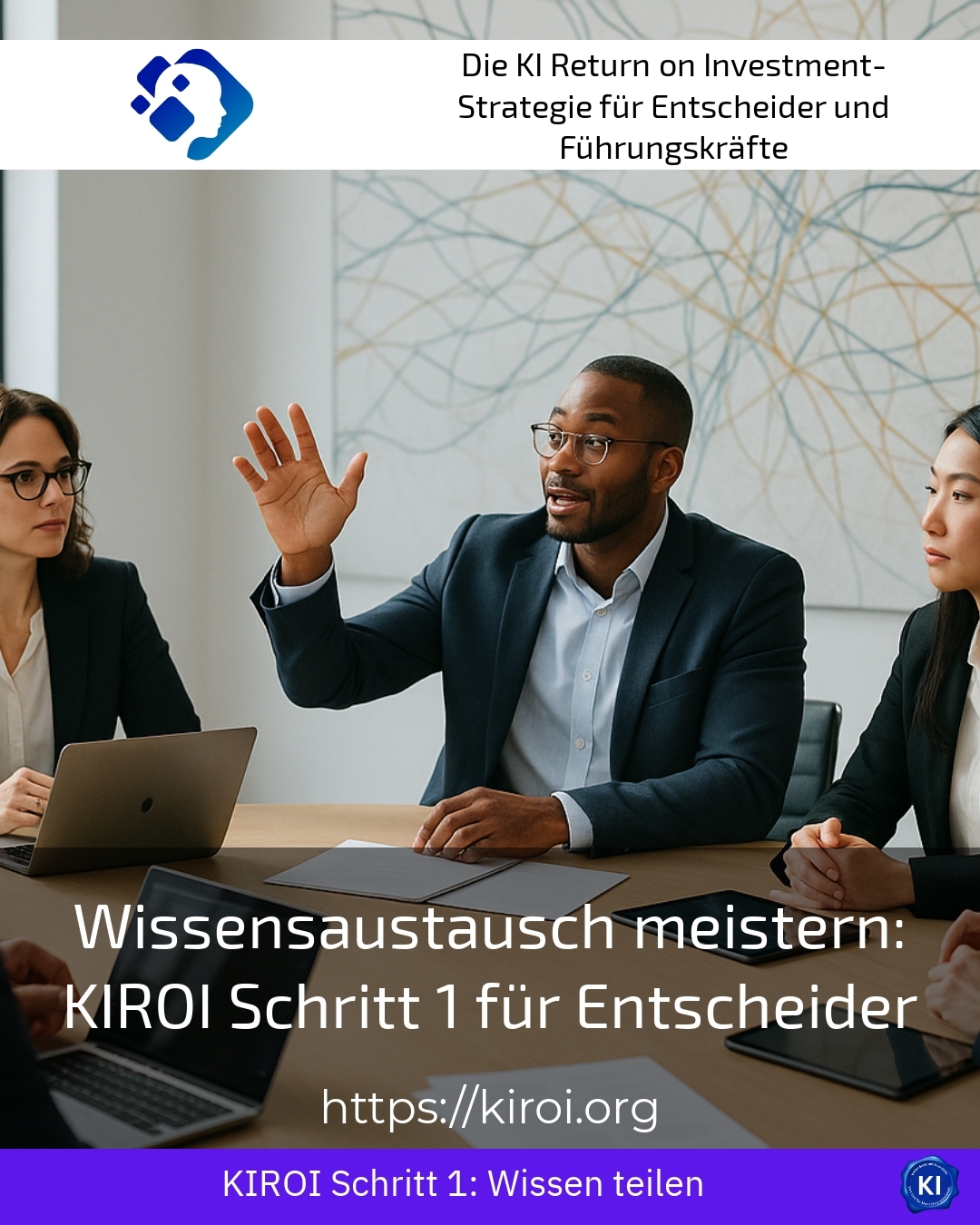
Mastering knowledge exchange: KIROI Step 1 for decision-makers

4.9
(1314)

The exchange of knowledge – whether between individual employees, teams, or entire organisations – is no longer a given. Projects focused on knowledge sharing, in particular, are often under immense pressure because changes happen rapidly and an organisation's know-how is a key resource in the digital age. Companies and leaders who specifically promote knowledge exchange not only create a clear competitive advantage but also ensure that experiences, skills, and critical competencies are retained and utilised. But how can this exchange be systematically managed to achieve sustainable impact? This is the central theme of this article – and it is precisely here that transruptions coaching comes in as a support to provide impetus and enable concrete results.

What lies behind successful knowledge exchange?

Knowledge transfer is far more than simply giving or receiving documents or data. It's about the targeted transmission of usable know-how, context, and insights – those experiences that aren't always easy to document[6]. Explicit knowledge (e.g., policies, manuals) can be shared relatively easily, but the truly valuable implicit knowledge (e.g., experience, intuition) is often more difficult to grasp and can be best passed on through direct exchange[2][4]. For decision-makers, this means that sustainable knowledge transfer can only occur when both aspects are taken into account.

The factor of culture often plays an underestimated role. An open, trusting atmosphere is the basis for people to truly want to share their knowledge. And it forms the core for many successful projects that transruption coaching has accompanied.

BEST PRACTICE with one customer (name hidden due to NDA contract) A renowned logistics company wanted to capture the knowledge of experienced employees before their retirement and integrate it into younger colleagues„ teams. Instead of a classic mentoring programme, we developed a hybrid format comprising digital knowledge databases, moderated discussion rounds, and regular “storytelling„ workshops. This created a vibrant learning culture that translated the implicit knowledge of the “old hands„ into the practical application of junior staff. The result: process improvements, higher satisfaction, and a palpable increase in the “team spirit".

Real-world examples show that successful knowledge sharing is not a matter of chance, but requires targeted impulses. Projects often fail not due to a lack of technology, but due to insufficient attention to the human factors that govern the sharing process[1].

KIROI Step 1: Creating the right framework

In collaborations, Transruptions-Coaching often starts at Step 1 of KIROI – the analysis and design of the right framework conditions for knowledge exchange. This is because many organisations approach us with typical issues:

  • Expert knowledge remains stuck in silos.
  • Employees don't know who to approach with questions.
  • Critical information is lost when skilled workers leave.

KIROI Step 1 focuses precisely on this: designing the right structures, processes, and tools to facilitate systematic knowledge sharing. This includes consciously setting incentives that foster a desire for knowledge sharing – and only using technical platforms where they genuinely help.

BEST PRACTICE with one customer (name hidden due to NDA contract) In a medium-sized manufacturing company, knowledge sharing was long considered an „optional extra“ and only occurred sporadically. As part of a change project, we worked with management to introduce a clear „give and take“ culture: learning time and knowledge sponsorships were measurably integrated into performance agreements, and every contribution was publicly recognised. The result: the number of actively shared „lessons learned“ tripled within six months, and new, interdisciplinary project groups emerged, driving innovation together.

It is important to understand that tools and platforms – such as digital knowledge management systems or social intranets – are helpful, but only achieve their impact if they fit the company culture and are easy to use[2]. Clients often report that they relied on technology for too long – and overlooked the actual barriers.

Exemplary measures for successful knowledge exchange

Based on experience, transruptions coaching recommends step-by-step approaches to sustainably embed knowledge sharing:

  • Create transparent incentive systems: Formulate clear expectations and measurable goals for knowledge sharing – and link them to personal objective setting.
  • Establish structures for informal exchange: Joint learning formats, such as Coffee Talks, Brown Bag Lunches, or open discussion rounds, promote spontaneous knowledge transfer – entirely independent of hierarchies.
  • Enable knowledge curation: Consider how to document knowledge so that it remains easily discoverable, understandable, and practical – and regularly ensure that content is updated[3].
  • Utilise diverse methods: Combine digital platforms, personal exchange, and regular reflection to specifically foster explicit and implicit knowledge[4].
  • Building trust: Enable an open error culture where experiences can be openly shared – without fear of „knowledge theft“ or judgment.

BEST PRACTICE with one customer (name hidden due to NDA contract) In a consulting firm with internationally staffed project teams, knowledge often remained at a national level. We developed a „Community of Practice“ concept, where experts could regularly exchange ideas virtually and reflect on lessons learned together. A solution-oriented moderator was central to this, ensuring openness. The teams quickly reported improved solutions and better networking – which also benefited client projects.

This is how sustainable structures are created that go beyond one-off workshops. Knowledge sharing becomes part of everyday life – and ensures that companies can react flexibly to changes.

Implementing the YELLOW Step 1: Concrete tips for decision-makers

Many decision-makers ask us how they can take the first step in concrete terms. Here are some practical insights that transruption coaching brings from the industry:

  • Create spaces: Ensure there are physical and digital spaces where knowledge transfer can happen easily – from classic water cooler conversations to virtual project rooms[7].
  • Being a role model: Decision-makers who openly share their knowledge send a clear signal to the entire team. Show that sharing is encouraged – and that mistakes are also permitted to be discussed openly.
  • Continuously evaluate: Regularly gather feedback on knowledge sharing and adapt processes accordingly. What's working? What's not being used? What's still missing?

It is important that knowledge sharing is not seen as a one-off process, but rather as a continuous, adaptable exchange that adjusts to the organisation's requirements.

Ultimately, it’s about creating a culture where knowledge transfer is a natural part of work – and not felt as a burden or an extra task.

My analysis

Knowledge sharing is far more than a buzzword or standard procedure – it is a central success factor for organisations that want to remain agile, innovative and resilient. Experience shows that projects focused on knowledge sharing are particularly successful when they not only rely on tools and technology, but also specifically consider human factors, culture and continuous reflection. KIROI Step 1 provides a clear framework for this: analyse the initial situation, consciously design structures and create space for exchange that is truly lived.

Transruptions-Coaching supports organisations through precisely this important phase – with tried-and-tested methods and impulses that truly deliver. This transforms knowledge exchange from a project into everyday practice – and thus into a real driver of innovation, performance, and satisfaction.

Further links from the text above:

Definition Knowledge Exchange | Business Processes Glossary
Knowledge Exchange in Knowledge Management: Tools & Methods
Knowledge Sharing: The Ultimate Guide
Wissensaustausch ist der Prozess, bei dem Informationen, Fähigkeiten und Erfahrungen zwischen Einzelpersonen oder Gruppen geteilt werden. Warum ist er wichtig? Weil er Innovation, Problemlösung und kontinuierliche Verbesserung fördert.
Knowledge transfer – Wikipedia
Knowledge Sharing – Definition at Bizzikon
Knowledge Transfer – Definition at Sage
Knowledge Transfer – Methods, Examples, Definition
Ways to leverage knowledge sharing at Atlassian

For more information and if you have any questions, please contact Contact us or read more blog posts on the topic Artificial intelligence here.

How useful was this post?

Click on a star to rate it!

Average rating 4.9 / 5. Vote count: 1314

No votes so far! Be the first to rate this post.

Spread the love

transruption.org

The digital toolbox for
the digital winners of today and tomorrow

Business excellence for decision-makers & managers by and with Sanjay Sauldie

transruption
transruption

transruption: The digital toolbox for
the digital winners of today and tomorrow

Start » Mastering knowledge exchange: KIROI Step 1 for decision-makers
17 January 2025

Mastering knowledge exchange: KIROI Step 1 for decision-makers

4.9
(1314)

The exchange of knowledge – whether between individual employees, teams, or entire organisations – is no longer a given. Projects focused on knowledge sharing, in particular, are often under immense pressure because changes happen rapidly and an organisation's know-how is a key resource in the digital age. Companies and leaders who specifically promote knowledge exchange not only create a clear competitive advantage but also ensure that experiences, skills, and critical competencies are retained and utilised. But how can this exchange be systematically managed to achieve sustainable impact? This is the central theme of this article – and it is precisely here that transruptions coaching comes in as a support to provide impetus and enable concrete results.

What lies behind successful knowledge exchange?

Knowledge transfer is far more than simply giving or receiving documents or data. It's about the targeted transmission of usable know-how, context, and insights – those experiences that aren't always easy to document[6]. Explicit knowledge (e.g., policies, manuals) can be shared relatively easily, but the truly valuable implicit knowledge (e.g., experience, intuition) is often more difficult to grasp and can be best passed on through direct exchange[2][4]. For decision-makers, this means that sustainable knowledge transfer can only occur when both aspects are taken into account.

The factor of culture often plays an underestimated role. An open, trusting atmosphere is the basis for people to truly want to share their knowledge. And it forms the core for many successful projects that transruption coaching has accompanied.

BEST PRACTICE with one customer (name hidden due to NDA contract) A renowned logistics company wanted to capture the knowledge of experienced employees before their retirement and integrate it into younger colleagues„ teams. Instead of a classic mentoring programme, we developed a hybrid format comprising digital knowledge databases, moderated discussion rounds, and regular “storytelling„ workshops. This created a vibrant learning culture that translated the implicit knowledge of the “old hands„ into the practical application of junior staff. The result: process improvements, higher satisfaction, and a palpable increase in the “team spirit".

Real-world examples show that successful knowledge sharing is not a matter of chance, but requires targeted impulses. Projects often fail not due to a lack of technology, but due to insufficient attention to the human factors that govern the sharing process[1].

KIROI Step 1: Creating the right framework

In collaborations, Transruptions-Coaching often starts at Step 1 of KIROI – the analysis and design of the right framework conditions for knowledge exchange. This is because many organisations approach us with typical issues:

  • Expert knowledge remains stuck in silos.
  • Employees don't know who to approach with questions.
  • Critical information is lost when skilled workers leave.

KIROI Step 1 focuses precisely on this: designing the right structures, processes, and tools to facilitate systematic knowledge sharing. This includes consciously setting incentives that foster a desire for knowledge sharing – and only using technical platforms where they genuinely help.

BEST PRACTICE with one customer (name hidden due to NDA contract) In a medium-sized manufacturing company, knowledge sharing was long considered an „optional extra“ and only occurred sporadically. As part of a change project, we worked with management to introduce a clear „give and take“ culture: learning time and knowledge sponsorships were measurably integrated into performance agreements, and every contribution was publicly recognised. The result: the number of actively shared „lessons learned“ tripled within six months, and new, interdisciplinary project groups emerged, driving innovation together.

It is important to understand that tools and platforms – such as digital knowledge management systems or social intranets – are helpful, but only achieve their impact if they fit the company culture and are easy to use[2]. Clients often report that they relied on technology for too long – and overlooked the actual barriers.

Exemplary measures for successful knowledge exchange

Based on experience, transruptions coaching recommends step-by-step approaches to sustainably embed knowledge sharing:

  • Create transparent incentive systems: Formulate clear expectations and measurable goals for knowledge sharing – and link them to personal objective setting.
  • Establish structures for informal exchange: Joint learning formats, such as Coffee Talks, Brown Bag Lunches, or open discussion rounds, promote spontaneous knowledge transfer – entirely independent of hierarchies.
  • Enable knowledge curation: Consider how to document knowledge so that it remains easily discoverable, understandable, and practical – and regularly ensure that content is updated[3].
  • Utilise diverse methods: Combine digital platforms, personal exchange, and regular reflection to specifically foster explicit and implicit knowledge[4].
  • Building trust: Enable an open error culture where experiences can be openly shared – without fear of „knowledge theft“ or judgment.

BEST PRACTICE with one customer (name hidden due to NDA contract) In a consulting firm with internationally staffed project teams, knowledge often remained at a national level. We developed a „Community of Practice“ concept, where experts could regularly exchange ideas virtually and reflect on lessons learned together. A solution-oriented moderator was central to this, ensuring openness. The teams quickly reported improved solutions and better networking – which also benefited client projects.

This is how sustainable structures are created that go beyond one-off workshops. Knowledge sharing becomes part of everyday life – and ensures that companies can react flexibly to changes.

Implementing the YELLOW Step 1: Concrete tips for decision-makers

Many decision-makers ask us how they can take the first step in concrete terms. Here are some practical insights that transruption coaching brings from the industry:

  • Create spaces: Ensure there are physical and digital spaces where knowledge transfer can happen easily – from classic water cooler conversations to virtual project rooms[7].
  • Being a role model: Decision-makers who openly share their knowledge send a clear signal to the entire team. Show that sharing is encouraged – and that mistakes are also permitted to be discussed openly.
  • Continuously evaluate: Regularly gather feedback on knowledge sharing and adapt processes accordingly. What's working? What's not being used? What's still missing?

It is important that knowledge sharing is not seen as a one-off process, but rather as a continuous, adaptable exchange that adjusts to the organisation's requirements.

Ultimately, it’s about creating a culture where knowledge transfer is a natural part of work – and not felt as a burden or an extra task.

My analysis

Knowledge sharing is far more than a buzzword or standard procedure – it is a central success factor for organisations that want to remain agile, innovative and resilient. Experience shows that projects focused on knowledge sharing are particularly successful when they not only rely on tools and technology, but also specifically consider human factors, culture and continuous reflection. KIROI Step 1 provides a clear framework for this: analyse the initial situation, consciously design structures and create space for exchange that is truly lived.

Transruptions-Coaching supports organisations through precisely this important phase – with tried-and-tested methods and impulses that truly deliver. This transforms knowledge exchange from a project into everyday practice – and thus into a real driver of innovation, performance, and satisfaction.

Further links from the text above:

Definition Knowledge Exchange | Business Processes Glossary
Knowledge Exchange in Knowledge Management: Tools & Methods
Knowledge Sharing: The Ultimate Guide
Wissensaustausch ist der Prozess, bei dem Informationen, Fähigkeiten und Erfahrungen zwischen Einzelpersonen oder Gruppen geteilt werden. Warum ist er wichtig? Weil er Innovation, Problemlösung und kontinuierliche Verbesserung fördert.
Knowledge transfer – Wikipedia
Knowledge Sharing – Definition at Bizzikon
Knowledge Transfer – Definition at Sage
Knowledge Transfer – Methods, Examples, Definition
Ways to leverage knowledge sharing at Atlassian

For more information and if you have any questions, please contact Contact us or read more blog posts on the topic Artificial intelligence here.

How useful was this post?

Click on a star to rate it!

Average rating 4.9 / 5. Vote count: 1314

No votes so far! Be the first to rate this post.

Spread the love

Other content worth reading:

Mastering knowledge exchange: KIROI Step 1 for decision-makers

written by:

Keywords:

#compliance #Ethikrichtlinien #InnovationDurchAchtsamkeit #Sustainability #Unternehmenskultur #Verantwortungsketten #Wissensaustausch #Wissensmanagement #Wissenstransfer

Follow me on my channels:

Questions on the topic? Contact us now without obligation

Contact us

[wpforms id="331781" title="false"]

More articles worth reading

    Leave a comment










