
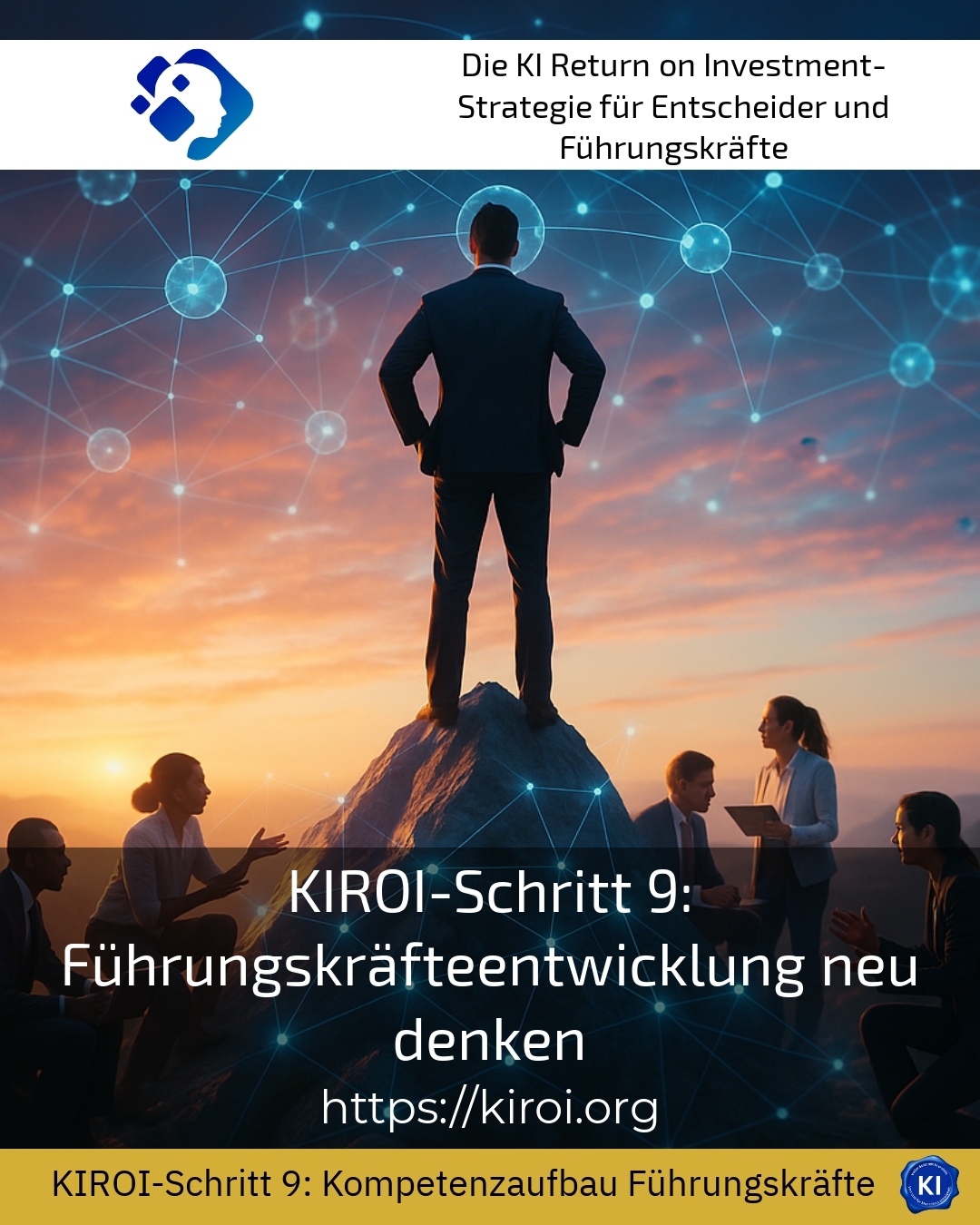
The Leadership Development is gaining ever more importance in today's world of work. Companies face the challenge of developing their leaders not only professionally but also personally in order to meet complex demands. Especially in times of change, leaders need new impulses and strategies that go far beyond traditional training. The ninth step of the AIROI approach shows how the Leadership Development makes you think anew, to unlock individual potential and enable sustainable success.
Leadership Development: Future-proof Methods and Approaches
Traditional formats such as seminars and workshops continue to be important components of Leadership Development. So training courses on topics such as agile project management, emotional intelligence, or communication impart technical and social skills. However, practice shows that pure knowledge input is not enough. Companies therefore often supplement with:
- Mentoring programmes, where experienced leaders directly share their knowledge, thereby enabling an exchange at eye level.
- Coaching that addresses individual challenges and develops competencies precisely.
- Job rotation as a practice-oriented method that offers managers experience in various company departments, thus strengthening their understanding of complex processes.
In large companies like Siemens or Lufthansa, the combination of these methods is used to comprehensively support and practically develop executives [1][3][6].
Practical impulses through transruption coaching
The AIROI Step 9 positions transruption coaching as a decisive accompaniment in the Leadership Development. This coaching format specifically supports managers in implementing concrete projects and challenges. This means that instead of theoretical concepts without practical benefit, there is active support in everyday work. The following fields of application are exemplary:
- Integration of digital leadership tools into daily team life
- Developing new leadership skills for managing hybrid working models
- Reflection on conflict and change situations in a leadership environment
This practical, hands-on support not only fosters personal development but also creates space for new perspectives and creative solutions. Leaders often report that they receive impulses through transruption coaching that they can immediately implement within their teams[5][8].
BEST PRACTICE with one customer (name hidden due to NDA contract) Through disruptive coaching, a medium-sized company was able to enable its managers to steer complex change processes using real project tasks. The participants learned to competently use digital tools, lead their teams in a motivating way, and recognise and productively utilise conflicts early on. This led to increased agility and a noticeable improvement in collaboration at all levels.
Concrete examples from various industries for effective leadership development
The challenges faced by leaders and their development paths are diverse across all industries. Below are some practical examples illustrating how companies support their leaders:
- Technology Sector A globally operating IT group regularly integrates Action Learning projects. In these projects, executives tackle real innovation tasks while simultaneously strengthening their strategic and communication skills[6].
- Automotive industry A manufacturer makes extensive use of mentoring programmes, in which management personnel from different sites exchange experiences and pass on sustainable leadership impulses.
- Healthcare Organisations foster their leadership teams with bespoke coaching sessions to enhance employee motivation during periods of intense change, while also strengthening self-reflection[4].
These examples show how diverse and targeted Leadership Development can be designed to meet individual industry and organisational requirements.
Recommendations for action for sustainable development
For businesses looking to rethink their leadership development, the following steps can serve as guidelines:
- Carry out systematic potential analyses to create individual strength and development profiles for managers.
- Implement a combination of formal training, practical tasks, and personal support through coaching or mentoring.
- Creating a continuous feedback culture to regularly reflect on learning progress.
- Utilise technological tools such as digital learning platforms for flexible professional development.
- Utilise innovative formats like transruption coaching, which support leaders in real-life work situations.
These measures help to understand development as an ongoing process that is oriented towards the individual goals of executives and the strategic requirements of the company[9][10][15].
My analysis
The modern Leadership Development benefits from a holistic approach that combines traditional learning formats with innovative and practical methods. Transruption coaching, in particular, contributes to supporting leaders in their individual practical environment, thereby enabling sustainable change. AIROI's nine-step approach demonstrates how diverse tools and new perspectives can help meet the high demands of a dynamic working world. Companies that take this step create a professional and future-oriented leadership culture.
Further links from the text above:
[1] Leadership Development Methods – Randstad
[2] 6 Examples of Leadership Development – Easy Feedback
[3] How to achieve leadership development – Forum Verlag
[4] The 7 Most Effective Leadership Coaching Methods – Sparrks
[5] Leadership Development – Concept and Methods – Rainmaker Society
[6] Leadership Development: 6 Key Methods – Kakoii
[8] Mixed methods for leadership development – Coaching Magazine
[9] Leadership Development: Trends and Measures – BrainersHub
[10] Effective leadership development: Concepts – and associates
[15] How does leadership development work? – Haufe
For more information and if you have any questions, please contact Contact us or read more blog posts on the topic Artificial intelligence here.






 Deutsch
  English (UK)