
The digital transformation is fundamentally changing companies. Executives face completely new challenges. They must understand technologies while simultaneously engaging people. Those who today Strengthening AI leadership skills deliberately Wants to invest in the future. Because intelligent systems are already permeating all business areas. Decision-makers who ignore this development risk falling behind. But how can they build these essential skills? What concrete steps lead to success? This article shows practical ways and provides valuable insights for your personal development.
Why modern leaders need new skills
The workplace is undergoing its largest transformation since the Industrial Revolution. Intelligent algorithms are taking over routine tasks and creating spaces for creative work. At the same time, completely new job profiles and requirements are emerging. Leaders must actively shape these changes and accompany their teams. They act as bridge builders between technological possibilities and human needs. This role requires a deep understanding of both sides. Clients often report uncertainties in handling new systems. They seek guidance and practical recommendations for their daily lives.
In the automotive industry, this change is particularly evident. Production managers now control connected production lines with intelligent quality control. Logistics managers optimize supply chains using predictive analytics and automated ordering systems. Human resources managers use algorithm-based tools for candidate selection and employee development. These examples illustrate the enormous pressure of change at all levels of hierarchy. Those who do not keep pace here quickly lose relevance and the ability to shape the future.
The key challenges for decision-makers:
Many executives come to coaching with similar issues. They feel overwhelmed by the technological development. The flood of new tools and possibilities seems overwhelming. At the same time, the pressure from board members and stakeholders is growing. Fast results are expected, but well-founded strategies take time. In the financial sector, department heads experience this dilemma particularly intensively. They must meet regulatory requirements and implement innovative solutions. Insurance companies are transforming their claims processing with intelligent detection systems. Banks automate credit decisions and personalize customer offers in real time.
Transruptive coaching offers valuable support for projects related to these complex change processes [1]. It helps leaders gain clarity about their strengths and areas for development. Through targeted reflection, new options and perspectives emerge. The coaching helps to connect technological opportunities with human-centered leadership.
Targeted strengthening of AI leadership skills through strategic learning
Building future-relevant skills requires a systematic approach. Semicontinuous training is not enough to develop sustainable competencies. Instead, a continuous learning process with clear goals is needed. Executives should first honestly analyze their current starting point. What technological foundations already exist? Where are the greatest knowledge gaps? This self-reflection forms the foundation for all further steps.
In healthcare, the need for new competencies is particularly evident. Clinic directors are implementing diagnostic assistance systems that allow for faster evaluation of findings. Nursing service teams are coordinating robotic support for physically demanding tasks. Practice managers are implementing intelligent scheduling and automated patient communication [2]. All of these executives require both technical understanding and change management skills. They need to lead teams, address fears, and highlight opportunities.
Best practice with a AIROI customer
A medium-sized manufacturing company faced the challenge of implementing intelligent manufacturing systems. The management leadership recognized early on that success depended significantly on the leadership culture. Within the framework of an intensive accompanying program, we developed a transformation strategy together. First, we analyzed the existing competencies of all levels of management through structured interviews and assessments. It became apparent that there was a significant discrepancy between technical knowledge and change competence among various department managers. We designed an individual development program with practical learning modules and coaching elements for all participants. The managers learned to realistically assess technological opportunities and communicate them in an understandable way. They practiced handling resistance and developed strategies for difficult team discussions. After six months, the participants reported a significantly increased sense of confidence in handling new systems. Employee acceptance of change increased measurably because the leadership displayed authenticity and competence. The company was able to complete the planned system implementation on time and within budget.
Practical steps for building competence
The path to solid leadership skills in the digital context leads through several stages. First and foremost, it is recommended to build a solid basic understanding of technological connections. This does not mean learning to program yourself or delving into mathematical models. Rather, it involves a conceptual understanding of how intelligent systems function and their potential uses. Leaders should understand what tasks intelligent systems are good at handling and where their limits lie.
In retail, managers experience this learning curve every day. They implement personalized recommendation systems for online stores and brick-and-mortar stores. Store managers use demand forecasts to optimize order quantities and reduce inventory costs. Visual Merchandisers work with tools that analyze customer flows and optimize presentation areas [3]. These practical applications require a fundamental understanding of systems but no programming skills.
People lead in times of technological change
Technical competence alone does not make a good leader. The human dimension is even gaining in importance. Especially in uncertain times, employees seek guidance and trust. Leaders must take fears seriously and at the same time convey confidence. They need the ability to explain complex changes in a comprehensible way. Clients often report difficulties in inspiring their teams for new developments. The reasons often lie in a lack of communication or a lack of involvement.
The AIROI-Masterclass- concept offers valuable insights for leaders in all industries [4]. It combines strategic technology understanding with practical leadership development. Participants learn to plan and successfully implement change projects in a structured manner. They develop their communication skills and strengthen their emotional intelligence.
In the media industry, it becomes particularly clear how important human-centric leadership remains. Editor-in-chiefs lead teams that work with intelligent research and text assistants. Program directors use algorithms to optimize broadcast schedules and reach out to viewers. Content managers coordinate the creation of personalized content for various platforms. In all these tasks, the human being remains at the center of leadership work.
Targetly strengthen AI leadership competencies through reflection and exchange
Self-reflection is a key factor in sustainable competence development. Leaders should regularly pause and critically question their actions. What goes well in collaboration with new technologies? Where do friction losses or resistance arise within the team? What personal patterns may hinder progress? These questions require honesty and the courage to self-criticize.
Exchange with other executives provides valuable insights and changes of perspective. Cross-industry networks allow for a broader perspective. In the energy industry, executives benefit from experiences from other transformation-intensive sectors. Network operators implement intelligent control systems for decentralized generation facilities. Energy providers use predictive models for optimized procurement and pricing. Sales managers personalize customer offers using data-based analytical tools.
Best practice with a AIROI customer
A leader from the logistics sector came to coaching with specific challenges. She led a team of forty employees in a distribution center and felt overwhelmed by the technological changes. The management had announced that they would introduce automated picking systems within a year. As part of the coaching, we first worked on the leader’s personal blocks and fears. She realized that her own uncertainty was spreading to the entire team and increasing resistance. Together we developed a communication strategy that focused on transparency and employee involvement. The leader learned to frame technological changes as opportunities without hiding risks. She systematically built her knowledge of the new systems and gained confidence. After four months, she reported of a completely changed team climate and high motivation. The employees brought their own suggestions for improvement and actively participated in the transformation. The project was described as a model for successful change processes throughout the company.
Ethical Dimensions of Technology-Enabled Leadership
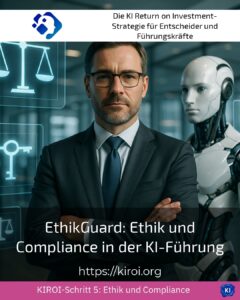
With growing technological capabilities, the ethical responsibility of leaders also increases. Algorithms make decisions that directly affect people. Leaders must understand how these decisions are made. They bear responsibility for fairness and transparency in automated processes. This ethical dimension is often underestimated, but is gaining increasing importance.
In human resources, ethical issues are particularly evident. Recruiting managers use systems that pre-screen and evaluate applications [5]. Human resources development specialists use tools to identify high potentials and development needs. Compensation experts work with models that analyze and optimize salary structures. In all of these applications, questions arise regarding freedom from discrimination and accountability. Management must actively address these issues and establish clear guidelines.
The pharmaceutical industry faces similar challenges in a regulated environment. Research leaders use intelligent systems to accelerate drug discovery. Quality managers implement automated testing procedures for production batches. Sales managers optimize field service management with data-based scheduling. All of these applications require ethical reflection and responsible leadership decisions.
Sustainable competence development for long-term success
Developing future-proof leadership skills is not a one-time project. Technologies continue to evolve, and requirements are constantly changing. Therefore, leaders need a mindset of lifelong learning. They should cultivate curiosity and remain open to experimentation. Mistakes are part of the learning process and provide valuable insights.
In the construction industry, change is happening more slowly than in other sectors. However, intelligent systems are also gaining importance for managers. Project managers use planning tools with integrated optimization and collision checking. Site managers coordinate construction site logistics with connected systems and real-time data. Purchasing managers analyze supplier performance and market developments with automated reports. These examples show that no sector is exempt from the transformation.
My AIROI Analysis
The systematic strengthening of leadership competencies in the context of intelligent systems represents one of the most important challenges of our time. My experience from numerous mentoring projects clearly shows that technical knowledge alone is not enough. Successful leaders combine technological understanding with a human-centered attitude and ethical reflection. They see themselves as bridgebuilders and translators between different worlds.
The AIROI-approach helps leaders to master these complex requirements. It provides a structured framework for competence development and self-reflection. The integration of practical examples from different industries enables transfer to one's own context. What I particularly value is the exchange between leaders from different sectors and company sizes.
Anyone who invests in their leadership skills today is laying the foundation for long-term success. Transformation does not stop; rather, it continues to accelerate continuously. Leaders who actively shape this development ensure their relevance and effectiveness. They become role models for their teams and drive positive change forward. Coaching by experienced coaches can significantly accelerate and deepen this development process. I invite you to embark on this journey together and unlock your potential.
Further links from the text above:
[1] Leadership Transruptions Coaching
[2] McKinsey Healthcare Insights
[3] Harvard Business Review – Retail
[4] AIROI-Masterclass Program
[5] SHRM – Technology in HR
For more information and if you have any questions, please contact Contact us or read more blog posts on the topic Artificial intelligence here.







 Deutsch
 English (UK)