
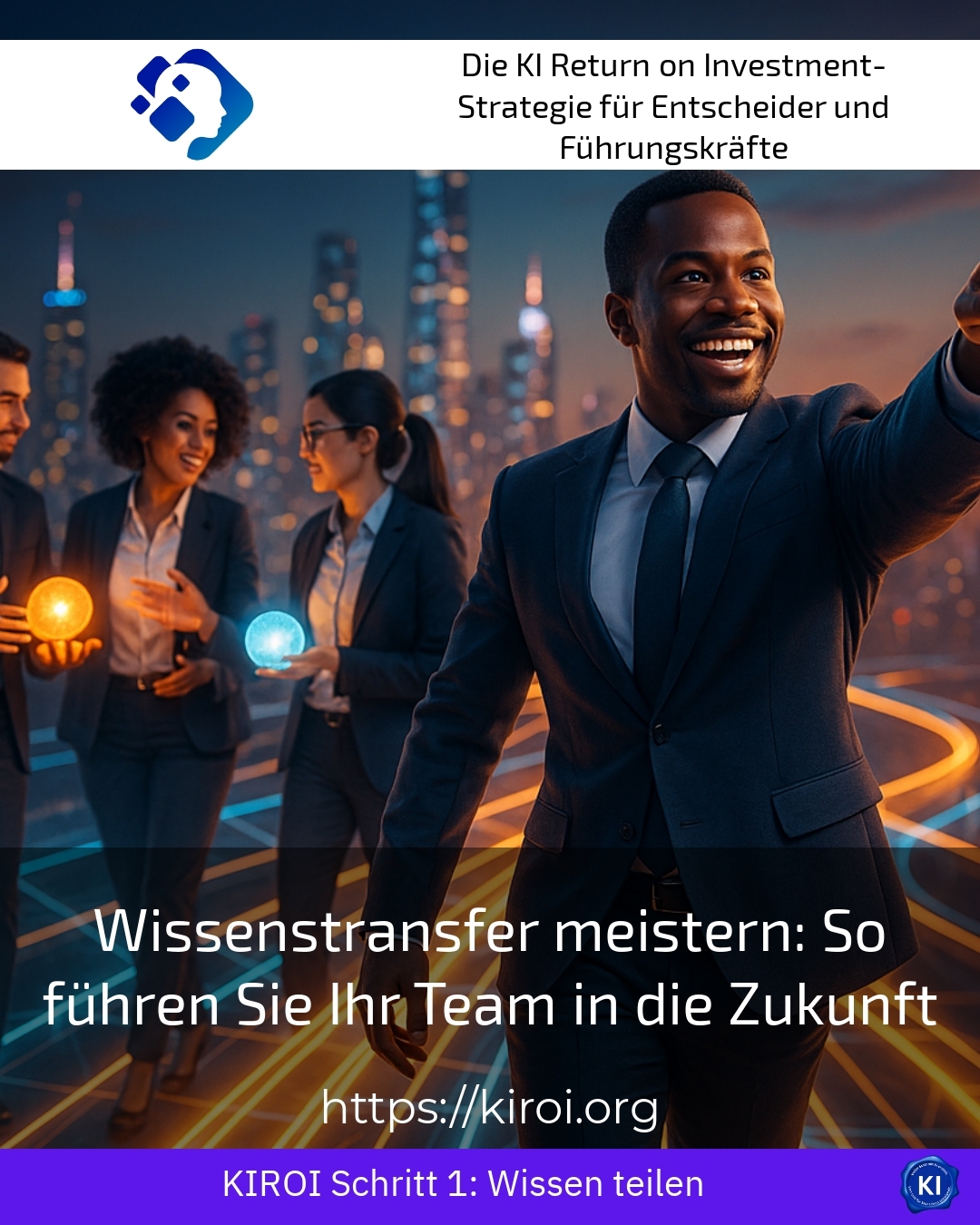
Imagine your most experienced employee leaving the company tomorrow. Decades of accumulated knowledge are gone forever. Numerous organizations experience this scenario on a daily basis. The demographic change further exacerbates the situation. At the same time, digitalization offers completely new possibilities. At the same time, the digital transformation offers a huge opportunity for companies to innovate and improve their business processes. Mastering Knowledge Transfer Today, archiving documents is more than just a task. It is about systematically passing on living knowledge of experience. This is where modern strategies come into play, which sustainably lead teams into the future. This article shows you tried-and-tested methods and inspiring examples.
Why systematic knowledge transfer is essential today
The working world is changing rapidly and continuously. Employees often change their positions more frequently than a generation ago. At the same time, the complexity in almost all areas is steadily increasing. Companies face the challenge of preserving valuable know-how. This involves more than just explicit expertise. Implicit knowledge plays an equally crucial role. This so-called tacit knowledge is difficult to document. It arises through years of practice and countless learning experiences in everyday work. Organizations that fail to actively secure this knowledge risk significant competitive disadvantages.
A medium-sized mechanical engineering company recently experienced exactly this situation. The long-time design manager retired. Within a few months, errors in product development accumulated. The onboarding time for new employees nearly doubled. A automotive supplier reported similar experiences. Several experts left the company simultaneously. Critical process knowledge was suddenly no longer available. Production repeatedly stalled due to avoidable errors. A third example comes from the chemical industry. After a generation change, the knowledge of specific process techniques was lacking. Quality fluctuated significantly, and customers were leaving [1].
Transfer of knowledge is mastered through structured methods
Successful knowledge exchange requires clear structures and proven methods. Mentoring programs are among the most effective tools in this field. Experienced employees accompany younger colleagues for extended periods of time. The personal exchange enables the transfer of experience. At the same time, valuable relationships between different generations within the company are created. A pharmaceutical company successfully implemented such a program a few years ago. The onboarding time for new laboratory assistants was reduced by thirty percent. The error rate also decreased significantly, measurable in a measurable way.
Storytelling is another effective method. Experienced employees tell stories about critical situations and their solutions. These stories are more memorable than dry documentation. A power company uses regular storytelling sessions in its teams. Technicians there report on unusual outages and how they are resolved. New employees thus learn from the experiences of the entire team. Moreover, this practice significantly strengthens the cohesion within the workforce.
Job rotation also offers great potential for knowledge sharing. Employees may occasionally move to other departments or areas. This allows them to gain new perspectives and at the same time share their own knowledge. A logistics company has been consistently implementing this model for several years. Dispatchers regularly work in the warehouse and vice versa. This greatly increases mutual understanding of processes and challenges. Overall, processes run more smoothly and efficiently [2].
Best practice with a AIROI customer
An internationally operating plant builder approached us with an urgent challenge. Several key personnel were approaching retirement age and a massive flow of knowledge was at risk. The company had already attempted to have manuals and documentation created. However, these attempts were hampered by the complexity of the existing knowledge base. As part of our transruptive coaching support, we developed a multi-stage approach together. First, we identified the most critical knowledge areas through structured interviews. Subsequently, we established so-called knowledge stands between experienced and younger employees. These teams worked closely together on real projects over several months. In parallel, we implemented digital knowledge management tools that supported the transfer. The results significantly exceeded all expectations. The customer reported a noticeable increase in problem-solving skills among younger employees. Critical project decisions could still be made competently. The onboarding time for complex plant projects was reduced by almost forty percent. The documentation of decision logic, which would otherwise have been lost, was particularly valuable.
Digital tools as catalysts
Modern technologies open up entirely new dimensions for knowledge exchange. Wikis and knowledge databases enable the structured collection of information. Employees can independently maintain and update content. A machine tool manufacturer runs an extensive internal wiki with great success. Service technicians document solutions for unusual machine problems there. Colleagues worldwide access this accumulated knowledge and benefit from it.
Video-based learning formats are also gaining great popularity. Experienced professionals explain complex processes clearly on camera. These recordings remain permanently available and accessible. A food manufacturer uses such videos for the training of new employees. Complex machine settings are demonstrated step by step. The quality of the onboarding increased measurably after introducing this method. At the same time, the videos significantly relieve experienced colleagues from routine tasks.
Artificial intelligence is increasingly supporting knowledge transfer in companies. Intelligent systems analyze large amounts of data and recognize patterns therein. They can automatically identify and process relevant knowledge. A chemical company uses AI-supported systems for process optimization. The system continuously learns from the decisions made by experienced employees. This machine learning preserves implicit knowledge in an innovative way in a permanent way [3].
Mastering the cultural prerequisites for successful knowledge transfer
Technical solutions alone are not enough to ensure sustainable knowledge exchange. The corporate culture must actively encourage and reward the sharing of knowledge. Unfortunately, in some organizations, knowledge is still considered a factor of power. Employees hoard information to strengthen and secure their positions. Such cultures block any attempt to systematically transfer knowledge in a massive way. Leaders have a responsibility to initiate and promote change in this regard.
One steel producer experienced this cultural challenge firsthand. Older masters reluctantly passed on their knowledge to younger ones. The management responded by introducing a new incentive system. Knowledge sharing became part of the performance evaluation and remuneration. Mentors received additional recognition for their contributions to the development of the next generation. Within two years, the atmosphere changed significantly for the better.
Psychological safety is another important prerequisite. Employees must be able to openly discuss mistakes without negative consequences. Only in this way can an atmosphere of honest exchange of experiences be created in the company. A electronics manufacturer established regular lessons-learned rounds after project completion. There, failed attempts are also thoroughly discussed and analyzed. This openness has demonstrably accelerated the learning curve of the entire company. A textile company went even one step further in this direction. There, mistakes are even celebrated when they lead to important insights. This culture promotes experimentation and accelerates innovation measurably [4].
Creating cross-generational collaboration
Different generations bring different strengths and perspectives. Experienced employees possess deep expertise and industry understanding. Younger colleagues often bring fresh ideas and digital skills. The combination of these two perspectives creates enormous potential for organizations. However, companies must actively promote and support this collaboration.
Reverse mentoring represents a particularly interesting approach. Young employees act as mentors for more experienced colleagues. For example, they practically teach digital skills and new working methods. A insurance company has been implementing this model with great success for some time. Senior executives learn from young talents how to use social media. At the same time, valuable relationships are formed across hierarchies and age boundaries.
Mixed-age project teams offer further opportunities for the natural exchange of knowledge. In a construction company, young engineers work closely with experienced polishers. The academic knowledge of the graduates complements the practical expertise of the craftsmen. This results in smoother and more rewarding projects for all involved. A furniture manufacturer reports on similarly positive experiences with mixed teams. Traditional craftsmanship techniques are combined with modern design approaches in a harmonious way.
Best practice with a AIROI customer
A medium-sized specialized machine manufacturer sought support in designing its succession plan. The founding generation was preparing to exit the operational business. Critical knowledge about customer relationships and market specifics threatened to be lost. In transruptions coaching, we accompanied the process intensively over eighteen months. We jointly developed a program for structured knowledge transfer. The departing shareholders initially conducted detailed knowledge discussions with us. These discussions were recorded and systematically evaluated and documented. Subsequently, we identified the most important knowledge holders at the second leadership level. For each of these employees, we created individual development plans and transfer concepts. Particularly successful was the introduction of customer visits in tandem with experienced colleagues. New sales representatives personally accompanied established customer support representatives to important appointments. This tacit knowledge about customer preferences and negotiation strategies was thus passed on. The customer later reported on a seamless handover without noticeable quality losses. Important customer relationships remained intact and even developed positively.
Mastering knowledge transfer in times of change
The working world is currently undergoing a profound transformation. Remote work and hybrid work models are fundamentally changing communication channels. The spontaneous exchange at the coffee machine is becoming less common. Companies must find new ways to facilitate informal knowledge exchange and establish them. Virtual formats can partially replace personal encounters, but not completely.
An IT service provider successfully established virtual coffee breaks for its distributed teams. Employees meet there without a fixed agenda for casual exchange. A consulting company uses digital whiteboards for joint brainstorming and knowledge gathering. The results remain permanently visible and can be added to by all parties. A financial service provider introduced weekly virtual knowledge sessions with great success. Experts share their specialized knowledge in short formats with the workforce there.
The increasing speed of change also requires more agile forms of knowledge. Long manuals become outdated faster than they can be written. Micro-learning formats offer a contemporary alternative for modern companies. Short learning units can be quickly created and updated as needed. A mechanical engineer uses such formats to convey safety guidelines. Employees can integrate the modules flexibly into their daily work [5].
My AIROI Analysis
The systematic development of knowledge management structures increasingly determines the long-term success of organizations. Our experience from numerous support projects shows clear patterns and success factors. Companies that invest early in structured exchange reap multiple benefits. They reduce onboarding times and significantly avoid costly errors caused by knowledge loss. At the same time, they significantly increase employee satisfaction through sustainable, appreciative knowledge sharing.
The biggest challenges often lie not in the technical field. Cultural barriers and a lack of leadership support permanently block many initiatives. Here, with our transruptive coaching, we target specific areas and accompany change processes. We help organizations create supportive frameworks for exchange. The combination of methodological expertise and process support has proven effective.
The integration of artificial intelligence into knowledge management processes appears particularly promising. These technologies can preserve and make experiential knowledge accessible in new ways. At the same time, we warn against excessive expectations of technical solutions alone. The human factor remains central to successful exchange and learning. Relationships and trust form the indispensable foundation for lasting knowledge transfer. Companies should therefore always consider both dimensions and develop them in a balanced manner. The future belongs to organizations that cleverly combine technological possibilities with human connection.
Further links from the text above:
[1] Wissensmanagement.net – Knowledge transfer as a success factor
[2] Haufe – Job Rotation: Definition, advantages and disadvantages
[3] Bitkom – Artificial Intelligence in Companies
[4] Gallup – Why Employee Engagement Matters
[5] E-Learning Journal – Microlearning Trends and Best Practices
For more information and if you have any questions, please contact Contact us or read more blog posts on the topic Artificial intelligence here.









 Deutsch
  English (UK)