
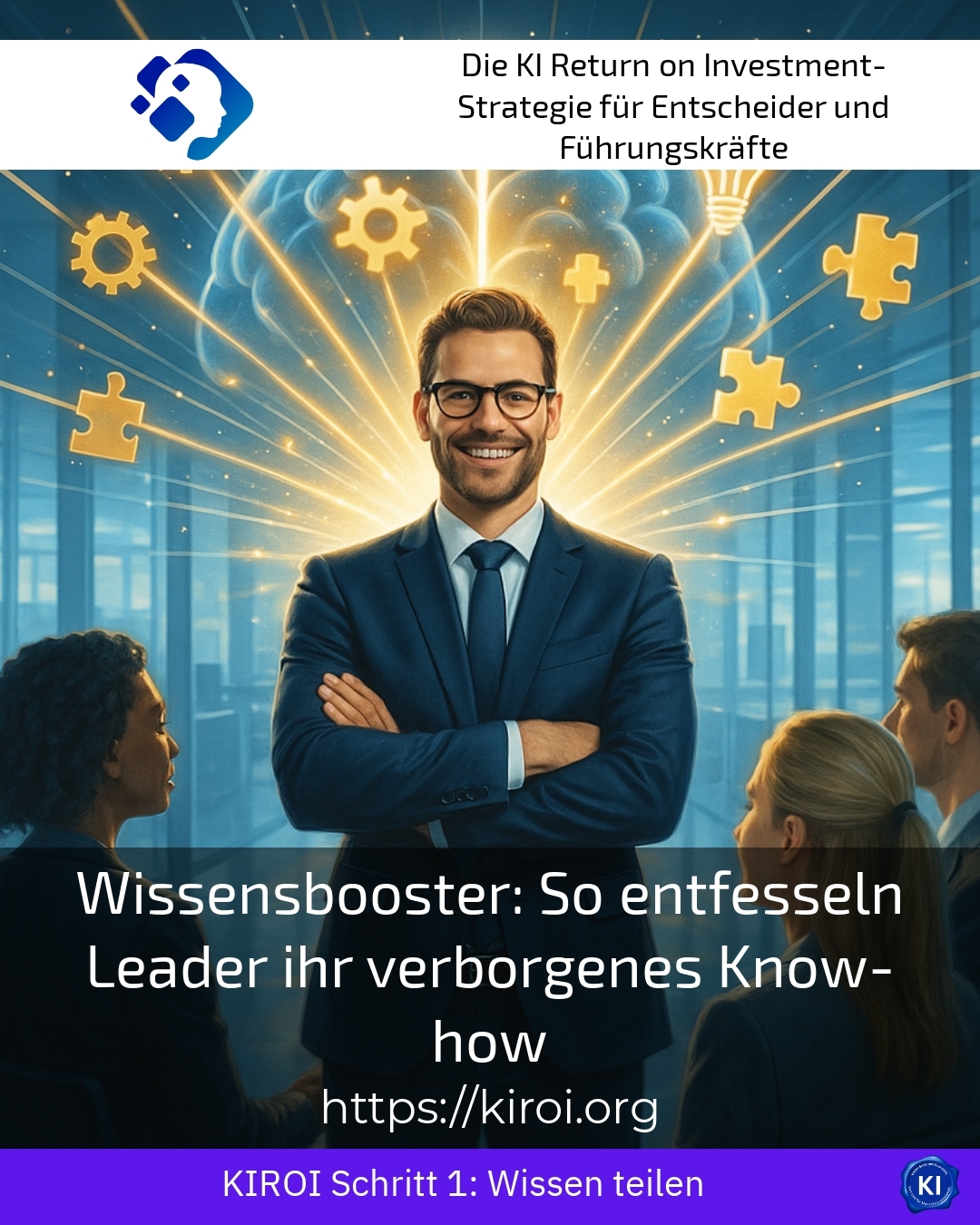
Imagine sitting on a treasure that you carry with you every day without ever fully uncovering it. That is precisely what countless executives experience in their professional daily lives because they systematically underestimate their own potential. The Knowledge booster for modern leaders does not lie hidden in external seminars or expensive further training, but already slumbers in the minds of those people who steer and shape companies on a daily basis. Clients frequently report that it is only through targeted guidance that they recognise which competencies they have long possessed. Unleashing this hidden know-how means initiating a fundamental shift in one's own leadership work.
Recognising and activating hidden resources
Every leader possesses a wealth of experience accumulated over years. This treasure trove consists of resolved conflicts, overcome crises, and countless decisions made under uncertainty. Yet many leaders reflexively reach for external solutions instead of consulting their own expertise. A production manager in the automotive industry, for instance, possesses implicit knowledge on process optimisation that no textbook can convey. The situation is similar with a sales director in the pharmaceutical sector who intuitively knows which arguments resonate with doctors. The IT manager of a medium-sized enterprise also carries within himself approaches to solutions that he has distilled from previous projects.
Transruption coaching supports leaders in systematically identifying these hidden resources. This is not about learning new skills, but about raising awareness of existing competencies. In the financial sector, this is particularly evident in risk managers who often underestimate their gut feeling. In healthcare, hospital managers frequently fail to use their experiential knowledge strategically enough. Retailers, in turn, possess deep customer knowledge that they are rarely able to put into words.
The Knowledge Booster as a Strategic Leadership Tool
An effective Knowledge booster works like a catalyst that transforms existing substances into new compounds. Logistics leaders can use their experience from supply chain crises to develop preventive strategies. HR managers in the service sector hold knowledge about employee motivation that scientific studies can only approximate. Marketing directors in the consumer goods industry have often developed a keen sense for trends that they can scarcely articulate themselves.
The targeted activation of this knowledge not only supports individual development, but also strengthens the entire organisation. When a managing director reflects on their experiences from failed projects, valuable learning moments are created. A head of department who documents her successful negotiation strategies creates transferable knowledge. The team leader who structures his conflict resolution approaches becomes a role model for his employees.
Best practice with a AIROI customer
A medium-sized engineering company faced the challenge of shortening its innovation cycles while maintaining quality. The Chief Technology Officer felt torn between operational demands and strategic goals, whilst his twenty years of industry experience lay underutilised. Through transruptions coaching, we worked together to extract his implicit success strategies and translated them into concrete recommendations for action. It became apparent that he had already accompanied similar transformations in earlier positions, but these experiences had never been systematically evaluated. Through structured reflection sessions, we identified three central success patterns that he had applied unconsciously. We documented these patterns and developed them into an internal training programme for his managers. The result was impressive, as innovation time fell by almost a third and employee satisfaction rose significantly. The Managing Director reported that, for the first time, he felt he was using his full potential. The organisation benefited sustainably from this knowledge transfer, and other departments began to initiate similar processes.
Methods for unlocking hidden know-how
Unfolding hidden knowledge requires appropriate methods and a secure framework for honest self-reflection. In the construction industry, project managers often use intuitive risk assessments based on years of building experience. Retail executives develop a feel for site qualities that is difficult to quantify. Human resources developers in large corporations frequently know instinctively which candidates will fit the team.
This form of experiential knowledge can be made accessible through various techniques and translated into strategic action. The narrative method, for example, invites leaders to recount success stories in detail while identifying patterns. The scenario technique confronts leaders with hypothetical situations in order to activate their implicit decision-making knowledge. Collegial case consultation makes it possible to re-evaluate one's own experiences through the lens of other perspectives.
Knowledge booster in daily management practice
The Knowledge booster unfolds its full effect when integrated into daily leadership practice. A sales director in the software sector can use their customer knowledge to influence product development. A hospital's director of nursing possesses deep insight into patient needs that is strategically valuable. A retail company's logistics manager is aware of bottlenecks before they become visible in metrics.
Clients frequently report that it is only through targeted stimuli that they realise what resources they possess. This realisation is both liberating and motivating, as it strengthens self-confidence. In the banking sector, this is evident in branch managers who underestimate their customer relationship knowledge. Hotel managers possess hospitality knowledge that goes far beyond standard procedures. Chief physicians carry within them medical experiential knowledge that is not found in any textbook.
Best practice with a AIROI customer
An executive from the energy sector came to transruption coaching focusing on professional reorientation and was actually looking for completely new paths for her career. During the discussion, however, it turned out that she possessed exceptional competencies in change management, which she had never considered particularly special herself. In her career up to that point, she had successfully accompanied three major restructurings and developed a keen sense for resistance. Together, we structured this knowledge and translated it into a personal competency portfolio that clearly highlighted her strengths. The executive realised that her supposed desire for change was actually a need for recognition of her existing skills. Instead of changing industry, she positioned herself internally as an expert in cultural change and took on a newly created staff position. The guidance helped her to make her hidden know-how visible and to deploy it strategically. Today, she advises other executives in the corporate group on complex change projects and passes on her experience. This development shows that looking inward often unlocks more potential than searching outward.
The role of self-reflection for sustainable success
Sustainable leadership competency is based on continuous self-reflection and the willingness to critically question one's own experiences. In the manufacturing sector, plant managers often underestimate their ability to intuitively understand complex systems. Purchasing managers in the food industry possess market knowledge that they rarely use explicitly. Quality managers in the automotive sector have a trained eye for detail that is difficult to train.
The targeted guidance provided by transruptions coaching supports leaders in recognising and addressing their blind spots. This is not about therapy, but about professional development on an equal footing with an experienced sparring partner. Managing directors in medium-sized enterprises often possess comprehensive knowledge that they have never formalised. Department heads in public authorities have administrative experience that is extraordinarily valuable. Creative directors in agencies carry within them aesthetic knowledge that can inspire their teams.
Permanently embedding the knowledge booster in the company
An effective Knowledge booster extends beyond the individual level and shapes the entire corporate culture. Insurance board members can systematically pass on their risk intuition and thereby develop the next generation of talent. Production supervisors in the chemical industry possess safety knowledge that can save lives. Retail branch managers know local specifics that would enrich central strategies.
The anchoring of this knowledge requires suitable structures and a culture of appreciation for experience. Mentoring programmes can help to transfer and preserve implicit knowledge between generations. Storytelling formats create spaces in which leaders can share their success stories and learn from one another. Peer consulting groups establish a continuous exchange that enriches and develops all participants.
Many leaders come to coaching dealing with issues such as overwhelm, a lack of direction or the feeling of being stuck. They are looking for fresh impetus and in doing so often discover that the solutions are already slumbering within them. Transruption coaching offers a structured framework for this journey of discovery and provides support with projects relating to personal and organisational transformation.
My AIROI Analysis
The systematic activation of hidden leadership knowledge represents one of the most effective levers for sustainable corporate development [1]. My analysis shows that many organisations invest significant resources in external training, whilst the existing experiential knowledge of their leaders remains largely untapped. This is not only inefficient, but also demotivating for the leaders concerned, who do not feel their competence is being recognised.
The AIROI methodology [2] offers a structured approach to systematically harnessing this potential and putting it to use within the organisation. It focuses on valuing individual experience, combined with modern reflection techniques and digital tools. The results speak for themselves, as managers report increased self-confidence and a clearer strategic focus.
For the future, I recommend that companies create explicit spaces for knowledge reflection and align leadership development more closely with existing competencies [3]. Investment in targeted guidance pays off quickly through better decisions and higher engagement. Organisations that unleash the hidden know-how of their leaders create a sustainable competitive advantage that is hard to copy. The combination of individual guidance and systematic knowledge management promises the best results for all involved.
Further links from the text above:
[1] Harvard Business Review – Leadership and Managing People
[2] AIROI Methodology for Leadership Development
[3] McKinsey – Insights on People and Organisational Performance
For more information and if you have any questions, please contact Contact us or read more blog posts on the topic Artificial intelligence here.






 Deutsch
  English (UK)