
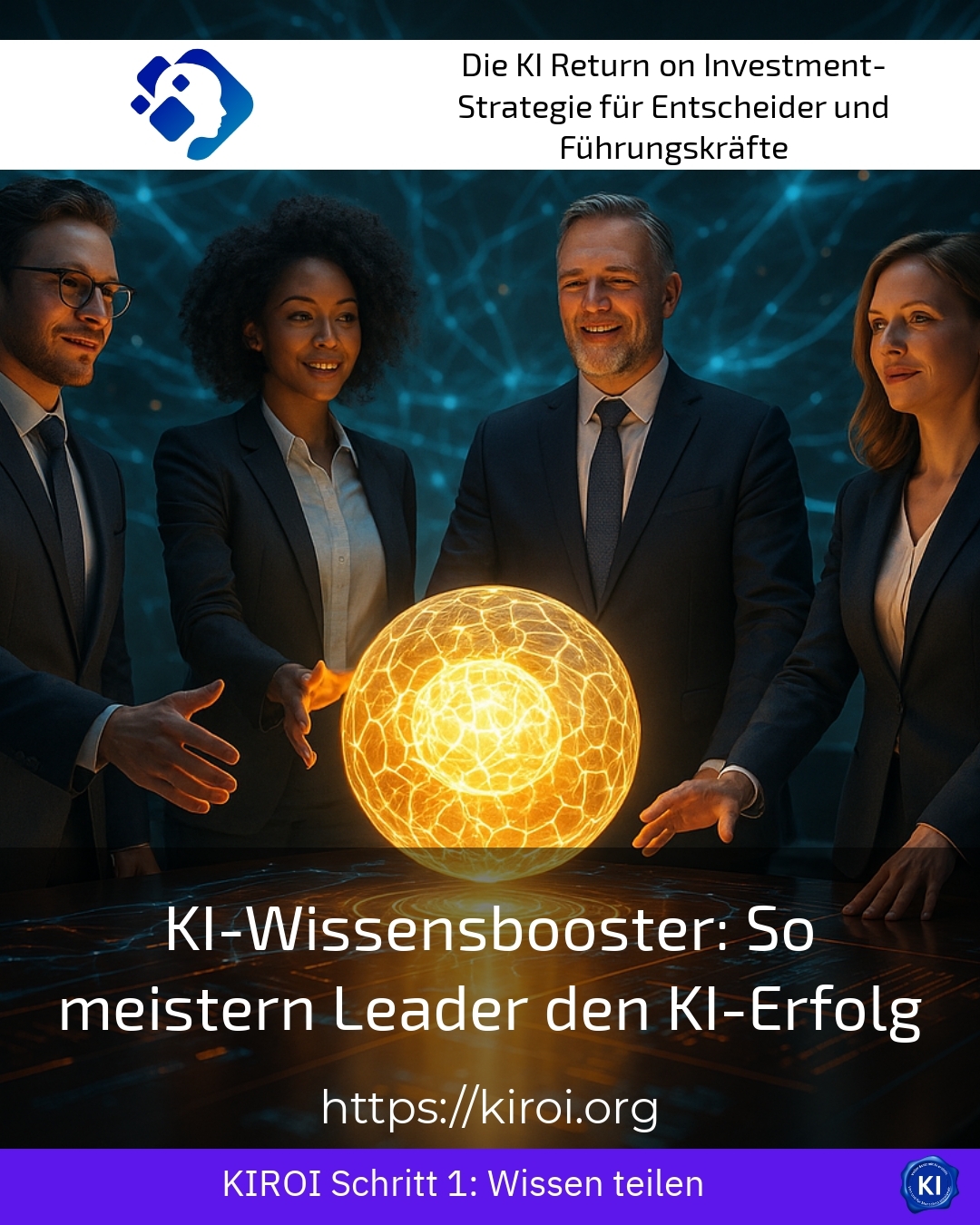
Imagine being able to actively shape the future of your company, rather than being overwhelmed by it. This is precisely the feeling of self-efficacy experienced by leaders who have their personal AI Knowledge Booster activate and systematically expand. Digital transformation is changing business models at breakneck speed. To be successful as a leader today, you need more than classic management skills. Artificial intelligence is permeating all industries and functional areas. It is no longer a question of whether this technology will become relevant. Rather, competence in dealing with it determines sustainable corporate success. Managers often report uncertainty and being overwhelmed by the diverse possibilities. At the same time, enormous opportunities are opening up for those who act early.
Why the AI Knowledge Booster Has Become Indispensable for Modern Leadership
The requirements for leaders have fundamentally changed in recent years. Technological understanding now forms a central pillar of successful business management. In retail, progressive companies are already using intelligent inventory management systems. These analyse purchasing behaviour and automatically optimise stock levels. In healthcare, learning algorithms are used to assist with diagnosis and treatment planning. Doctors and hospital managers must understand these tools to make informed decisions. The financial sector relies on automated risk analyses and fraud detection. Bank executives therefore need in-depth knowledge of the underlying mechanisms.
Manufacturing companies are implementing predictive maintenance systems in their production facilities. These detect potential machine failures before they occur. Logistics companies are optimising their route planning using intelligent algorithms. This reduces fuel consumption while significantly improving delivery reliability. In marketing, personalised customer approaches enable entirely new forms of communication. And in human resources, intelligent systems assist with candidate selection and talent development.
Best practice with a AIROI customer
A medium-sized mechanical engineering company from southern Germany faced a significant challenge. Management recognised early on that intelligent technologies would revolutionise competition. However, the management team lacked the necessary fundamental knowledge for strategic decisions. Together, we developed a structured further training programme for the senior management level. The support involved both theoretical fundamentals and practical application scenarios. Within six months, the management was able to make well-founded investment decisions. The company successfully implemented a system for predictive quality control in production. According to the company, the scrap rate fell by almost twenty percent. At the same time, employee satisfaction increased because repetitive inspection tasks were now automated. This example impressively shows how targeted knowledge transfer can improve concrete business results. The transruption coaching support helped the management team to reduce fears and recognise opportunities.
AI Knowledge Booster in Practice: Competence Building as a Strategic Leadership Task
Building technological expertise requires a systematic approach. Many leaders begin with superficial introductory courses and then stop. This fragmented approach rarely leads to sustainable results. Instead, a structured learning path with clear milestones is recommended. In the insurance sector, for example, boards of directors need to understand how claims processing can be automated. At the same time, they require insight into the ethical implications of algorithmic decisions.
The pharmaceutical industry uses intelligent systems for drug development and clinical trials. Here, executives must balance regulatory requirements with technological capabilities. Energy suppliers are relying on intelligent grids and decentralised generation facilities. Management must be able to oversee and strategically control these complex systems. In the construction industry, digital planning tools are revolutionising project execution. Construction companies are benefiting from automated resource planning and cost calculation. The media industry is experimenting with automated content creation and personalised recommendation systems. Here, technological understanding determines the future viability of entire business models.
Practical steps for a personal AI knowledge booster
The path to becoming a tech-savvy leader begins with an honest self-assessment. Where do you currently stand in your knowledge of intelligent systems? Which use cases are particularly relevant to your industry? In the hotel sector, for example, intelligent systems optimise room pricing in real-time. They analyse booking patterns and dynamically adjust prices to demand fluctuations. Restaurant chains use demand forecasting for their staffing and procurement. In the transport sector, autonomous systems enable completely new logistics concepts. Shipping companies must anticipate these developments and adapt their strategies accordingly.
Farms are focusing on precision farming with sensor technology and drone monitoring. This allows yields to be optimised while conserving resources. Textile companies are using intelligent systems for trend forecasting and production planning. This makes fashion faster and more precisely tailored to customer wishes. And in the education sector, adaptive learning systems enable individualised educational paths for every learner.
Best practice with a AIROI customer
A managing director of a medium-sized retail chain came for support with a specific request. She felt overwhelmed by the rapid pace of technological developments. Her company was losing market share to digitally savvy competitors. Together, we first developed a personal knowledge strategy for the management. In parallel, we devised a transformation concept for the entire company. The transruption coaching support helped to constructively resolve resistance within the leadership team. The managing director learned to realistically assess and prioritise technological opportunities. The company incrementally introduced intelligent inventory management. Customer footfall and sales per square metre improved significantly after six months. Particularly valuable was the realisation that technology does not replace people, but supports them. Employees became active drivers of the digital transformation. Today, they report greater job satisfaction and fewer routine tasks.
Understanding the human dimension of technological change
Technological competence alone does not make a successful leader. The human dimension remains crucial for sustainable transformative success. Employees often bring fears and reservations about new technologies. Taking these concerns seriously is one of the most important leadership tasks. In the banking sector, for example, consultants worry about their jobs. Intelligent systems are increasingly handling routine consulting and standard transactions. Here, leaders must show new perspectives and create development opportunities.
The insurance sector is seeing entirely new job profiles emerge due to automation. Yesterday's claims handlers are becoming process optimisers and customer advisors for complex cases. In healthcare, intelligent diagnostic systems are complementing medical expertise. This allows doctors to dedicate more time to patient care. The legal sector is experiencing similar changes through automated contract analysis and research tools. Lawyers are focusing more on strategic consulting and creative problem-solving.
Overcoming resistance through authentic communication
Successful transformation requires open and honest communication at all levels. Leaders must address uncertainties instead of ignoring them. In the industrial sector, production managers frequently report initial distrust from the workforce. The introduction of intelligent monitoring systems sparks fears of total control. Transparent communication about the purpose and limits of the technology helps here. In retail, sales staff fear becoming redundant due to self-checkout systems. Smart leadership demonstrates how their role evolves towards consultation and customer care.
In the catering industry, ordering systems and service robots are enabling new gains in efficiency. Staff can concentrate more on hospitality and individual guest care. The travel industry is relying on intelligent booking systems and personalised recommendations. Travel agents are becoming experience curators, fulfilling complex requests. And in the property sector, virtual tours and valuation algorithms are significantly supporting the sales process.
The AI knowledge booster as a competitive advantage for forward-thinking leaders
Investing in technological knowledge today secures long-term competitive advantages. The learning curve may seem steep at first, but the investment pays off manifold. In the consulting sector, tech-savvy partners can better support their clients. They understand the possibilities and limitations of intelligent systems from their own experience. The automotive industry is undergoing a fundamental transformation towards connected mobility. Managers require a deep understanding of software development and data economics. In the telecommunications sector, entirely new business models are emerging through intelligent network control.
The chemical industry uses machine learning for the development of new materials and process optimisation. Here, traditional expertise and modern analytical methods are optimally combined. In sports management, performance analysis and injury prevention enable better results. Clubs and associations are investing heavily in data-driven decision-making. The entertainment industry is increasingly personalising content and optimising production processes through intelligent systems.
Best practice with a AIROI customer
The board of a logistics company recognised the transformative nature of intelligent systems early on. The company transported goods across Europe and was under significant cost pressure. However, management did not know where to begin with the transformation. In the transruption coaching support, we developed a structured roadmap. First, the executives systematically expanded their personal understanding of technology. Then, together with experts, they identified the most promising use cases. The company gradually implemented intelligent route optimisation for its fleet. According to internal calculations, fuel costs fell by more than fifteen per cent. At the same time, the punctuality of deliveries improved significantly. Drivers reported less stress due to better planning and more realistic timeframes. The management team gained confidence in making technological decisions. This competence now enables the independent further development of the digital strategy.
My AIROI Analysis
Accompanying numerous leaders on their journey to technological proficiency reveals clear patterns. Success depends less on prior technical knowledge and more on the right mindset. Curiosity and a willingness to learn are the crucial factors for sustainable knowledge acquisition. At the same time, I observe that many leaders underestimate how much they already understand. Often, all that's missing is a structured framework to place existing knowledge within. The AIROI methodology provides precisely this orientation framework for systematic competency development.
Leaders who link their learning to concrete business challenges are particularly successful. Abstract theory often remains ineffective without a practical connection. The AI Knowledge Booster unfolds its full potential only when applied to real-world problems. The realisation that technological transformation is a continuous process also seems important to me. There is no endpoint where one has „finished learning“. Instead, a dynamic understanding develops that grows with the technologies.
The emotional dimension deserves special attention in any transformation project. Fears and resistance are natural reactions to profound changes. Leaders who acknowledge these feelings in themselves and their teams build trust. This enables genuine willingness to change rather than superficial compliance. My recommendation, therefore, is: start building your personal knowledge today. Seek competent guidance that understands your individual needs. And be patient with yourself, because sustainable competence development takes time.
Further links from the text above:
[1] McKinsey – The State of AI
[2] Gartner – Artificial Intelligence Research
[3] World Economic Forum – AI and Robotics
[4] Harvard Business Review – AI and Machine Learning
[5] MIT – Artificial Intelligence Research
For more information and if you have any questions, please contact Contact us or read more blog posts on the topic Artificial intelligence here.









 Deutsch
  English (UK)