
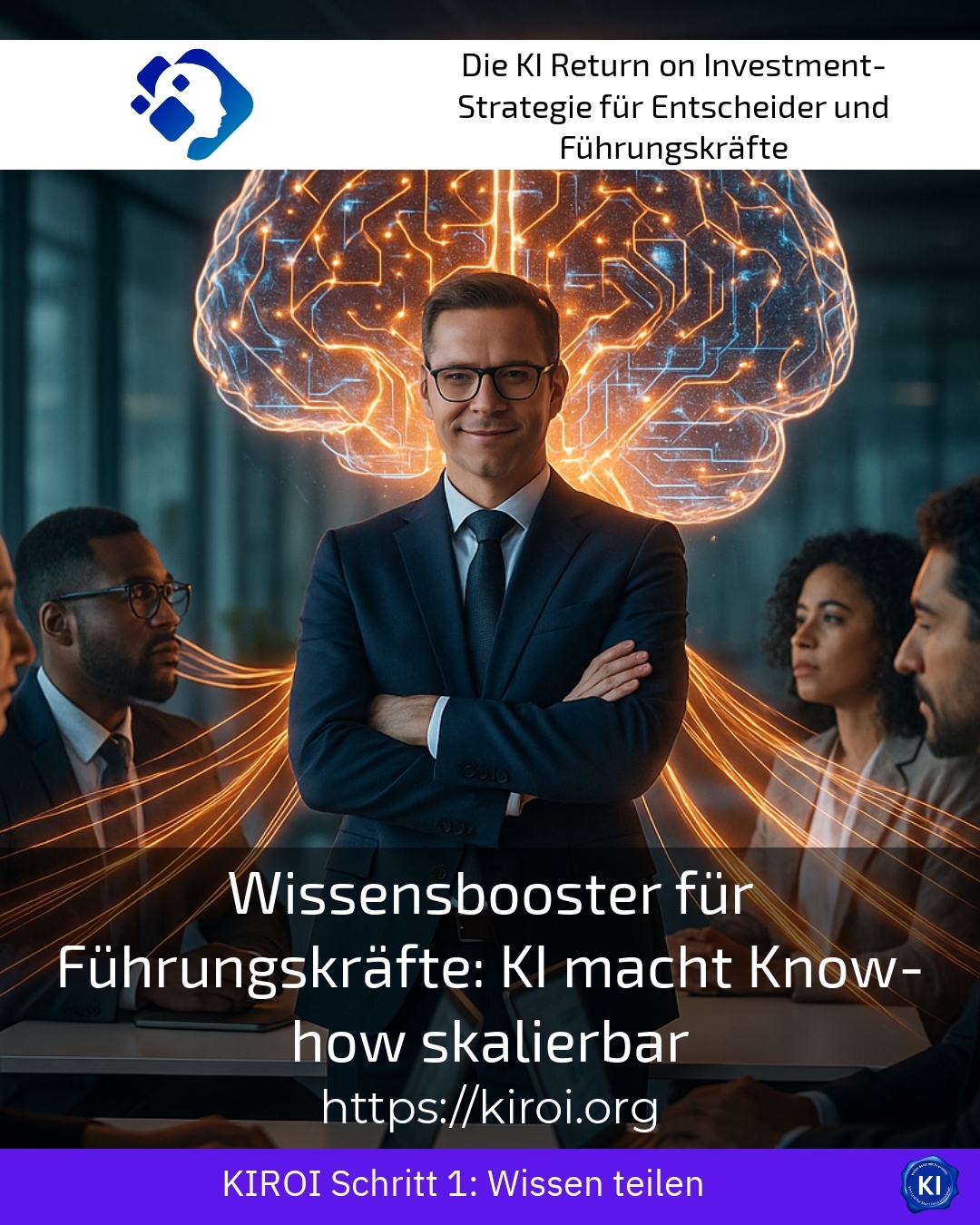
Imagine that all the knowledge and experience of your best executives are suddenly available to every employee – 24/7, instantly accessible and precisely tailored to the specific situation. What sounded like a utopia just a few years ago is now becoming a reality in innovative companies that have understood that the Knowledge booster for leaders: AI makes know-how scalable It is a crucial competitive advantage. Digital transformation not only changes business models and processes, but also fundamentally revolutionizes the way knowledge is shared, preserved, and utilized within organizations.
Warum traditionelle Wissensvermittlung ihre Grenzen erreicht
The traditional transfer of leadership knowledge has been practiced for decades following proven patterns: seminars, workshops, mentoring programs, and learning-by-doing characterize the development of leaders. These methods undoubtedly have their value and validity. However, increasingly structural weaknesses are becoming apparent. An experienced field manager in a mechanical engineering company can only pass on his knowledge of successful negotiation with Asian suppliers to a few colleagues at a time. When this expert leaves the company, decades of accumulated experience often goes unrecoverable [1].
In the automotive supply industry, we often observe project managers repeating the same mistakes that other teams have made years ago. The reason is not a lack of intelligence. The problem lies in the fact that relevant knowledge remains hidden in heads, email folders, or unstructured filing systems. A mid-sized manufacturer of drive components told us that just searching for relevant project documentation consumes about 15 percent of its engineers’ working time. Such inefficiencies add up to enormous costs. They also hinder innovation and agility.
The knowledge booster for executives: AI makes expertise scalable through intelligent systems
Modern technologies open entirely new possibilities for knowledge scaling. Intelligent assistance systems can capture, structure, and provide contextually relevant knowledge from the tacit knowledge of experienced executives. For example, a production manager in machine tool manufacturing uses a system that has analyzed his decision patterns in the face of capacity constraints. New managers in his department now receive situation-specific recommendations based on his proven experience. The experienced colleague himself gains time for strategic tasks. At the same time, the onboarding of new team members accelerates significantly.
In the medical technology industry, progressive companies are already relying on systems that support quality decisions. A quality manager at a manufacturer of diagnostic devices automatically receives similar historical cases when evaluating deviations. The system presents the decisions made at that time and their consequences. Such applications not only relieve the burden on the management team; they also reduce the risk of incorrect decisions and speed up release processes.
Best practice with a AIROI customer
An internationally operating manufacturer of precision components for the aerospace industry faced the challenge of systematically securing and making accessible the knowledge of its most experienced manufacturing experts. Three of the five senior experts were on the verge of retirement. Their specialized knowledge about critical machining processes was nowhere documented. As part of a transruptive coaching session, we developed together with the company a multi-stage concept for knowledge extraction and digitization. The experts were initially interviewed in structured interviews about typical problem situations. We recorded these interviews and transcribed them. Subsequently, the findings were processed in an intelligent knowledge system that provides context-specific support. Today, young engineers can consult the system when encountering complex manufacturing issues and receive answers based on the experts’ wealth of experience. The onboarding time for new employees was reduced by about 40 percent. At the same time, the error rate in critical processes decreased measurably. The company reports a significantly higher level of satisfaction among both new employees and experienced experts, who now feel valued as knowledge disseminators.
Practical application areas in industry
The applications of intelligent knowledge systems extend to almost all areas of management. In personnel management, such systems, for example, support the preparation of difficult employee interviews. A department manager in the electronics manufacturing industry receives impulses and formulation suggestions before a critical meeting based on proven communication patterns. The system takes into account the specific situation and the personality of the employee, insofar as this information is available. Of course, technology does not replace human empathy and intuition. However, it can provide valuable suggestions and highlight blind spots.
In the area of strategic planning, executives use intelligent systems to analyze market trends and developments in competition. A sales manager at a manufacturer of industrial valves described to us how his team identifies market opportunities that would have remained undetected previously using such tools. The system aggregates information from various sources. It detects patterns and generates recommendations for action. The final decision, of course, remains the responsibility of the human being. However, the quality of the decision-making basis improves significantly.
Knowledge booster for executives: AI makes know-how scalable in change management
Change processes pose particular challenges for leaders. This is where the value of scaled experience knowledge becomes particularly evident. A plant manager who has successfully led several reorganizations has invaluable experience in resistance management, communication strategies, and critical success factors. This knowledge can now be systematically captured and made accessible to other leaders. At a supplier of agricultural machinery, we observed how such a knowledge system supported project managers in introducing new manufacturing technologies. The system provides context-specific advice on employee engagement and handling typical objections.
A manufacturer of hydraulic components uses similar approaches when integrating acquired companies. The experiences from previous integrations have been systematically documented and compiled. Executives who are responsible for such an integration for the first time receive situation-specific support. They learn from the successes and failures of their predecessors without having to experience them themselves.
Best practice with a AIROI customer
A medium-sized family-run plastics processing company was in the midst of a generational change. The family owners wanted to ensure that the management knowledge they had built up over decades would not be lost. At the same time, the next generation should be able to develop its own style. In transruptive coaching, we initially worked on identifying the critical knowledge areas. Which decision situations require special expertise? Where are the biggest risks associated with a knowledge transfer deficit? Subsequently, we developed a tailored knowledge assurance concept. The departing executives conducted structured reflection discussions. In doing so, they not only documented facts but also contexts, considerations, and alternative action options. This content was prepared in an intelligent system. The successors now regularly use this system as a sparring partner for important decisions. They report a significantly increased sense of security. At the same time, they retain the freedom to make their own decisions. The generational change has thus been much more harmonious than in comparable companies. Often, the new leaders report that they perceive the system as a valuable mentor.
Challenges and critical success factors
The introduction of knowledge scaling systems is not a self-evident process. It requires careful planning and professional guidance. A common mistake is to place the technology at the center. However, the cultural dimension is crucial. Sharing knowledge must be rooted in value. In hierarchically structured organizations, the willingness to share knowledge may be low. Leaders sometimes fear being replaced by knowledge sharing. In this case, sensitive change management is needed [2].
A packaging machine manufacturer experienced that the technical implementation went smoothly, but usage fell short of expectations. The analysis showed that the management perceived the system as an additional burden. They saw no immediate benefit for their daily work. Only through intensive communication and the involvement of multipliers was it possible to increase acceptance. This case illustrates the importance of a holistic approach. Technology alone does not create change.
Knowledge booster for executives: AI makes know-how scalable through cultural transformation
Successful implementation requires a cultural shift towards a learning organization. Leaders must understand that shared knowledge does not weaken their position; it rather strengthens the entire company. In practice, we observe that successful transformations are most often actively promoted by the management. For example, a manager of a tool manufacturer documents his strategic considerations in an internal knowledge system. He makes it transparent which factors influence his decisions. This example serves as a model that motivates other managers to follow suit.
Data protection and ethical issues also require attention. When systems analyze the behavior and decision patterns of executives, sensitive data is created. Clear rules and transparency are needed here. Employees must know what data is collected and how it is used. A trusting approach to these issues is essential for the acceptance of such systems.
Best practice with a AIROI customer
A metal processing company with multiple locations in Europe wanted to fundamentally modernize its leadership development program. The previous in-person seminars only reached a fraction of the executives. The quality of leadership varied greatly between the locations. In transruptive coaching, we developed a hybrid concept that combined in-person elements with digital knowledge delivery. First, we identified together with experienced leaders the most important leadership competencies and situations. These were prepared in interactive learning modules. In addition, we implemented a system for situation-specific support in the workplace. A leader who, for example, prepares a difficult feedback session receives context-specific prompts and reflection questions. The system continuously learns from the users’ experiences. After one year of operation, there was a significant improvement in leadership quality, as measured by employee surveys. The turnover in critical areas decreased measurably. At the same time, the satisfaction of the managers with their own development increased. The CEO described the project as one of the most important transformation steps of recent years.
The role of professional support
Knowledge-scaling projects touch upon sensitive areas of the organization. They require technical expertise as well as change management and strategic thinking. Many companies underestimate the complexity of such projects. They buy technology and expect the rest to come naturally. Reality often looks different. Unused systems, frustrated employees, and failed projects are not uncommon.
transruptions-Coaching positions itself as a facilitator of projects around such transformations. We help companies ask the right questions. Which knowledge is truly critical? What cultural barriers need to be overcome? How can the stakeholders be involved? These questions cannot be answered solely with technology. They require a deep understanding of organizational dynamics and human behavior.
In practice, we work closely with managers, HR managers, and IT leaders. We bring together different perspectives and create spaces for constructive dialogue. Often, clients report that it is only through this holistic approach that the true potential becomes visible. Technology is a tool, not the goal. The goal is an organization that optimally uses its knowledge and continuously develops it [3].
My AIROI Analysis
The scaling of leadership knowledge through intelligent systems marks a turning point in corporate management. Organizations that seize this trend early gain sustainable competitive advantages. They lose less critical knowledge due to turnover and demographic change. They significantly accelerate the onboarding of new leaders. They improve the quality of decisions through the systematic use of experiential knowledge.
At the same time, we warn against excessive expectations and technological credulity. No system can replace human leadership. Empathy, intuition, and situational judgment remain indispensable. Intelligent systems can support, provide impulses, and stimulate reflection. However, the responsibility for leadership decisions remains with the human being. Anyone who forgets this risks losing out on the potential.
Several factors are crucial for successful implementation. The senior management must actively support and demonstrate the initiative. The technology must fit the corporate culture and not the other way around. Data protection and ethical issues require transparent regulations. The implementation requires professional guidance that integrates the technical and cultural aspects. We observe that companies that consider these factors achieve significantly better results.
The Knowledge booster for leaders: AI makes know-how scalable This is no longer a distant vision of the future. It is a reality that can and should be shaped today. The question is no longer whether companies will take this path. The question is which companies will seize the opportunities first and generate competitive advantages from them. We invite you to explore these opportunities and, together with us, to consider which approaches might be appropriate for your company.
Further links from the text above:
[1] McKinsey – Tacit Knowledge Transfer in Organizations
[2] Harvard Business Review – Knowledge Management Insights
[3] Gartner – Knowledge Management Definition and Best Practices
For more information and if you have any questions, please contact Contact us or read more blog posts on the topic Artificial intelligence here.











 Deutsch
 English (UK)